Abou Khouzam Raefa, Lehn Jean-Marie, Mayr Hemma, Clavien Pierre-Alain, Wallace Michael Bradley, Ducreux Michel, Limani Perparim, Chouaib Salem
Thumbay Research Institute for Precision Medicine, Gulf Medical University, Ajman P.O. Box 4184, United Arab Emirates.
Institut de Science et d'Ingénierie Supramoléculaires (ISIS), Université de Strasbourg, 8 Allée Gaspard Monge, F-67000 Strasbourg, France.
Cancers (Basel). 2023 Feb 15;15(4):1235. doi: 10.3390/cancers15041235.
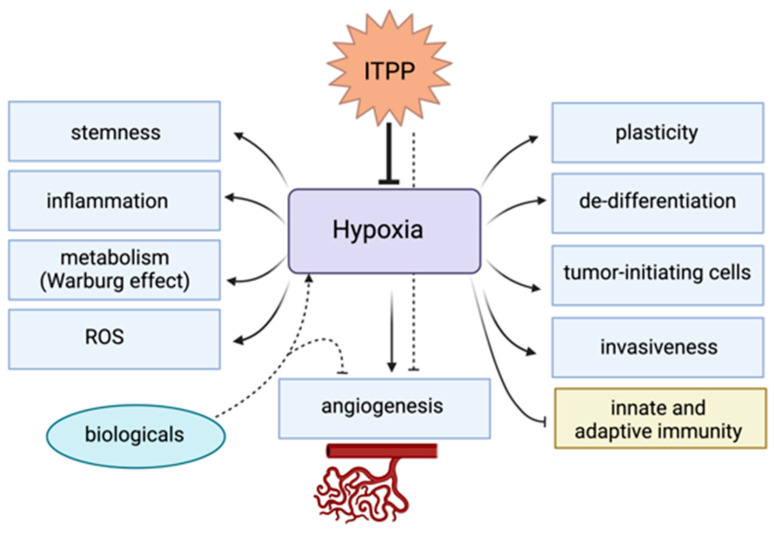
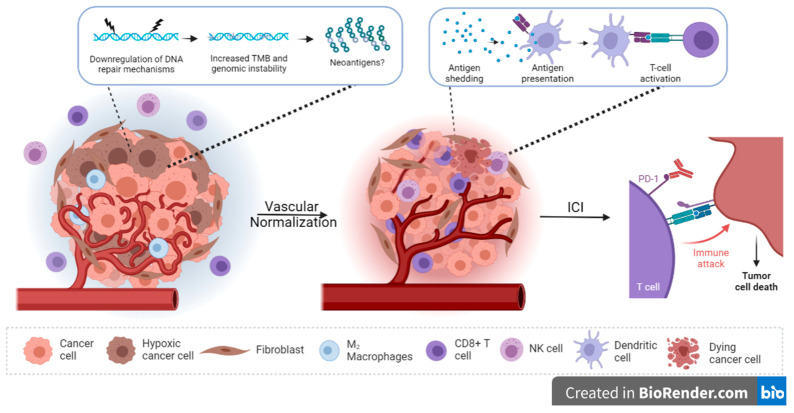
Pancreatic ductal adenocarcinoma (PDAC) is the most common type of pancreatic cancer, and it is a disease of dismal prognosis. While immunotherapy has revolutionized the treatment of various solid tumors, it has achieved little success in PDAC. Hypoxia within the stroma-rich tumor microenvironment is associated with resistance to therapies and promotes angiogenesis, giving rise to a chaotic and leaky vasculature that is inefficient at shuttling oxygen and nutrients. Hypoxia and its downstream effectors have been implicated in immune resistance and could be contributing to the lack of response to immunotherapy experienced by patients with PDAC. Paradoxically, increasing evidence has shown hypoxia to augment genomic instability and mutagenesis in cancer, suggesting that hypoxic tumor cells could have increased production of neoantigens that can potentially enable their clearance by cytotoxic immune cells. Strategies aimed at relieving this condition have been on the rise, and one such approach opts for normalizing the tumor vasculature to reverse hypoxia and its downstream support of tumor pathogenesis. An important consideration for the successful implementation of such strategies in the clinic is that not all PDACs are equally hypoxic, therefore hypoxia-detection approaches should be integrated to enable optimal patient selection for achieving improved patient outcomes.
胰腺导管腺癌(PDAC)是最常见的胰腺癌类型,且是一种预后不佳的疾病。虽然免疫疗法彻底改变了各种实体瘤的治疗方式,但在PDAC治疗中却收效甚微。富含基质的肿瘤微环境中的缺氧与治疗抵抗相关,并促进血管生成,导致血管系统紊乱且渗漏,在输送氧气和营养物质方面效率低下。缺氧及其下游效应因子与免疫抵抗有关,可能是PDAC患者对免疫疗法缺乏反应的原因。矛盾的是,越来越多的证据表明缺氧会增加癌症中的基因组不稳定性和诱变作用,这表明缺氧肿瘤细胞可能会增加新抗原的产生,而这些新抗原可能会使它们被细胞毒性免疫细胞清除。旨在缓解这种情况的策略不断增加,其中一种方法是使肿瘤血管正常化,以逆转缺氧及其对肿瘤发病机制的下游支持。在临床上成功实施此类策略的一个重要考虑因素是,并非所有PDAC都同样缺氧,因此应采用缺氧检测方法,以便为实现改善患者预后进行最佳的患者选择。