Matsuoka-Uchiyama Natsumi, Tsuji Kenji, Takahashi Kensaku, Fukushima Kazuhiko, Takeuchi Hidemi, Kitamura Shinji, Inagaki Kenichi, Uchida Haruhito A, Wada Jun
Department of Nephrology, Rheumatology, Endocrinology and Metabolism, Okayama University Graduate School of Medicine, Dentistry and Pharmaceutical Sciences, 2-5-1 Shikata-cho, Okayama 700-8558, Japan.
Department of Chronic Kidney Disease and Cardiovascular Disease, Okayama University Graduate School of Medicine, Dentistry and Pharmaceutical Sciences, 2-5-1 Shikata-cho, Okayama 700-8558, Japan.
Diagnostics (Basel). 2023 Feb 10;13(4):669. doi: 10.3390/diagnostics13040669.
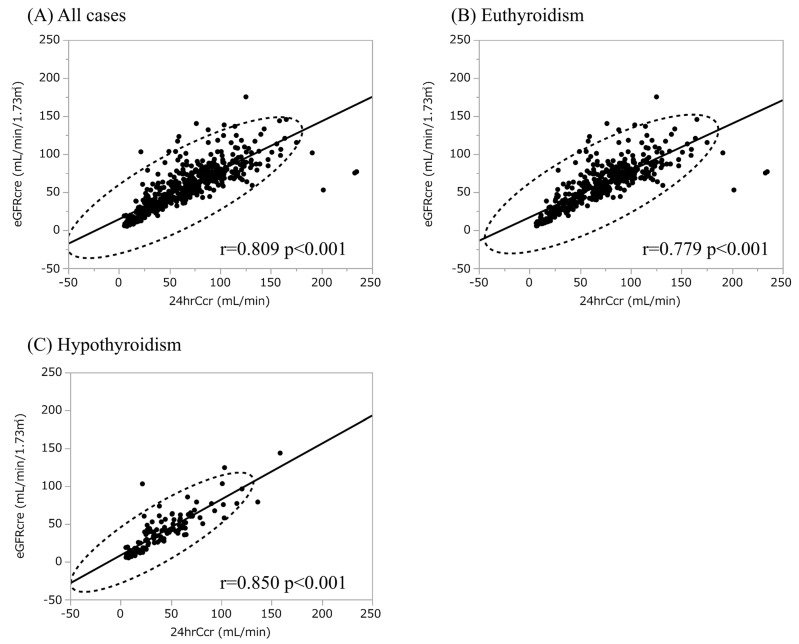
While hypothyroidism increases serum creatinine (Cr) levels, it is uncertain whether the elevation is mediated via a decline in the glomerular filtration rate (GFR) or the reflection of enhanced Cr production from the muscles or both. In the present study, we explored an association between urinary Cr excretion rate (CER) and hypothyroidism. A total of 553 patients with chronic kidney disease were enrolled in a cross-sectional study. Multiple linear regression analysis was performed to explore the association between hypothyroidism and urinary CER. The mean urinary CER was 1.01 ± 0.38 g/day and 121 patients (22%) had hypothyroidism. The multiple linear regression analysis revealed explanatory variables with urinary CER, including age, sex, body mass index, 24 h Cr clearance (24hrCcr), and albumin while hypothyroidism was not considered an independent explanatory variable. In addition, scatter plot analysis with regression fit line representing the association between estimated GFR calculated using s-Cr (eGFRcre) and 24hrCcr revealed that eGFRcre and 24hrCcr had strong correlations with each other in hypothyroid patients as well as euthyroid patients. Collectively, hypothyroidism was not considered an independent explanatory variable for urinary CER in the present study and eGFRcre is a useful marker to evaluate kidney function regardless of the presence of hypothyroidism.
虽然甲状腺功能减退会升高血清肌酐(Cr)水平,但目前尚不确定这种升高是通过肾小球滤过率(GFR)下降介导的,还是肌肉中Cr生成增加的反映,抑或是两者共同作用的结果。在本研究中,我们探讨了尿Cr排泄率(CER)与甲状腺功能减退之间的关联。共有553例慢性肾脏病患者纳入了一项横断面研究。采用多元线性回归分析来探讨甲状腺功能减退与尿CER之间的关联。尿CER的平均值为1.01±0.38 g/天,121例患者(22%)患有甲状腺功能减退。多元线性回归分析显示,尿CER的解释变量包括年龄、性别、体重指数、24小时Cr清除率(24hrCcr)和白蛋白,而甲状腺功能减退未被视为独立的解释变量。此外,用代表基于血清Cr计算的估计GFR(eGFRcre)与24hrCcr之间关联的回归拟合线进行散点图分析,结果显示甲状腺功能减退患者和甲状腺功能正常患者中,eGFRcre与24hrCcr之间均具有很强的相关性。总体而言,在本研究中甲状腺功能减退未被视为尿CER的独立解释变量,且无论是否存在甲状腺功能减退,eGFRcre都是评估肾功能的有用指标。