Kim Jung Guel, Park Sang-Min, Kim Ho-Joong, Yeom Jin S
Spine Center and Department of Orthopedic Surgery, Seoul National University College of Medicine and Seoul National University Bundang Hospital, Seongnam 13620, Republic of Korea.
Healthcare (Basel). 2023 Feb 6;11(4):468. doi: 10.3390/healthcare11040468.
Several prognostic factors have been reported for chronic low back pain (CLBP). However, there are no studies on the prediction of CLBP development in the general population using a risk prediction model. This cross-sectional study aimed to develop and validate a risk prediction model for CLBP development in the general population, and to create a nomogram that can help a person at risk of developing CLBP to receive appropriate counseling on risk modification.
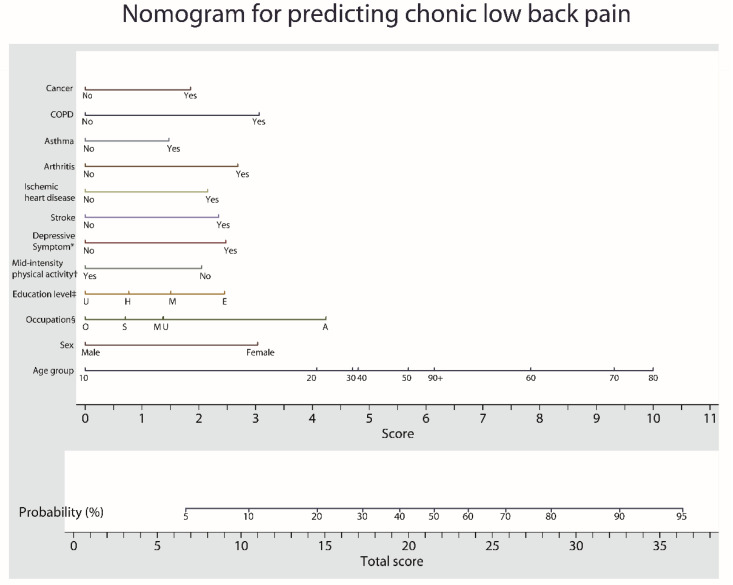
Data on CLBP development, demographics, socioeconomic history, and comorbid health conditions of the participants were obtained through a nationally representative health examination and survey from 2007 to 2009. Prediction models for CLBP development were derived from a health survey on a random sample of 80% of the data and validated in the remaining 20%. After developing the risk prediction model for CLBP, the model was incorporated into a nomogram.
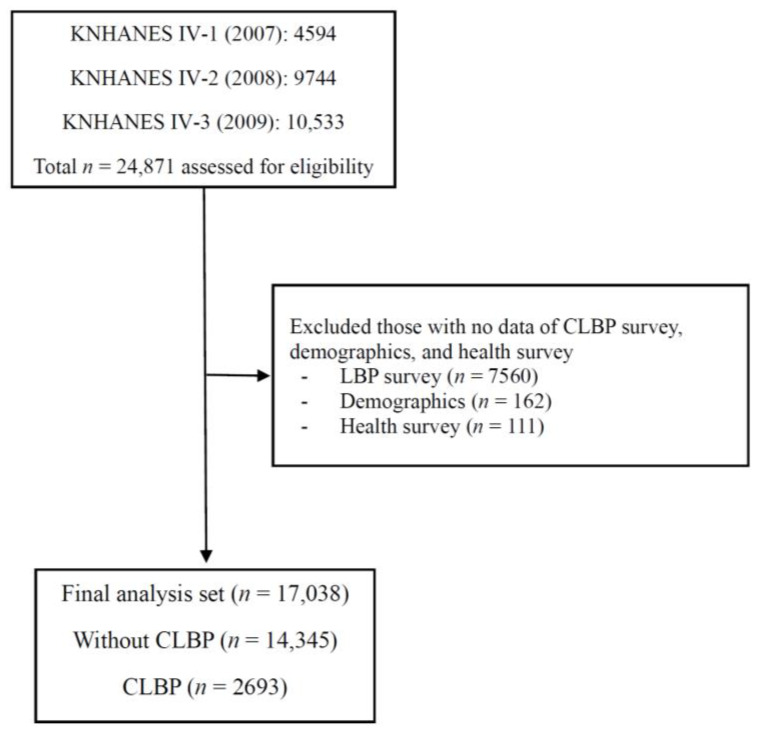
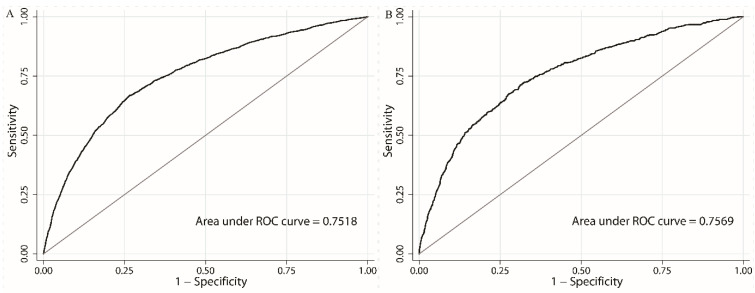
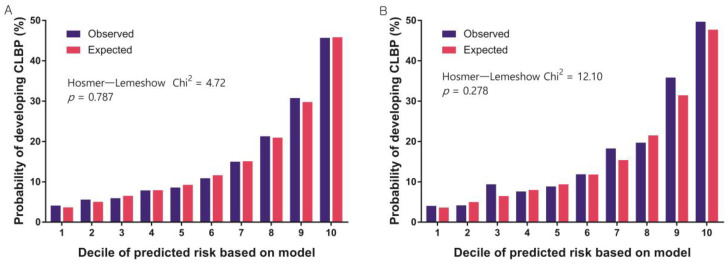
Data for 17,038 participants were analyzed, including 2693 with CLBP and 14,345 without CLBP. The selected risk factors included age, sex, occupation, education level, mid-intensity physical activity, depressive symptoms, and comorbidities. This model had good predictive performance in the validation dataset (concordance statistic = 0.7569, Hosmer-Lemeshow chi-square statistic = 12.10, = 0.278). Based on our model, the findings indicated no significant differences between the observed and predicted probabilities.
The risk prediction model presented by a nomogram, which is a score-based prediction system, can be incorporated into the clinical setting. Thus, our prediction model can help individuals at risk of developing CLBP to receive appropriate counseling on risk modification from primary physicians.
已有多项关于慢性下腰痛(CLBP)的预后因素的报道。然而,尚无研究使用风险预测模型来预测普通人群中CLBP的发生情况。这项横断面研究旨在开发并验证一个用于预测普通人群中CLBP发生的风险预测模型,并创建一个列线图,以帮助有CLBP发生风险的人接受有关风险修正的适当咨询。
通过2007年至2009年具有全国代表性的健康检查和调查,获取参与者关于CLBP发生情况、人口统计学、社会经济史和合并健康状况的数据。CLBP发生的预测模型来自对80%数据的随机样本进行的健康调查,并在其余20%的数据中进行验证。在开发出CLBP的风险预测模型后,将该模型纳入列线图。
分析了17038名参与者的数据,其中包括2693名患有CLBP的参与者和14345名未患CLBP的参与者。选定的风险因素包括年龄、性别、职业、教育水平、中等强度体力活动、抑郁症状和合并症。该模型在验证数据集中具有良好的预测性能(一致性统计量=0.7569,Hosmer-Lemeshow卡方统计量=12.10,P=0.278)。基于我们的模型,研究结果表明观察到的概率与预测的概率之间无显著差异。
由列线图呈现的风险预测模型是一种基于分数的预测系统,可纳入临床环境。因此,我们的预测模型可以帮助有CLBP发生风险的个体从初级医生那里获得有关风险修正的适当咨询。