Lucha-López María Orosia, Hidalgo-García César, Monti-Ballano Sofía, Márquez-Gonzalvo Sergio, Ferrández-Laliena Loreto, Müller-Thyssen-Uriarte Julián, Lucha-López Ana Carmen
Unidad de Investigación en Fisioterapia, Spin off Centro Clínico OMT-E Fisioterapia SLP, Universidad de Zaragoza, Domingo Miral s/n, 50009 Zaragoza, Spain.
Unidad de Investigación en Fisioterapia, Universidad de Zaragoza, Domingo Miral s/n, 50009 Zaragoza, Spain.
Biomedicines. 2023 Aug 2;11(8):2175. doi: 10.3390/biomedicines11082175.
Risk factors such as obesity and a sedentary lifestyle contribute to the development of chronic low back pain.
To describe how body mass index (BMI) influences the prevalence of chronic low back pain in the general Spanish population and assess this influence given other factors as sex, age, physical occupational demands, and recreational physical activity.
An analytical cross-sectional design was performed based on secondary data from the European Health Survey in Spain (2020). Data on age, gender, physical occupational demands, physical activity, BMI, and presence of chronic low back pain were extracted.
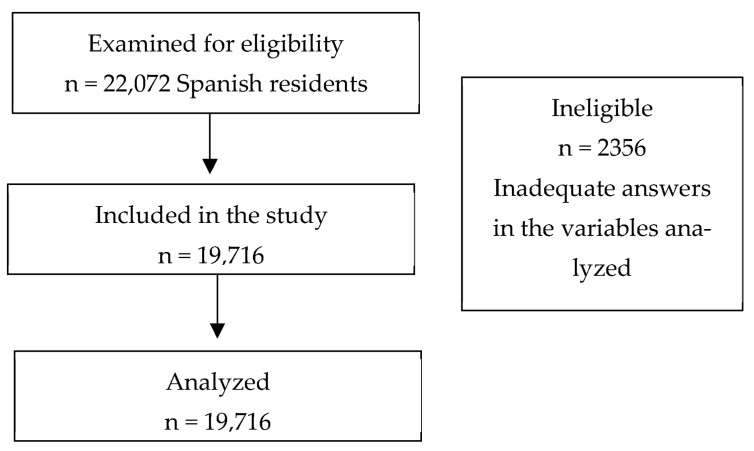
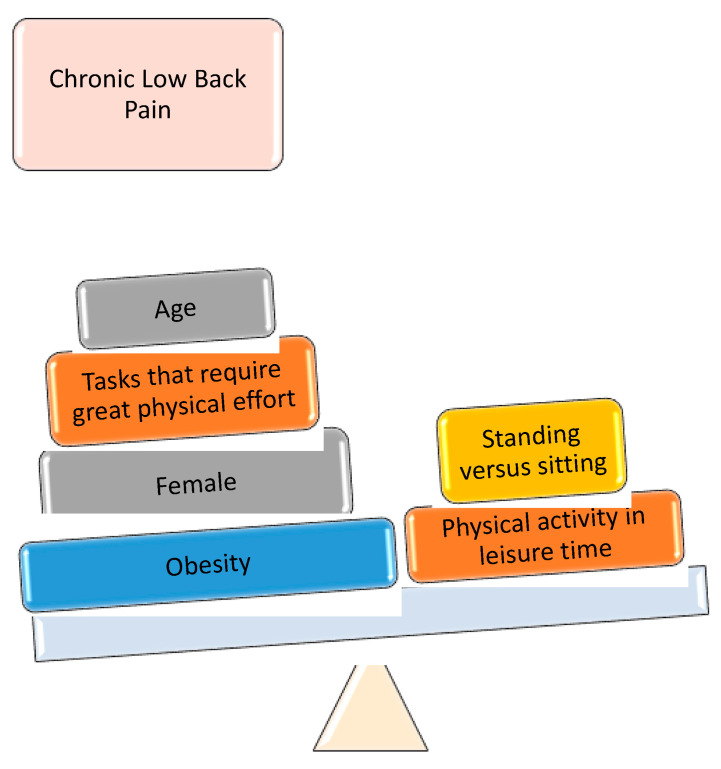
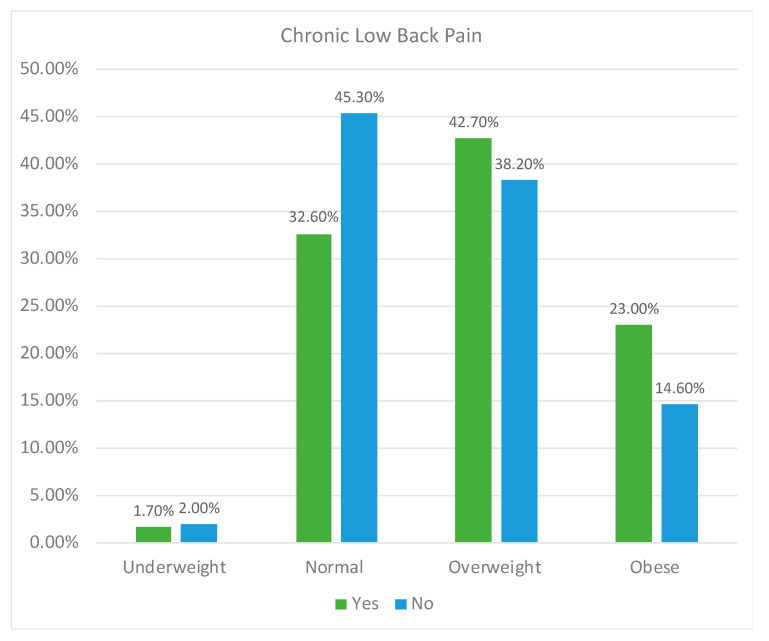
A total of 19,716 (52.2% women) subjects with a median age of 53 years old were analyzed. Of these, 18.3% had chronic low back pain, 39% were overweight, and 16.1% were obese. The adjusted generalized linear model showed that being obese increased the odds of chronic low back pain by 1.719 times ( < 0.001). Being a woman increased the odds by 1.683 times ( < 0.001). Performing occupational tasks requiring high physical demands increased the odds by 1.403 times ( < 0.001). Performing physical activity in leisure time several times a week decreased the odds by 0.598 times ( < 0.001). For every additional year of age, the odds of chronic low back pain increased by 3.3% ( < 0.001).
Obesity is related with the presence of chronic low back pain in the general Spanish population. This association persists, being the more relevant factor, after adjusting the association of BMI and chronic low back pain with other factors such as sex, age, physical occupational demands, and recreational physical activity.
肥胖和久坐不动的生活方式等风险因素会导致慢性下腰痛的发生。
描述体重指数(BMI)如何影响西班牙普通人群中慢性下腰痛的患病率,并在考虑性别、年龄、体力劳动需求和休闲体育活动等其他因素的情况下评估这种影响。
基于西班牙欧洲健康调查(2020年)的二手数据进行分析性横断面设计。提取了关于年龄、性别、体力劳动需求、体育活动、BMI和慢性下腰痛情况的数据。
共分析了19716名受试者(52.2%为女性),中位年龄为53岁。其中,18.3%患有慢性下腰痛,39%超重,16.1%肥胖。调整后的广义线性模型显示,肥胖使慢性下腰痛的几率增加1.719倍(P<0.001)。女性使几率增加1.683倍(P<0.001)。从事需要高体力要求的职业任务使几率增加1.403倍(P<0.001)。每周在休闲时间进行几次体育活动使几率降低0.598倍(P<0.001)。年龄每增加一岁,慢性下腰痛的几率增加3.3%(P<0.001)。
在西班牙普通人群中,肥胖与慢性下腰痛的存在有关。在调整BMI与慢性下腰痛的关联以及与性别、年龄、体力劳动需求和休闲体育活动等其他因素的关联后,这种关联仍然存在,且是更相关的因素。