Neurophysiology Department, Burgos University Hospital, 09006 Burgos, Spain.
Neurology Department, Valladolid Clinical University Hospital, 47003 Valladolid, Spain.
Int J Environ Res Public Health. 2023 Feb 19;20(4):3690. doi: 10.3390/ijerph20043690.
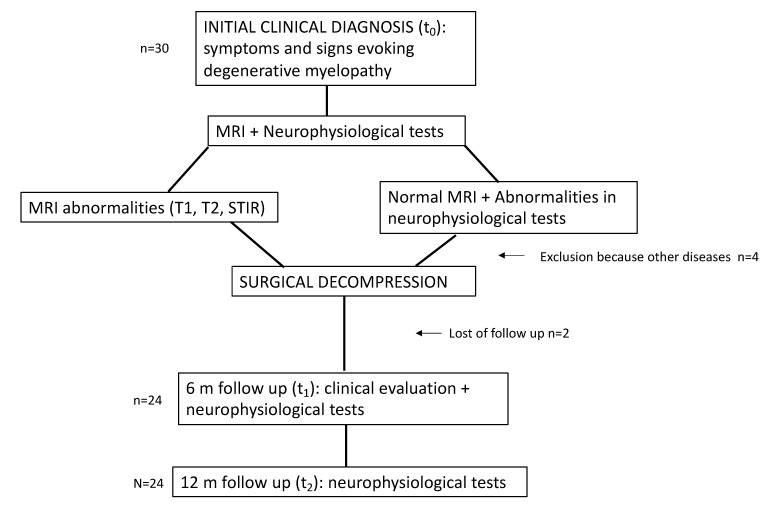
Degenerative cervical myelopathy (DCM) consists of spinal cord damage due to its compression through the cervical spine. The leading cause is degenerative. The diagnosis is clinical, and the therapeutic approach is usually surgical. Confirmation of the diagnostic suspicion is done by magnetic resonance imaging (MRI); however, this test lacks functional information of the spinal cord, the abnormality of which may precede involvement in neuroimaging. Neurophysiological examination using somatosensory evoked potentials (SSEPs) and transcranial magnetic stimulation (TMS) allows for an evaluation of spinal cord function, and provides information in the diagnostic process. Its role in the post-surgical follow-up of patients undergoing decompressive surgery is being studied. We present a retrospective study of 24 patients with DCM and surgical decompression who underwent neurophysiological tests (TMS and SSEP) before, 6, and 12 months after surgery. The result of the TMS and the SSEP in the post-operative follow-up did not correlate with the clinical outcome, either subjective or measured by clinical scales at six months. We only found post-surgical improvement of central conduction times (CMCTs) in patients with severe pre-surgical motor impairment on TMS. In patients with normal pre-surgical CMCT, we found a transient worsening with return to baseline at the one-year follow-up. Most patients presented pre-surgical increased P40 latency at diagnosis. CMCT and SSEP were more related to clinical outcomes one year after the surgical procedure and were very useful in diagnosing.
退行性颈脊髓病(DCM)是由于颈椎压迫脊髓而导致的脊髓损伤。主要原因是退行性病变。诊断是临床的,治疗方法通常是手术。通过磁共振成像(MRI)确认诊断怀疑,但该测试缺乏脊髓的功能信息,其异常可能先于神经影像学的参与。使用体感诱发电位(SSEP)和经颅磁刺激(TMS)进行神经生理学检查可以评估脊髓功能,并在诊断过程中提供信息。它在接受减压手术的患者的术后随访中的作用正在研究中。我们回顾性研究了 24 例 DCM 患者和接受手术减压的患者,他们在手术前、手术后 6 个月和 12 个月进行了神经生理学测试(TMS 和 SSEP)。TMS 和 SSEP 的术后随访结果与 6 个月时的主观或临床量表测量的临床结果均无相关性。我们仅发现 TMS 中术前运动障碍严重的患者术后中央传导时间(CMCT)有改善。在术前 CMCT 正常的患者中,我们发现术后 1 年时出现短暂恶化,随后恢复基线。大多数患者在诊断时表现为术前 P40 潜伏期延长。CMCT 和 SSEP 在术后 1 年与临床结果更相关,对诊断非常有用。