Yamashita Shiori, Dozono Naoki, Tobori Shota, Nagayasu Kazuki, Kaneko Shuji, Shirakawa Hisashi, Ueda Hiroshi
Department of Molecular Pharmacology, Graduate School of Pharmaceutical Sciences, Kyoto University, 46-29 Yoshida-Shimoadachi-cho, Sakyo-ku, Kyoto 606-8501, Japan.
Department of Pharmacology and Therapeutic Innovation, Nagasaki University Institute of Biomedical Sciences, Nagasaki 852-8521, Japan.
Int J Mol Sci. 2023 Feb 9;24(4):3465. doi: 10.3390/ijms24043465.
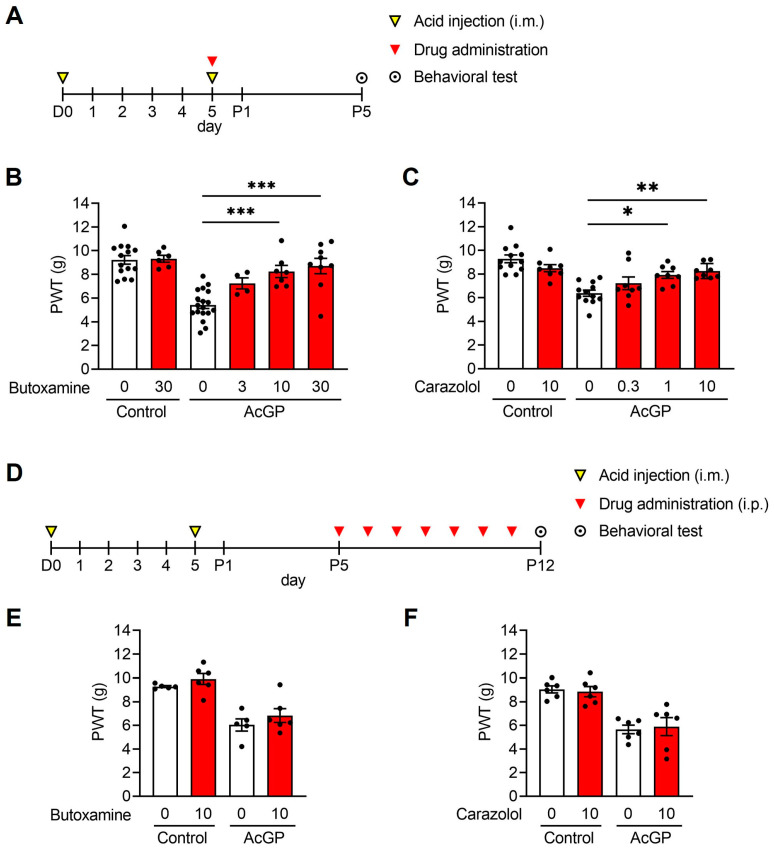
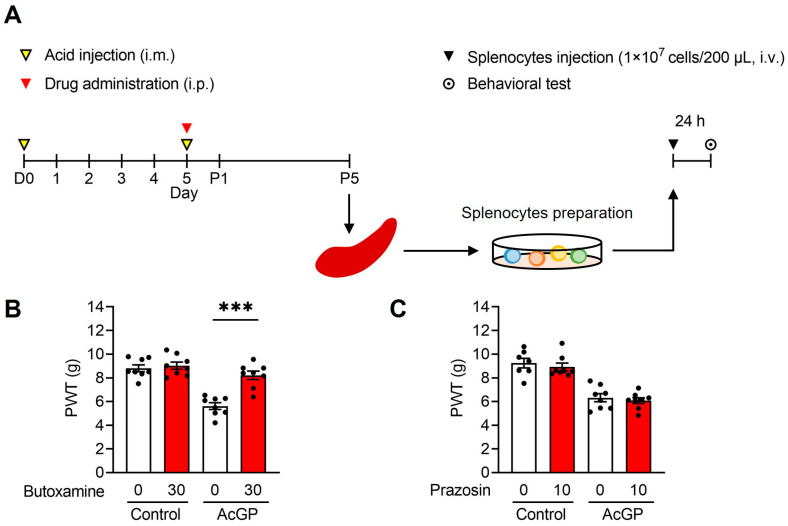
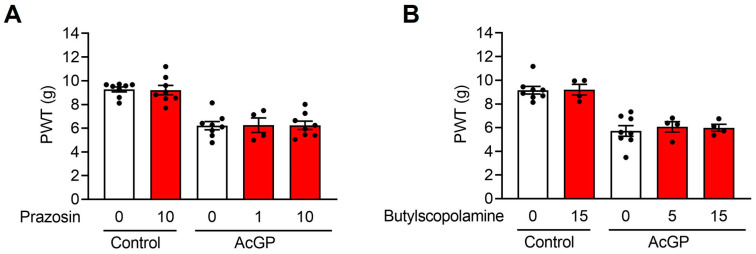
Abnormalities in the peripheral immune system are involved in the pathophysiology of fibromyalgia, although their contribution to the painful symptoms remains unknown. Our previous study reported the ability of splenocytes to develop pain-like behavior and an association between the central nervous system (CNS) and splenocytes. Since the spleen is directly innervated by sympathetic nerves, this study aimed to examine whether adrenergic receptors are necessary for pain development or maintenance using an acid saline-induced generalized pain (AcGP) model (an experimental model of fibromyalgia) and whether the activation of these receptors is also essential for pain reproduction by the adoptive transfer of AcGP splenocytes. The administration of selective β2-blockers, including one with only peripheral action, prevented the development but did not reverse the maintenance of pain-like behavior in acid saline-treated C57BL/6J mice. Neither a selective α1-blocker nor an anticholinergic drug affects the development of pain-like behavior. Furthermore, β2-blockade in donor AcGP mice eliminated pain reproduction in recipient mice injected with AcGP splenocytes. These results suggest that peripheral β2-adrenergic receptors play an important role in the efferent pathway from the CNS to splenocytes in pain development.
外周免疫系统的异常参与了纤维肌痛的病理生理过程,尽管它们对疼痛症状的影响尚不清楚。我们之前的研究报道了脾细胞产生疼痛样行为的能力以及中枢神经系统(CNS)与脾细胞之间的关联。由于脾脏直接受交感神经支配,本研究旨在使用酸性生理盐水诱导的全身性疼痛(AcGP)模型(一种纤维肌痛的实验模型)来检查肾上腺素能受体对于疼痛的发生或维持是否必要,以及这些受体的激活对于通过AcGP脾细胞的过继转移来再现疼痛是否也至关重要。给予选择性β2阻滞剂,包括一种仅具有外周作用的阻滞剂,可预防酸性生理盐水处理的C57BL/6J小鼠疼痛样行为的发生,但不能逆转其维持。选择性α1阻滞剂和抗胆碱能药物均不影响疼痛样行为的发生。此外,供体AcGP小鼠中的β2阻断消除了注射AcGP脾细胞的受体小鼠中的疼痛再现。这些结果表明,外周β2肾上腺素能受体在疼痛发生过程中从中枢神经系统到脾细胞的传出通路中起重要作用。