Department of Applied Biological Science, Graduate School of Agriculture, Tokyo University of Agriculture and Technology, Fuchu-shi 183-8509, Tokyo, Japan.
Department of Translational and Precision Medicine, Sapienza University of Rome, 00185 Rome, Italy.
Int J Mol Sci. 2023 Feb 14;24(4):3817. doi: 10.3390/ijms24043817.
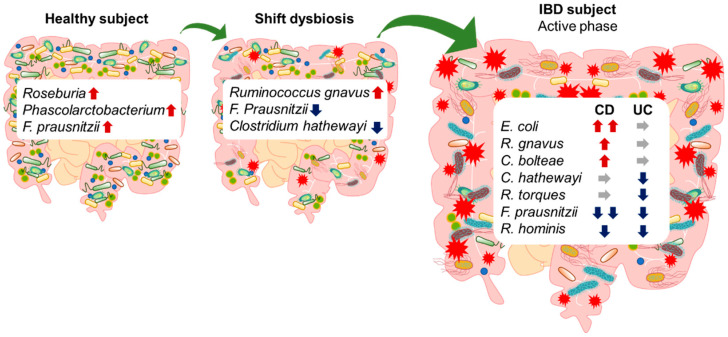
Inflammatory bowel disease (IBD) is an inflammatory disease of the gastrointestinal tract, the incidence of which has rapidly increased worldwide, especially in developing and Western countries. Recent research has suggested that genetic factors, the environment, microbiota, and immune responses are involved in the pathogenesis; however, the underlying causes of IBD are unclear. Recently, gut microbiota dysbiosis, especially a decrease in the abundance and diversity of specific genera, has been suggested as a trigger for IBD-initiating events. Improving the gut microbiota and identifying the specific bacterial species in IBD are essential for understanding the pathogenesis and treatment of IBD and autoimmune diseases. Here, we review the different aspects of the role played by gut microbiota in the pathogenesis of IBD and provide a theoretical basis for modulating gut microbiota through probiotics, fecal microbiota transplantation, and microbial metabolites.
炎症性肠病(IBD)是一种胃肠道炎症性疾病,其发病率在全球范围内迅速上升,尤其在发展中国家和西方国家。最近的研究表明,遗传因素、环境、微生物群和免疫反应都与发病机制有关;然而,IBD 的根本原因尚不清楚。最近,肠道微生物群失调,特别是特定属的丰度和多样性下降,被认为是引发 IBD 起始事件的因素。改善肠道微生物群并确定 IBD 中的特定细菌种类对于理解 IBD 和自身免疫性疾病的发病机制和治疗至关重要。在这里,我们综述了肠道微生物群在 IBD 发病机制中的不同作用,并为通过益生菌、粪便微生物移植和微生物代谢物来调节肠道微生物群提供了理论依据。