Feng Jiayu, Liang Lin, Chen Yuyi, Tian Pengchao, Zhao Xuemei, Huang Boping, Wu Yihang, Wang Jing, Guan Jingyuan, Huang Liyan, Li Xinqing, Zhang Yuhui, Zhang Jian
State Key Laboratory of Cardiovascular Disease, Heart Failure Center, National Center for Cardiovascular Diseases, Fuwai Hospital, Chinese Academy of Medical Sciences and Peking Union Medical College, Beijing 100037, China.
Key Laboratory of Clinical Research for Cardiovascular Medications, National Health Committee, Beijing 100037, China.
J Clin Med. 2023 Feb 8;12(4):1363. doi: 10.3390/jcm12041363.
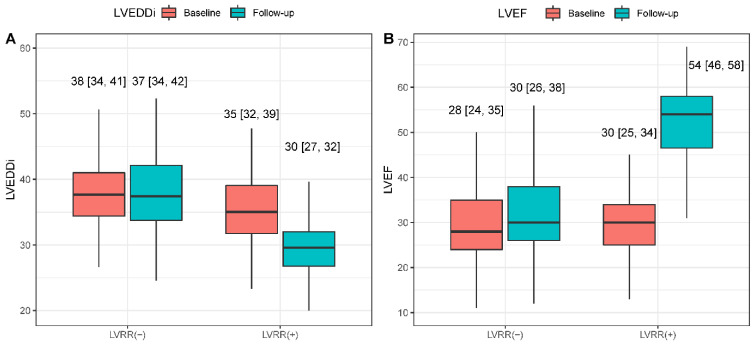
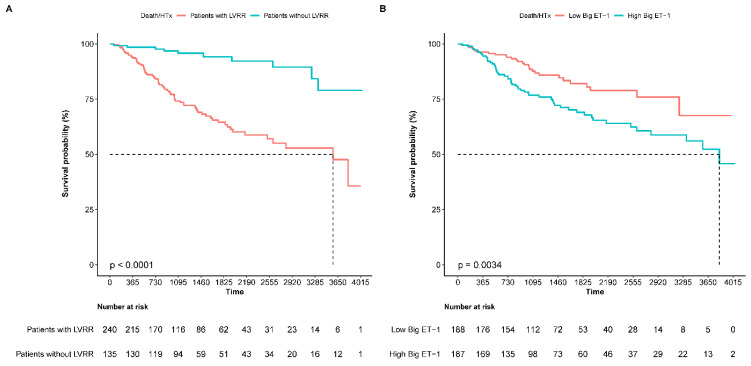
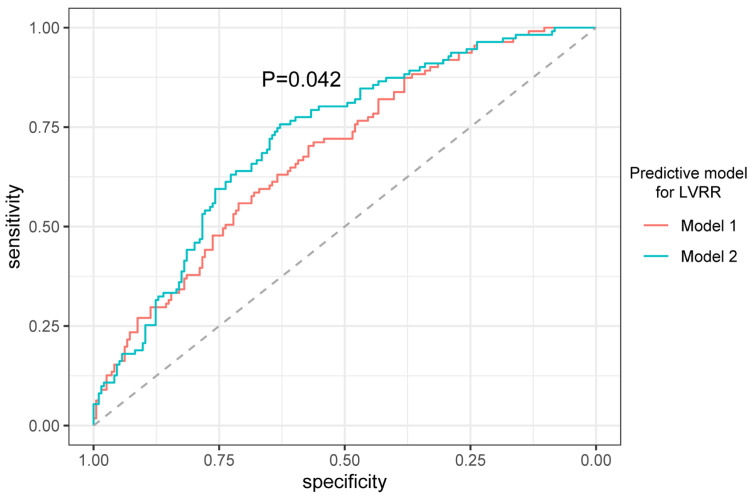
This study aimed to investigate the predictive value of Big endothelin-1(ET-1) for left ventricular reverse remodeling (LVRR) and prognosis in patients with dilated cardiomyopathy (DCM). Patients with DCM and a left ventricular ejection fraction (LVEF) ≤ 50% from 2008 to 2017 were included. LVRR was defined as the LVEF increased by at least 10% or follow-up LVEF increased to at least 50% with a minimum improvement of 5%; meanwhile, the index of left ventricular end-diastolic diameter (LVEDDi) decreased by at least 10% or LVEDDi decreased to ≤33 mm/m. The composite outcome for prognostic analysis consisted of death and heart transplantations. Of the 375 patients included (median age 47 years, 21.1% female), 135 patients (36%) had LVRR after a median of 14 months of treatment. An independent association was found between Big ET-1 at baseline and LVRR in the multivariate model (OR 0.70, 95% CI 0.55-0.89, = 0.003, per log increase). Big ET-1, body mass index, systolic blood pressure, diagnosis of type 2 diabetes mellitus (T2DM) and treatment with ACEI/ARB were significant predictors for LVRR after stepwise selection. Adding Big ET-1 to the model improved the discrimination (∆AUC = 0.037, = 0.042 and reclassification (IDI, 3.29%; = 0.002; NRI, 35%; = 0.002) for identifying patients with LVRR. During a median follow-up of 39 (27-68) months, Big ET-1 was also independently associated with the composite outcome of death and heart transplantations (HR 1.45, 95% CI 1.13-1.85, = 0.003, per log increase). In conclusion, Big ET-1 was an independent predictor for LVRR and had prognostic implications, which might help to improve the risk stratification of patients with DCM.
本研究旨在探讨大内皮素-1(ET-1)对扩张型心肌病(DCM)患者左心室逆向重构(LVRR)及预后的预测价值。纳入2008年至2017年左心室射血分数(LVEF)≤50%的DCM患者。LVRR定义为LVEF至少增加10%或随访时LVEF增加至至少50%且最小改善幅度为5%;同时,左心室舒张末期内径(LVEDDi)指数至少降低10%或LVEDDi降低至≤33 mm/m。预后分析的复合终点包括死亡和心脏移植。在纳入的375例患者(中位年龄47岁,21.1%为女性)中,135例患者(36%)在中位治疗14个月后发生LVRR。在多变量模型中发现基线大ET-1与LVRR之间存在独立关联(OR 0.70,95%CI 0.55 - 0.89,P = 0.003,每对数增加)。经逐步选择后,大ET-1、体重指数、收缩压、2型糖尿病(T2DM)诊断及ACEI/ARB治疗是LVRR的显著预测因素。将大ET-1纳入模型可改善对LVRR患者识别的辨别力(∆AUC = 0.037,P = 0.042)和重新分类(IDI,3.29%;P = 0.002;NRI,35%;P = 0.002)。在中位随访39(27 - 68)个月期间,大ET-1还与死亡和心脏移植的复合终点独立相关(HR 1.45,95%CI 1.13 - 1.85,P = 0.003,每对数增加)。总之,大ET-1是LVRR的独立预测因素且具有预后意义,这可能有助于改善DCM患者的风险分层。