Verdejo Hugo E, Rojas Adolfo, López-Crisosto Camila, Baraona Fernando, Gabrielli Luigi, Maracaja-Coutinho Vinicius, Chiong Mario, Lavandero Sergio, Castro Pablo F
Advanced Center for Chronic Diseases (ACCDiS), Division Enfermedades Cardiovasculares, Facultad de Medicina, Pontificia Universidad Católica de Chile, Santiago 8330077, Chile.
Advanced Center for Chronic Diseases (ACCDiS), Facultad de Ciencias Químicas y Farmacéuticas & Facultad de Medicina, Universidad de Chile, Santiago 8380492, Chile.
J Clin Med. 2023 Feb 16;12(4):1571. doi: 10.3390/jcm12041571.
Pulmonary artery hypertension (PAH) is a chronic and progressive disease. Although current therapy has improved the disease prognosis, PAH has a poor survival rate. The key feature leading to disease progression and death is right ventricular (RV) failure.
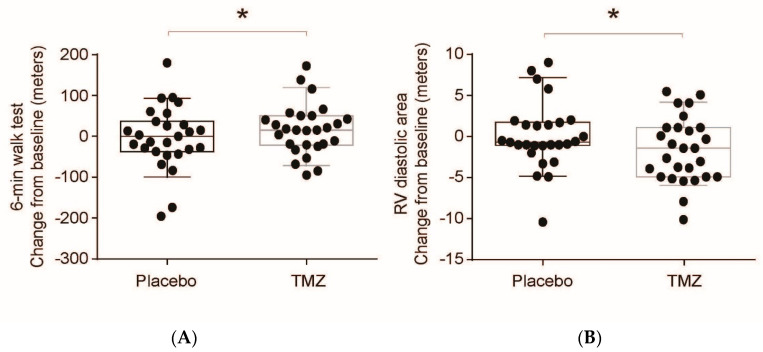
We assessed the role of trimetazidine, a fatty acid beta-oxidation (FAO) inhibitor, in right ventricular function, remodeling, and functional class in PAH patients, with a placebo-controlled double-blind, case-crossover trial. Twenty-seven PAH subjects were enrolled, randomized, and assigned to trimetazidine or placebo for three months and then reallocated to the other study arm. The primary endpoint was RV morphology and function change after three months of treatment. Secondary endpoints were the change in exercise capacity assessed by a 6 min walk test after three months of treatment and the change in pro-BNP and Galectin-3 plasma levels after three months. Trimetazidine use was safe and well-tolerated. After three months of treatment, patients in the trimetazidine group showed a small but significant reduction of RV diastolic area, and a substantial increase in the 6 min walk distance (418 vs. 438 mt, = 0.023), without significant changes in biomarkers.
A short course of trimetazidine is safe and well-tolerated on PAH patients, and it is associated with significant increases in the 6MWT and minor but significant improvement in RV remodeling. The therapeutic potential of this drug should be evaluated in larger clinical trials.
肺动脉高压(PAH)是一种慢性进行性疾病。尽管目前的治疗方法改善了疾病预后,但PAH的生存率仍较低。导致疾病进展和死亡的关键特征是右心室(RV)衰竭。
我们通过一项安慰剂对照的双盲病例交叉试验,评估了脂肪酸β氧化(FAO)抑制剂曲美他嗪在PAH患者右心室功能、重塑和功能分级中的作用。纳入27名PAH受试者,随机分组,给予曲美他嗪或安慰剂治疗3个月,然后重新分配到另一研究组。主要终点是治疗3个月后右心室形态和功能的变化。次要终点是治疗3个月后通过6分钟步行试验评估的运动能力变化以及3个月后血浆脑钠肽前体(pro-BNP)和半乳糖凝集素-3水平的变化。使用曲美他嗪安全且耐受性良好。治疗3个月后,曲美他嗪组患者的右心室舒张面积虽有小幅但显著的减小,6分钟步行距离大幅增加(418米对438米,P = 0.023),生物标志物无显著变化。
短期使用曲美他嗪对PAH患者安全且耐受性良好,与6分钟步行试验距离显著增加以及右心室重塑有轻微但显著的改善相关。该药物的治疗潜力应在更大规模的临床试验中进行评估。