Shao Ji, Zhu Jiazhu, Jin Kai, Guan Xiaojun, Jian Tianming, Xue Ying, Wang Changjun, Xu Xiaojun, Sun Fengyuan, Si Ke, Gong Wei, Ye Juan
Department of Ophthalmology, The Second Affiliated Hospital of Zhejiang University, School of Medicine, Hangzhou 310009, China.
Center for Neuroscience and Department of Neurobiology of the Second Affiliated Hospital, State Key Laboratory of Modern Optical Instrumentation, Zhejiang University School of Medicine, Hangzhou 310027, China.
J Pers Med. 2023 Jan 23;13(2):204. doi: 10.3390/jpm13020204.
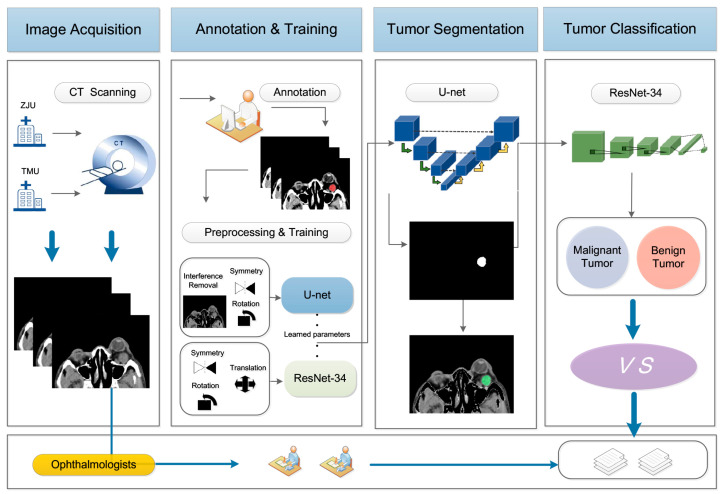
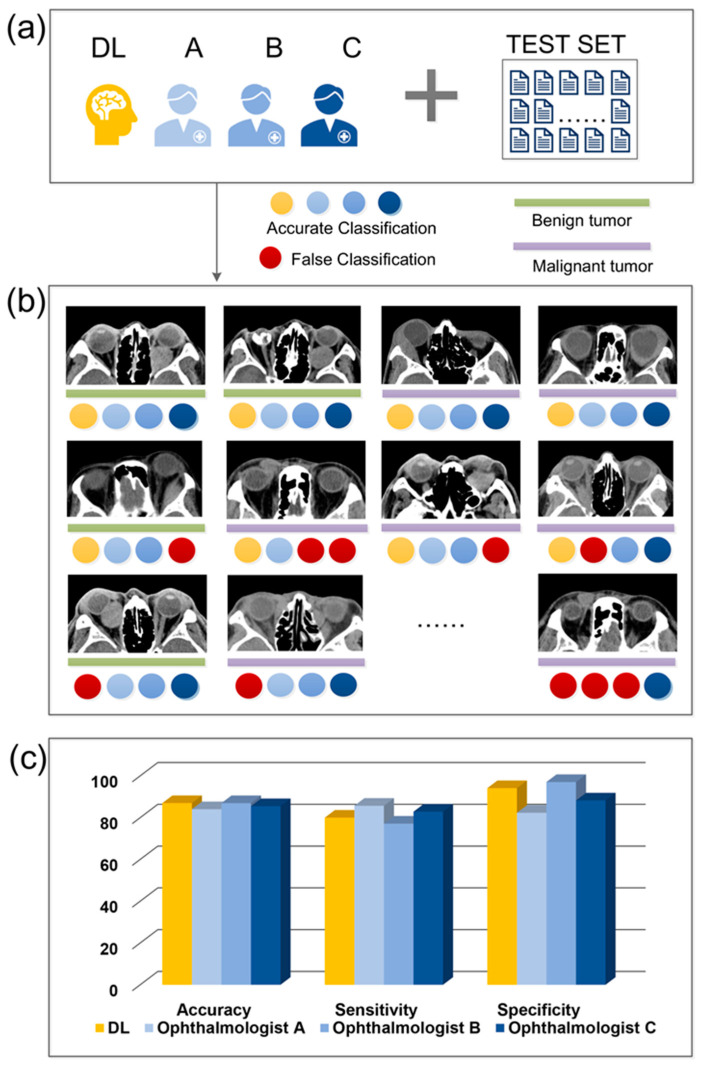
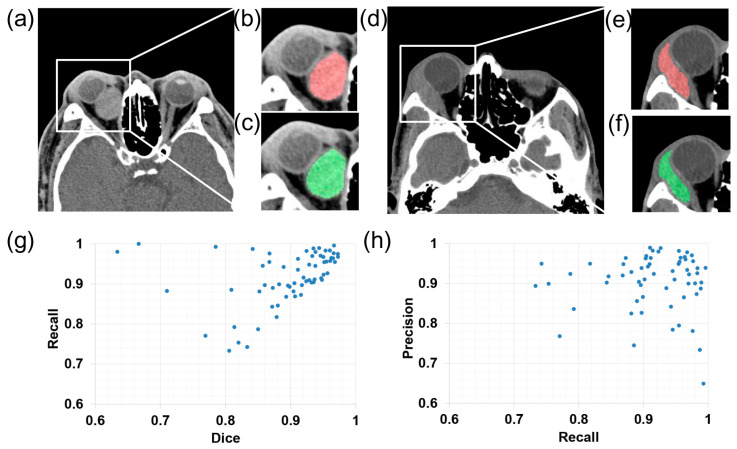
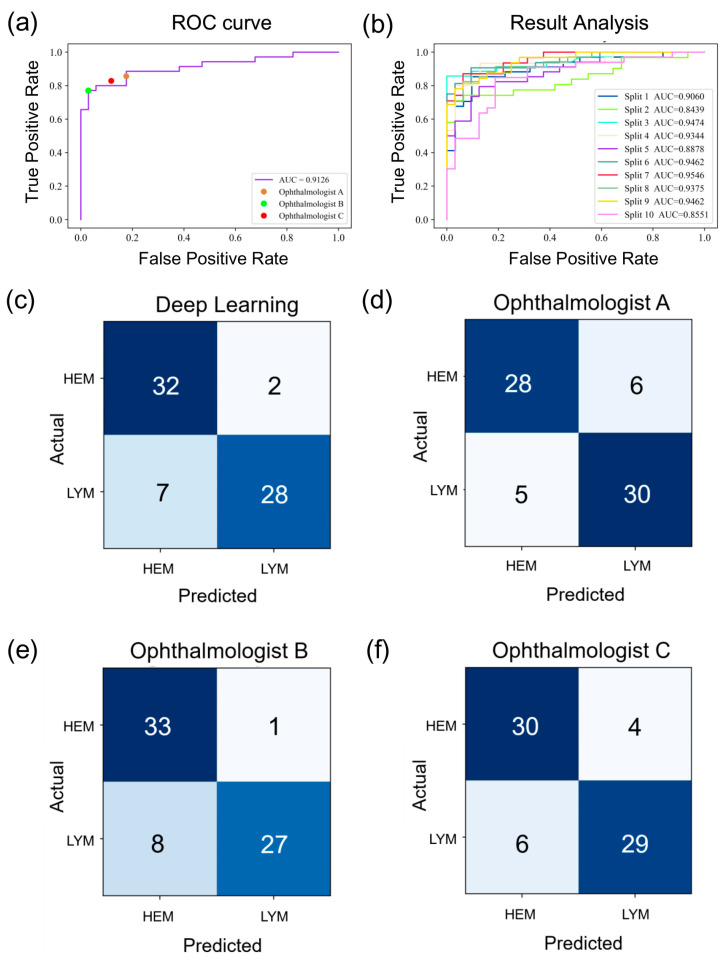
Determining the nature of orbital tumors is challenging for current imaging interpretation methods, which hinders timely treatment. This study aimed to propose an end-to-end deep learning system to automatically diagnose orbital tumors. A multi-center dataset of 602 non-contrast-enhanced computed tomography (CT) images were prepared. After image annotation and preprocessing, the CT images were used to train and test the deep learning (DL) model for the following two stages: orbital tumor segmentation and classification. The performance on the testing set was compared with the assessment of three ophthalmologists. For tumor segmentation, the model achieved a satisfactory performance, with an average dice similarity coefficient of 0.89. The classification model had an accuracy of 86.96%, a sensitivity of 80.00%, and a specificity of 94.12%. The area under the receiver operating characteristics curve (AUC) of the 10-fold cross-validation ranged from 0.8439 to 0.9546. There was no significant difference on diagnostic performance of the DL-based system and three ophthalmologists ( > 0.05). The proposed end-to-end deep learning system could deliver accurate segmentation and diagnosis of orbital tumors based on noninvasive CT images. Its effectiveness and independence from human interaction allow the potential for tumor screening in the orbit and other parts of the body.
对于当前的影像解读方法而言,确定眼眶肿瘤的性质具有挑战性,这阻碍了及时治疗。本研究旨在提出一种端到端的深度学习系统,以自动诊断眼眶肿瘤。准备了一个包含602张非增强计算机断层扫描(CT)图像的多中心数据集。经过图像标注和预处理后,这些CT图像被用于训练和测试深度学习(DL)模型,分以下两个阶段:眼眶肿瘤分割和分类。将测试集上的性能与三位眼科医生的评估结果进行比较。对于肿瘤分割,该模型取得了令人满意的性能,平均骰子相似系数为0.89。分类模型的准确率为86.96%,灵敏度为80.00%,特异性为94.12%。十折交叉验证的受试者工作特征曲线(AUC)下面积在0.8439至0.9546之间。基于深度学习的系统与三位眼科医生的诊断性能无显著差异(>0.05)。所提出的端到端深度学习系统能够基于无创CT图像实现眼眶肿瘤的准确分割和诊断。其有效性以及不依赖人工交互的特点使其具有在眼眶及身体其他部位进行肿瘤筛查的潜力。