Gori Alessio, Russo Sara, Topino Eleonora
Department of Health Sciences, University of Florence, Via di San Salvi 12, Pad. 26, 50135 Florence, Italy.
Integrated Psychodynamic Psychotherapy Institute (IPPI), Via Ricasoli 32, 50122 Florence, Italy.
J Pers Med. 2023 Jan 29;13(2):247. doi: 10.3390/jpm13020247.
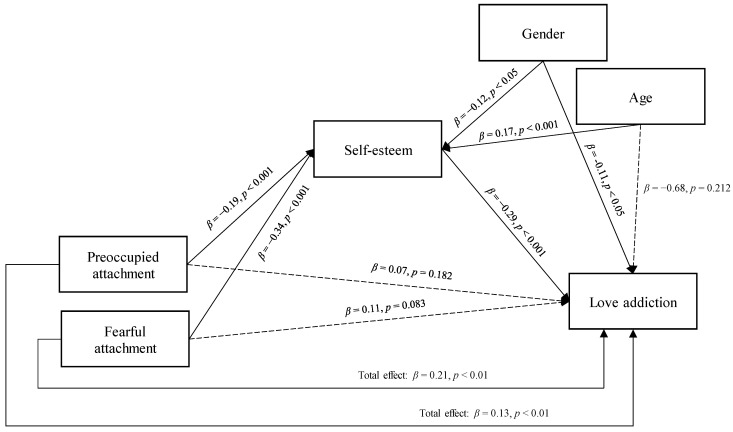
Love addiction is a dysfunctional relational modality that takes on the addiction characteristics and which, for the individuals who suffer from it, can have a negative and pervasive impact on various areas of functioning. The objective of this research was the analysis the factors that can be associated with love addiction, particularly focusing on adult attachment patterns and self-esteem. A sample group of 300 individuals who declared themselves to have a romantic relationship was involved in this research ( = 37.83 years, = 12.937). They completed an online survey including the Love Addiction Inventory-Short form, Relationship Questionnaire, and Rosenberg Self-Esteem Scale. Results showed significant and positive associations between preoccupied and fearful adult attachment and love addiction. Furthermore, these relationships were totally mediated by self-esteem. Gender and age were controlled as potential covariates and showed significant effects in influencing the levels of self-esteem and love addiction. Such findings may provide useful information for orienting future research and supporting an effective clinical practice.
爱情成瘾是一种功能失调的关系模式,具有成瘾特征,对患有爱情成瘾的个体而言,它会对各个功能领域产生负面且普遍的影响。本研究的目的是分析可能与爱情成瘾相关的因素,尤其侧重于成人依恋模式和自尊。一个由300名宣称自己处于恋爱关系中的个体组成的样本组参与了本研究(平均年龄 = 37.83岁,标准差 = 12.937)。他们完成了一项在线调查,包括爱情成瘾量表简版、关系问卷和罗森伯格自尊量表。结果显示,痴迷型和恐惧型成人依恋与爱情成瘾之间存在显著的正相关。此外,这些关系完全由自尊介导。将性别和年龄作为潜在协变量进行控制,结果显示它们在影响自尊水平和爱情成瘾方面具有显著作用。这些发现可能为指导未来研究和支持有效的临床实践提供有用信息。