Department of Pharmacy, Quaid-i-Azam University, Islamabad 45320, Pakistan.
Department of Healthcare Biotechnology, Atta-ur-Rahman School of Applied Biosciences, National University of Sciences and Technology, Islamabad 44000, Pakistan.
Medicina (Kaunas). 2023 Jan 31;59(2):272. doi: 10.3390/medicina59020272.
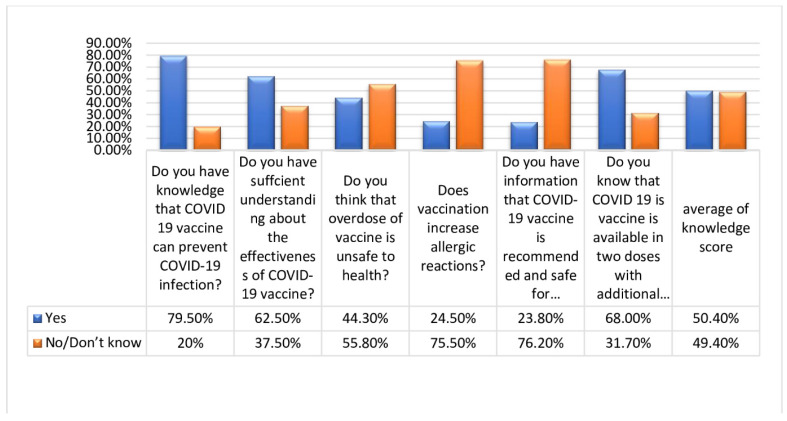
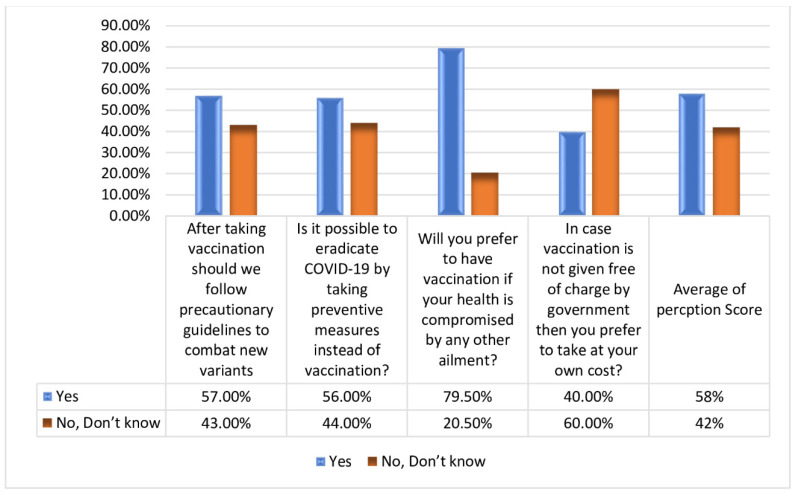
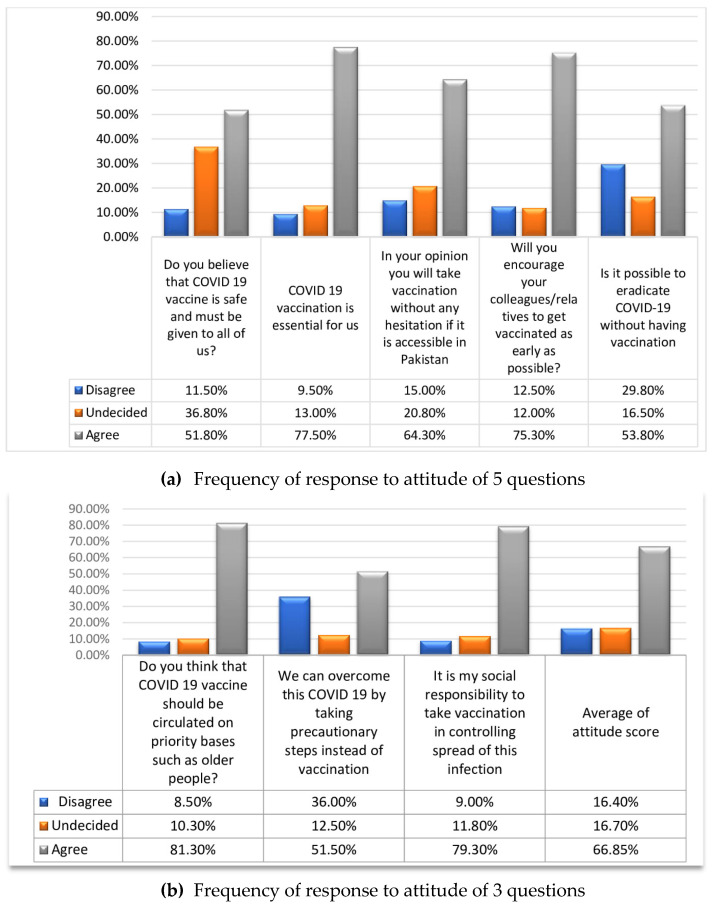
Several vaccines have been approved for the prevention of the coronavirus disease, discovered on 31 December in Wuhan, China. Pakistan procured vaccines from various countries. However, the lack of knowledge and reluctance of the general population to embrace the use of the vaccines are considered to be the major determinant of the slow vaccination rate. Hence, it is necessary to evaluate the willingness of the general population about their perception of the COVID-19 vaccination. A cross sectional survey based on a self-structured questionnaire comprising 18 questions was conducted (from 21 April-21 June) on 400 Pakistani participants to evaluate their knowledge, attitude, and perception towards the COVID-19 vaccination. Chi-square independent t-test and one-way Anova including a multiple step wise linear regression were used to draw conclusions about the results. < 0.05 was considered significant. A total of 400 participants responded in the knowledge, attitude, and perception (KAP) survey of which 46.5% were female and 53.5% were male. The mean age of participants was 36.08 years. This survey showed a poor knowledge (50.5%), a fair attitude (75.1%) and a poor perception (58.1%) towards the COVID-19 vaccination. Higher mean knowledge and attitude scores were reported in the age group 21-40, females, and unmarried urban citizens. Regression analysis showed that age, education, residence, and employment status influenced the knowledge and perception score to a considerable extent. The findings reflect an inadequate knowledge and perception on the one hand, but a better attitude towards the COVID-19 vaccination. This knowledge attitude and perception (KAP) survey will help in better understanding the opinion of the general population towards vaccination, and will be useful for policy makers and health care authorities aiming to increase the vaccination rate.
已批准几种疫苗来预防在中国武汉发现的 2019 年冠状病毒病。巴基斯坦从不同国家采购疫苗。然而,一般人群对疫苗的知识匮乏且不愿意使用疫苗,这被认为是接种率缓慢的主要决定因素。因此,有必要评估一般人群对 COVID-19 疫苗接种的看法。本研究采用基于 18 个问题的自我结构化问卷,于 2021 年 4 月 21 日至 6 月 21 日对 400 名巴基斯坦参与者进行了横断面调查,以评估他们对 COVID-19 疫苗接种的知识、态度和看法。采用卡方独立性检验、单向方差分析(包括多元逐步线性回归)来得出关于结果的结论。<0.05 被认为具有统计学意义。共有 400 名参与者参与了知识、态度和看法(KAP)调查,其中 46.5%为女性,53.5%为男性。参与者的平均年龄为 36.08 岁。该调查显示,人们对 COVID-19 疫苗接种的知识水平较差(50.5%)、态度较好(75.1%)和看法较差(58.1%)。21-40 岁、女性和未婚城市居民的平均知识和态度得分较高。回归分析表明,年龄、教育、居住和就业状况在很大程度上影响了知识和看法得分。这些发现反映出一方面知识和看法不足,但另一方面对 COVID-19 疫苗接种的态度较好。这项知识、态度和看法(KAP)调查将有助于更好地了解一般人群对疫苗接种的看法,并将有助于决策者和卫生保健当局提高疫苗接种率。