Kenesi Erzsébet, Kolbert Zsuzsanna, Kaszler Nikolett, Klement Éva, Ménesi Dalma, Molnár Árpád, Valkai Ildikó, Feigl Gábor, Rigó Gábor, Cséplő Ágnes, Lindermayr Christian, Fehér Attila
Institute of Plant Biology, Biological Research Centre, Eötvös Lóránd Research Network, Temesvári Krt. 62, H-6726 Szeged, Hungary.
Department of Plant Biology, University of Szeged, Közép Fasor 52, H-6726 Szeged, Hungary.
Plants (Basel). 2023 Feb 8;12(4):750. doi: 10.3390/plants12040750.
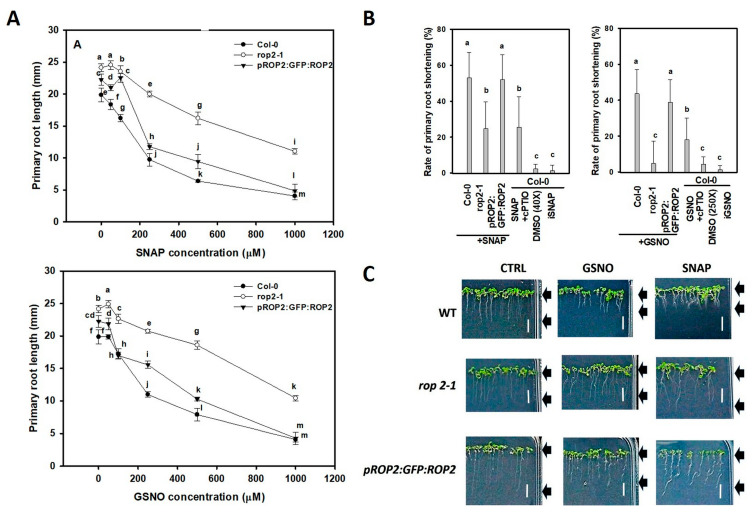
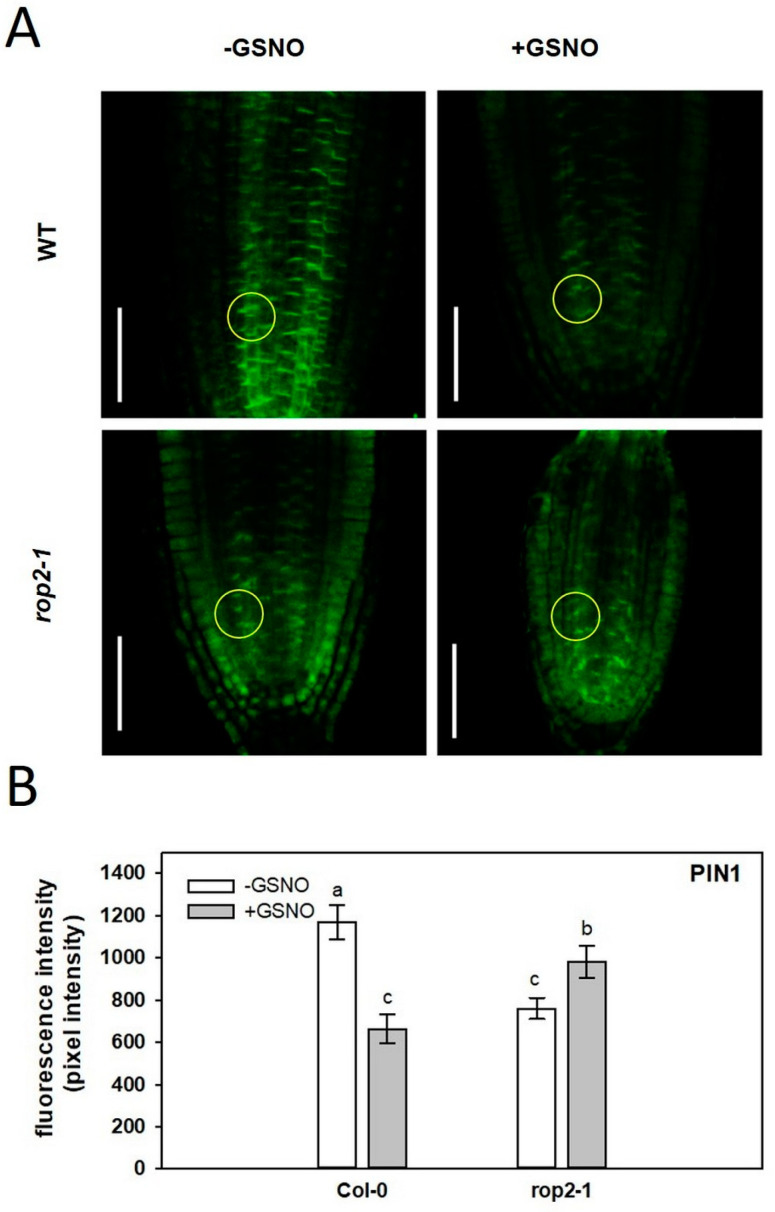
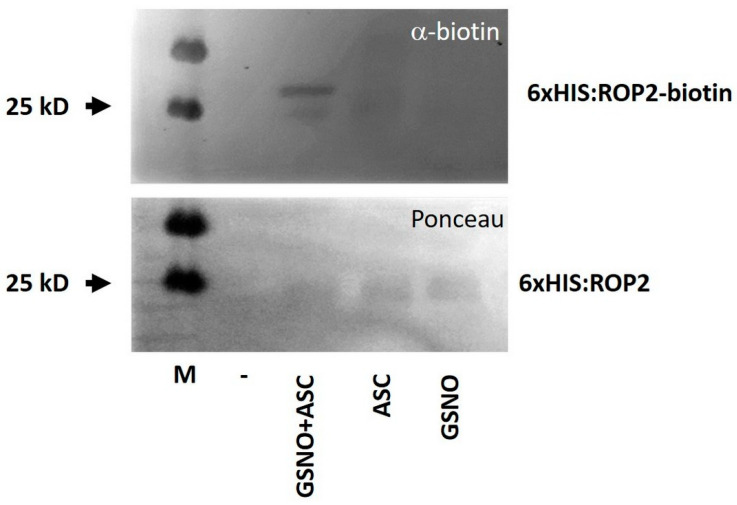
Nitric oxide (NO) is a versatile signal molecule that mediates environmental and hormonal signals orchestrating plant development. NO may act via reversible S-nitrosation of proteins during which an NO moiety is added to a cysteine thiol to form an S-nitrosothiol. In plants, several proteins implicated in hormonal signaling have been reported to undergo S-nitrosation. Here, we report that the Arabidopsis ROP2 GTPase is a further potential target of NO-mediated regulation. The ROP2 GTPase was found to be required for the root shortening effect of NO. NO inhibits primary root growth by altering the abundance and distribution of the PIN1 auxin efflux carrier protein and lowering the accumulation of auxin in the root meristem. In insertion mutants, however, wild-type-like root size of the NO-treated roots were maintained in agreement with wild-type-like PIN1 abundance in the meristem. The ROP2 GTPase was shown to be S-nitrosated in vitro, suggesting that NO might directly regulate the GTPase. The potential mechanisms of NO-mediated ROP2 GTPase regulation and ROP2-mediated NO signaling in the primary root meristem are discussed.
一氧化氮(NO)是一种多功能信号分子,可介导协调植物发育的环境和激素信号。NO可能通过蛋白质的可逆S-亚硝基化起作用,在此过程中,一个NO部分被添加到半胱氨酸硫醇上以形成S-亚硝基硫醇。在植物中,已有报道称几种参与激素信号传导的蛋白质会发生S-亚硝基化。在此,我们报道拟南芥ROP2 GTP酶是NO介导调控的另一个潜在靶点。发现ROP2 GTP酶是NO引起根缩短效应所必需的。NO通过改变PIN1生长素外排载体蛋白的丰度和分布以及降低根分生组织中生长素的积累来抑制主根生长。然而,在插入突变体中,经NO处理的根保持野生型样的根大小,这与分生组织中野生型样的PIN1丰度一致。ROP2 GTP酶在体外被证明发生了S-亚硝基化,这表明NO可能直接调节该GTP酶。本文讨论了在主根分生组织中NO介导的ROP2 GTP酶调控和ROP2介导的NO信号传导的潜在机制。