González-Feijoo Rocío, Rodríguez-Seijo Andrés, Fernández-Calviño David, Arias-Estévez Manuel, Arenas-Lago Daniel
Department of Plant Biology and Soil Science, Área de Edafoloxía e Química Agrícola, Facultade de Ciencias, Universidade de Vigo, 32004 Ourense, Spain.
Plants (Basel). 2023 Feb 10;12(4):801. doi: 10.3390/plants12040801.
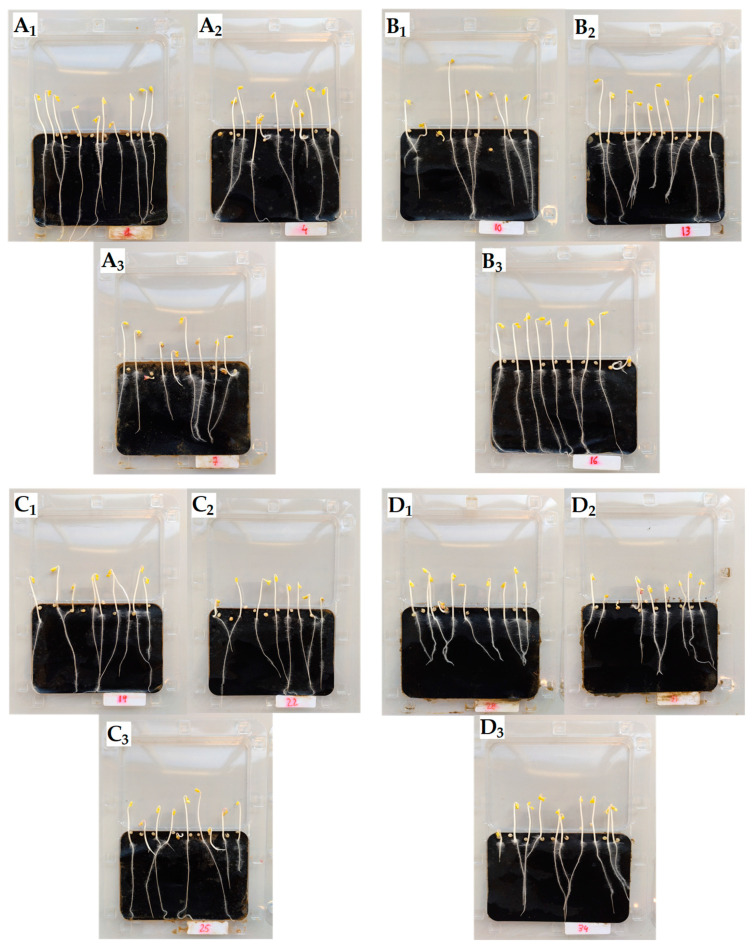
Globally, cadmium (Cd) is one of the metals that causes the most significant problems of contamination in agricultural soils and toxicity in living organisms. In this study, the ability of three different nanoparticles (dose 3% /) (hydroxyapatite (HANPs), maghemite (MNPs), or zero-valent iron (FeNPs)) to decrease the availability of Cd in artificially contaminated agricultural soil was investigated. The effect of Cd and nanoparticles on germination and early growth of L. was also assessed by tolerance/toxicity bioassays. The available Cd contents in the contaminated soil decreased after treatment with the nanoparticles (available Cd decreased with HANPs: >96.9%, MNPs: >91.9%, FeNPs: >94%), indicating that these nanoparticles are highly efficient for the fixation of available Cd. The toxicity/tolerance bioassays showed different behavior for each nanoparticle. The HANPs negatively affected germination (G(%): 20% worsening compared to control soil), early root growth (G: -27.7% compared to control soil), and aerial parts (Ap: -12%) of , but showed positive effects compared to Cd-contaminated soils (G: +8-11%; Ap: +26-47%). MNP treatment in Cd-contaminated soils had a positive effect on germination (G(%): 6-10% improvement) and early growth of roots (G: +16%) and aerial parts (Ap: +16-19%). The FeNPs had a positive influence on germination (G(%): +10%) and growth of aerial parts (Ap: +12-16%) but not on early growth of roots (G: 0%). These nanoparticles can be used to reduce highly available Cd contents in contaminated soils, but MNPs and FeNPs showed the most favorable effects on the early growth and germination of .
在全球范围内,镉(Cd)是导致农业土壤污染问题最为严重且对生物体具有毒性的金属之一。在本研究中,研究了三种不同的纳米颗粒(剂量3%/)(羟基磷灰石(HANPs)、磁赤铁矿(MNPs)或零价铁(FeNPs))降低人工污染农业土壤中镉有效性的能力。还通过耐受性/毒性生物测定评估了镉和纳米颗粒对生菜发芽和早期生长的影响。用纳米颗粒处理后,污染土壤中有效镉含量降低(HANPs处理后有效镉降低:>96.9%,MNPs:>91.9%,FeNPs:>94%),表明这些纳米颗粒对固定有效镉非常有效。毒性/耐受性生物测定显示每种纳米颗粒的行为不同。HANPs对生菜的发芽(发芽率(G(%)):与对照土壤相比恶化20%)、早期根系生长(G:与对照土壤相比-27.7%)和地上部分(Ap:-12%)有负面影响,但与镉污染土壤相比显示出积极影响(G:+8-11%;Ap:+26-47%)。在镉污染土壤中进行MNP处理对发芽(发芽率(G(%)):提高6-10%)以及根系(G:+16%)和地上部分(Ap:+16-19%)的早期生长有积极影响。FeNPs对发芽(发芽率(G(%)):+10%)和地上部分生长(Ap:+12-16%)有积极影响,但对根系早期生长(G:0%)没有影响。这些纳米颗粒可用于降低污染土壤中高有效性的镉含量,但MNPs和FeNPs对生菜的早期生长和发芽显示出最有利的影响。