Nick Gilbert A, Williams Sharifa, Lekas Helen-Maria, Pahl Kerstin, Blau Chloe, Kamin Don, Fuller-Lewis Crystal
Nathan S. Kline Institute for Psychiatric Research, Division of Social Solutions & Services Research, Orangeburg, NY.
City University of New York, The Graduate Center, New York, NY.
Drug Alcohol Depend Rep. 2022 Sep 29;5:100099. doi: 10.1016/j.dadr.2022.100099. eCollection 2022 Dec.
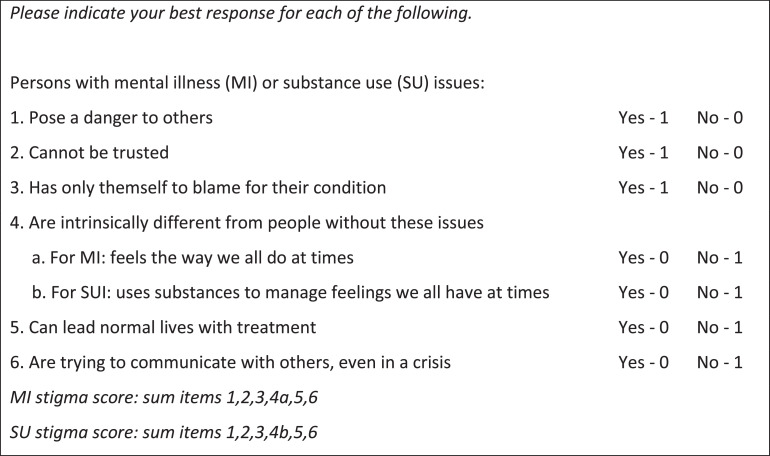
Limited empirical data and research exists about stigmatizing attitudes and perceptions held by law enforcement officers towards persons with mental illness and substance use issues. Pre- and post-training survey data from 92 law enforcement personnel who attended a 40-hour Crisis Intervention Team (CIT) training was used to investigate training-related changes in mental illness stigma and substance use stigma. Training participant's mean age was 38.35 ± 9.50 years, majority white non-Hispanic race/ethnicity (84.2%), male gender (65.2%), and reported job category as road patrol (86.9%). Pre-training, 76.1% endorsed at least one stigmatizing attitude towards people with mental illness, and 83.7% held a stigmatizing attitude towards those with substance use problems. Poisson regression revealed that working road patrol (RR=0.49, <0.05), awareness of community resources (RR=0.66, <0.05), and higher levels of self-efficacy (RR=0.92, <0.05) were associated with lower mental illness stigma pre-training. Knowledge of communication strategies (RR=0.65, <0.05) was associated with lower pre-training substance use stigma. Post-training, improvement in knowledge of community resources and increases in self-efficacy were significantly associated with decreases in both mental illness and substance use stigma. These findings highlight the existence of stigma related to both mental illness and substance use pre-training suggesting the need for implicit and explicit bias training prior to the start of active law enforcement duty. These data are consistent with prior reports indicating CIT trainings as a path to address mental illness and substance use stigma. Further research on effects of stigmatizing attitudes and additional stigma-specific training content is warranted.
关于执法人员对患有精神疾病和物质使用问题者的污名化态度和认知,现有的实证数据和研究有限。来自92名参加了40小时危机干预小组(CIT)培训的执法人员的培训前和培训后调查数据,被用于调查与培训相关的精神疾病污名和物质使用污名的变化。培训参与者的平均年龄为38.35±9.50岁,大多数为非西班牙裔白人种族/族裔(84.2%),男性(65.2%),报告的工作类别为道路巡逻(86.9%)。培训前,76.1%的人认可至少一种对患有精神疾病者的污名化态度,83.7%的人对有物质使用问题者持有污名化态度。泊松回归显示,从事道路巡逻工作(RR=0.49,<0.05)、对社区资源的了解(RR=0.66,<0.05)以及较高的自我效能感水平(RR=0.92,<0.05)与培训前较低的精神疾病污名相关。沟通策略知识(RR=0.65,<0.05)与培训前较低的物质使用污名相关。培训后,社区资源知识的改善和自我效能感的提高与精神疾病和物质使用污名的减少显著相关。这些发现凸显了培训前存在与精神疾病和物质使用相关的污名,表明在积极执法工作开始前需要进行隐性和显性偏见培训。这些数据与之前的报告一致,表明CIT培训是解决精神疾病和物质使用污名的一条途径。有必要对污名化态度的影响和其他特定于污名的培训内容进行进一步研究。