Sekel Nicole M, Beckner Meaghan E, Conkright William R, LaGoy Alice D, Proessl Felix, Lovalekar Mita, Martin Brian J, Jabloner Leslie R, Beck Alaska L, Eagle Shawn R, Dretsch Michael, Roma Peter G, Ferrarelli Fabio, Germain Anne, Flanagan Shawn D, Connaboy Christopher, Haufler Amy J, Nindl Bradley C
Neuromuscular Research Laboratory, Warrior Human Performance Research Center, University of Pittsburgh, Pittsburgh, PA, United States.
Military Sleep Tactics and Resilience Research Team, Department of Psychiatry, School of Medicine, University of Pittsburgh, Pittsburgh, PA, United States.
Front Psychol. 2023 Feb 8;14:1102425. doi: 10.3389/fpsyg.2023.1102425. eCollection 2023.
Laboratory-based studies designed to mimic combat or military field training have consistently demonstrated deleterious effects on warfighter's physical, cognitive, and emotional performance during simulated military operational stress (SMOS).
The present investigation sought to determine the impact of a 48-h simulated military operational stress (SMOS) on military tactical adaptive decision making, and the influence of select psychological, physical performance, cognitive, and physiological outcome measures on decision making performance.
Male ( = 48, 26.2 ± 5.5 years, 177.7 ± 6.6 cm, 84.7 ± 14.1 kg.) subjects currently serving in the U.S. military were eligible to participate in this study. Eligible subjects completed a 96-h protocol that occurred over five consecutive days and four nights. Day 2 (D2) and day 3 (D3) consisted of 48-h of SMOS wherein sleep opportunity and caloric needs were reduced to 50%. Differences in SPEAR total block score from baseline to peak stress (D3 minus D1) were calculated to assess change in military tactical adaptive decision making and groups were stratified based on increase (high adaptors) or decrease (low adaptors) of the SPEAR change score.
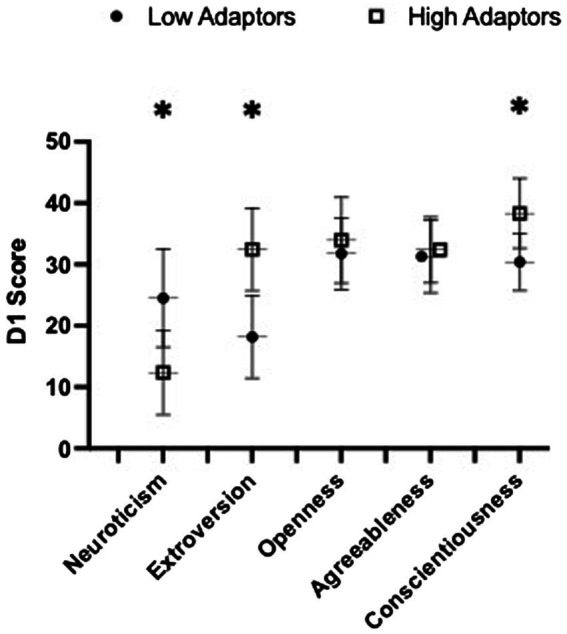
Overall, military tactical decision-making declined 1.7% from D1 to D3 ( < 0.001). High adaptors reported significantly higher scores of aerobic capacity ( < 0.001), self-report resilience ( = 0.020), extroversion ( < 0.001), and conscientiousness ( < 0.001). at baseline compared to low adaptors, while low adaptors reported greater scores in Neuroticism ( < 0.001).
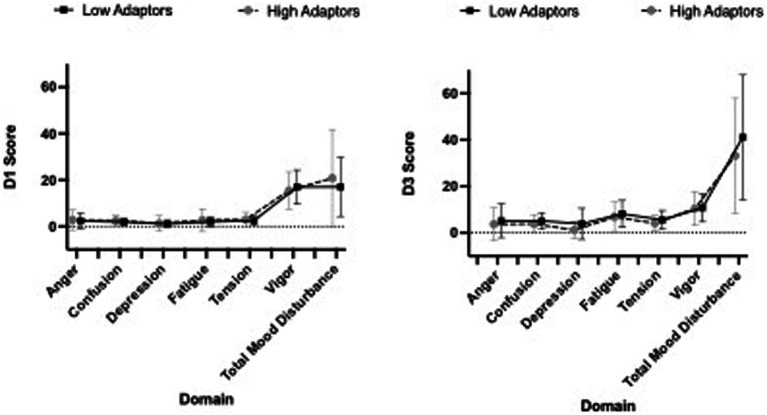
The present findings suggest that service members whose adaptive decision making abilities improved throughout SMOS (i.e., high adaptors) demonstrated better baseline psychological/self-reported resilience and aerobic capacity. Further, changes in adaptive decision-making were distinct from those of lower order cognitive functions throughout SMOS exposure. With the transition of future military conflicts placing higher priority on enhancing and sustaining cognitive readiness and resiliency, data presented here demonstrates the importance of measuring and categorizing baseline measures inherent to military personnel, in order to change and train one's ability to suffer less of a decline during high stress conditions.
旨在模拟战斗或军事野外训练的实验室研究一直表明,在模拟军事行动压力(SMOS)期间,对战士的身体、认知和情绪表现会产生有害影响。
本研究旨在确定48小时模拟军事行动压力(SMOS)对军事战术适应性决策的影响,以及选定的心理、身体表现、认知和生理结果指标对决策表现的影响。
目前在美国军队服役的男性(n = 48,26.2±5.5岁,177.7±6.6厘米,84.7±14.1千克)受试者有资格参加本研究。符合条件的受试者完成了一项为期96小时的方案,该方案持续五天四夜。第2天(D2)和第3天(D3)包括48小时的SMOS,其中睡眠机会和热量需求减少到50%。计算从基线到压力峰值(D3减去D1)的SPEAR总分块得分差异,以评估军事战术适应性决策的变化,并根据SPEAR变化得分的增加(高适应者)或减少(低适应者)对组进行分层。
总体而言,从D1到D3,军事战术决策下降了1.7%(P < 0.001)。与低适应者相比,高适应者在基线时报告的有氧能力得分显著更高(P < 0.001)、自我报告的恢复力得分(P = 0.020)、外向性得分(P < 0.001)和尽责性得分(P < 0.001)。而低适应者在神经质方面的得分更高(P < 0.001)。
本研究结果表明,在整个SMOS期间适应性决策能力得到改善的服役人员(即高适应者)表现出更好的基线心理/自我报告的恢复力和有氧能力。此外,在整个SMOS暴露期间,适应性决策的变化与较低级认知功能的变化不同。随着未来军事冲突的转变,将更高的优先级放在增强和维持认知准备和恢复力上,此处呈现的数据表明了测量和分类军事人员固有基线指标的重要性,以便改变和训练个人在高压力条件下减少下降的能力。