Rubatto Marco, Sciamarrelli Nadia, Borriello Silvia, Pala Valentina, Mastorino Luca, Tonella Luca, Ribero Simone, Quaglino Pietro
Department of Medical Sciences, Dermatologic Clinic, University of Turin, Torino, Italy.
Front Med (Lausanne). 2023 Feb 9;9:959289. doi: 10.3389/fmed.2022.959289. eCollection 2022.
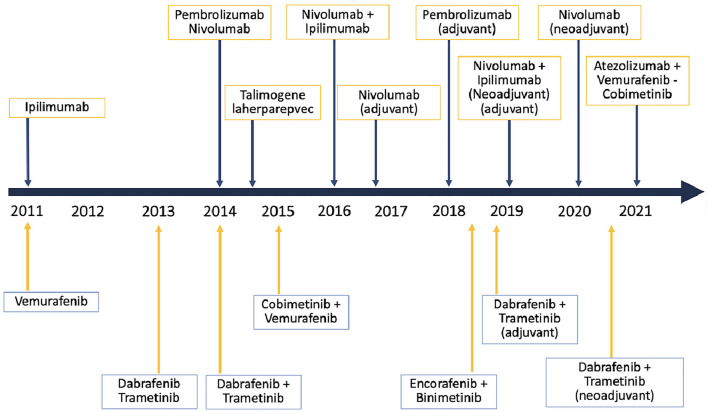
Advanced melanoma and non-melanoma skin cancers (NMSCs) are burdened with a dismal prognosis. To improve the survival of these patients, studies on immunotherapy and target therapies in melanoma and NMSCs are rapidly increasing. BRAF and MEK inhibitors improve clinical outcomes, and anti-PD1 therapy demonstrates better results than chemotherapy or anti-CTLA4 therapy in terms of the survival of patients with advanced melanoma. In recent years, the combination therapy of nivolumab plus ipilimumab has gained ground in studies for its survival and response rate benefits in patients with advanced melanoma. In addition, neoadjuvant treatment for stages III and IV melanoma, either as monotherapy or combination therapy, has recently been discussed. Another promising strategy evaluated in recent studies is the triple combination of anti-PD-1/PD-L1 immunotherapy and anti-BRAF plus anti-MEK targeted therapy. On the contrary, in advanced and metastatic BCC, successful therapeutic strategies, such as vismodegib and sonidegib, are based on the inhibition of aberrant activation of the Hedgehog signaling pathway. In these patients, anti-PD-1 therapy with cemiplimab should be reserved as the second-line therapy in case of disease progression or poor response. In patients with locally advanced or metastatic SCC, who are not candidates for surgery or radiotherapy, anti-PD1 agents such as cemiplimab, pembrolizumab, and cosibelimab (CK-301) have shown significant results in terms of response rate. PD-1/PD-L1 inhibitors, such as avelumab, have also been used in Merkel carcinoma, achieving responses in half of the patients with advanced disease. The latest prospect emerging for MCC is the locoregional approach involving the injection of drugs that can stimulate the immune system. Two of the most promising molecules used in combination with immunotherapy are cavrotolimod (a Toll-like receptor 9 agonist) and a Toll-like receptor 7/8 agonist. Another area of study is cellular immunotherapy with natural killer cells stimulated with an IL-15 analog or CD4/CD8 cells stimulated with tumor neoantigens. Neoadjuvant treatment with cemiplimab in CSCCs and nivolumab in MCCs has shown promising results. Despite the successes of these new drugs, the new challenges ahead will be to select patients who will benefit from these treatments based on biomarkers and parameters of the tumor microenvironment.
晚期黑色素瘤和非黑色素瘤皮肤癌(NMSC)预后不佳。为提高这些患者的生存率,黑色素瘤和NMSC的免疫治疗及靶向治疗研究正在迅速增加。BRAF和MEK抑制剂可改善临床结局,在晚期黑色素瘤患者的生存率方面,抗PD1治疗比化疗或抗CTLA4治疗效果更好。近年来,纳武单抗加伊匹单抗的联合治疗因其在晚期黑色素瘤患者中的生存和缓解率优势在研究中得到广泛应用。此外,近期还讨论了III期和IV期黑色素瘤的新辅助治疗,包括单药治疗或联合治疗。近期研究评估的另一个有前景的策略是抗PD-1/PD-L1免疫治疗与抗BRAF加抗MEK靶向治疗的三联组合。相反,在晚期和转移性基底细胞癌中,维莫德吉和索尼德吉等成功的治疗策略基于对Hedgehog信号通路异常激活的抑制。在这些患者中,疾病进展或反应不佳时,西米普利单抗抗PD-1治疗应留作二线治疗。在不适合手术或放疗的局部晚期或转移性鳞状细胞癌患者中,西米普利单抗、帕博利珠单抗和考西贝利单抗(CK-301)等抗PD1药物在缓解率方面显示出显著效果。阿维鲁单抗等PD-1/PD-L1抑制剂也已用于默克尔细胞癌,使一半的晚期疾病患者获得缓解。默克尔细胞癌最新出现的前景是局部区域治疗方法,包括注射可刺激免疫系统的药物。与免疫治疗联合使用的两个最有前景的分子是卡沃托利莫德(一种Toll样受体9激动剂)和一种Toll样受体7/8激动剂。另一个研究领域是用IL-15类似物刺激的自然杀伤细胞或用肿瘤新抗原刺激的CD4/CD8细胞进行细胞免疫治疗。西米普利单抗用于皮肤鳞状细胞癌和纳武单抗用于默克尔细胞癌的新辅助治疗已显示出有前景的结果。尽管这些新药取得了成功,但未来新的挑战将是根据生物标志物和肿瘤微环境参数选择能从这些治疗中获益的患者。