Pascal Virginie, Dupont Marine, de Rouault Paco, Rizzo David, Rossille Delphine, Jeannet Robin, Daix Thomas, François Bruno, Genebrier Steve, Cornic Marie, Monneret Guillaume, Venet Fabienne, Ferrant Juliette, Roussel Mikael, Reizine Florian, Le Souhaitier Mathieu, Tadié Jean-Marc, Tarte Karin, Feuillard Jean, Cogné Michel
CNRS UMR-7276, INSERM U1262, Team 3 BioPIC of CRIBL, University of Limoges, and Immunology Laboratory of Dupuytren Hospital University Center (CHU) of Limoges, Limoges, France.
CNRS UMR-7276, INSERM U1262, Team 1 2MB2C of CRIBL, University of Limoges, and Hematology Laboratory of Dupuytren Hospital University Center (CHU) of Limoges, Limoges, France.
iScience. 2023 Mar 17;26(3):106260. doi: 10.1016/j.isci.2023.106260. Epub 2023 Feb 21.
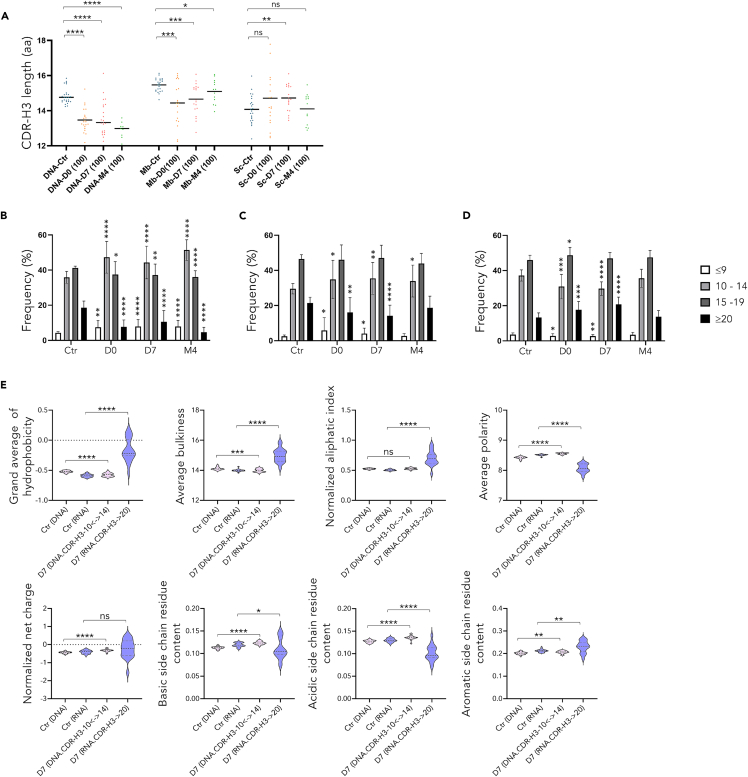
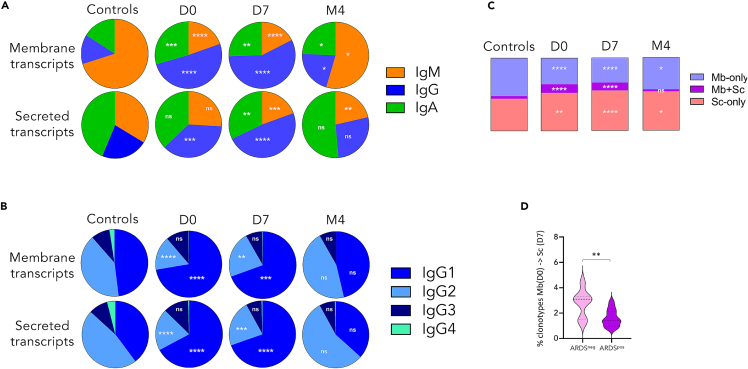
To understand the fine differential elements that can lead to or prevent acute respiratory distress syndrome (ARDS) in COVID-19 patients, it is crucial to investigate the immune response architecture. We herein dissected the multiple layers of B cell responses by flow cytometry and Ig repertoire analysis from acute phase to recovery. Flow cytometry with FlowSOM analysis showed major changes associated with COVID-19 inflammation such as an increase of double-negative B-cells and ongoing plasma cell differentiation. This paralleled COVID-19-driven expansion of two disconnected B-cell repertoires. Demultiplexing successive DNA and RNA Ig repertoire patterns characterized an early expansion of IgG1 clonotypes with atypically long and uncharged CDR3, the abundance of this inflammatory repertoire being correlated with ARDS and likely pejorative. A superimposed convergent response included convergent anti-SARS-CoV-2 clonotypes. It featured progressively increasing somatic hypermutation together with normal-length or short CDR3 and it persisted until a quiescent memory B-cell stage after recovery.
为了解导致或预防COVID-19患者发生急性呼吸窘迫综合征(ARDS)的细微差异因素,研究免疫反应结构至关重要。我们在此通过流式细胞术和Ig库分析,剖析了从急性期到恢复期B细胞反应的多个层面。采用FlowSOM分析的流式细胞术显示,与COVID-19炎症相关的主要变化,如双阴性B细胞增加和浆细胞持续分化。这与COVID-19驱动的两个不连续B细胞库的扩增平行。对连续的DNA和RNA Ig库模式进行解复用分析,发现具有非典型长且无电荷CDR3的IgG1克隆型早期扩增,这种炎症库的丰度与ARDS相关且可能预后不良。叠加的趋同反应包括趋同的抗SARS-CoV-2克隆型。其特征是体细胞超突变逐渐增加,同时CDR3长度正常或较短,并且这种反应一直持续到恢复后的静止记忆B细胞阶段。