Simnica Donjete, Schultheiß Christoph, Mohme Malte, Paschold Lisa, Willscher Edith, Fitzek Antonia, Püschel Klaus, Matschke Jakob, Ciesek Sandra, Sedding Daniel G, Zhao Yu, Gagliani Nicola, Maringer Yacine, Walz Juliane S, Heide Janna, Schulze-Zur-Wiesch Julian, Binder Mascha
Department of Internal Medicine IV Oncology/Hematology Martin-Luther-University Halle-Wittenberg Halle (Saale) Germany.
Department of Neurosurgery University Medical Center Hamburg-Eppendorf (UKE) Hamburg Germany.
Clin Transl Immunology. 2021 Aug 28;10(9):e1340. doi: 10.1002/cti2.1340. eCollection 2021.
T cells have an essential role in the antiviral defence. Public T-cell receptor (TCR) clonotypes are expanded in a substantial proportion of COVID-19 patients. We set out to exploit their potential use as read-out for COVID-19 T-cell immune responses.
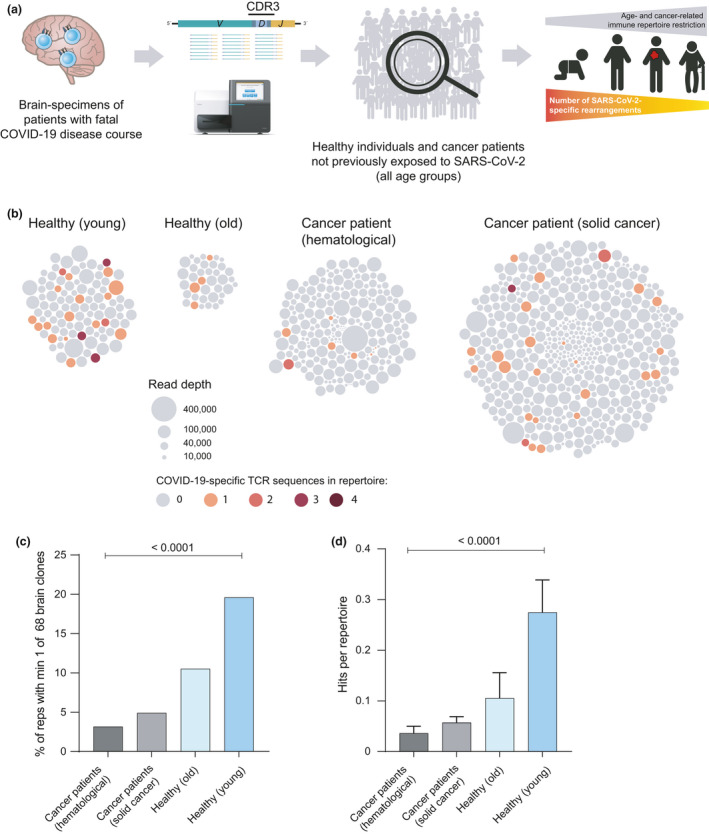
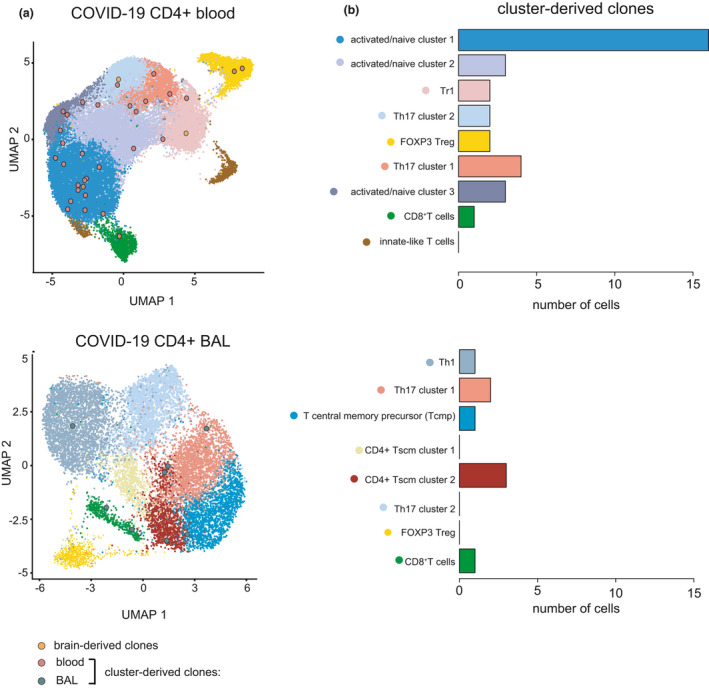
We searched for COVID-19-associated T-cell clones with public TCRs, as defined by identical complementarity-determining region 3 (CDR3) beta chain amino acid sequence that can be reproducibly detected in the blood of COVID-19 patients. Of the different clonotype identification algorithms used in this study, deep sequencing of brain tissue of five patients with fatal COVID-19 delivered 68 TCR clonotypes with superior representation across 140 immune repertoires of unrelated COVID-19 patients.
Mining of immune repertoires from subjects not previously exposed to the virus showed that these clonotypes can be found in almost 20% of pre-pandemic immune repertoires of healthy subjects, with lower representation in repertoires from risk groups like individuals above the age of 60 years or patients with cancer.
Together, our data show that at least a proportion of the SARS-CoV-2 T-cell response is mediated by public TCRs that are present in repertoires of unexposed individuals. The lower representation of these clones in repertoires of risk groups or failure to expand such clones may contribute to more unfavorable clinical COVID-19 courses.
T细胞在抗病毒防御中起关键作用。在相当一部分新冠病毒疾病(COVID-19)患者中,公共T细胞受体(TCR)克隆型会扩增。我们试图利用它们作为COVID-19 T细胞免疫反应的读出指标。
我们寻找具有公共TCR的与COVID-19相关的T细胞克隆,其定义为互补决定区3(CDR3)β链氨基酸序列相同,且能在COVID-19患者血液中重复检测到。在本研究中使用的不同克隆型鉴定算法中,对五名死于COVID-19的患者的脑组织进行深度测序,得到了68种TCR克隆型,在140个无关COVID-19患者的免疫组库中具有更高的代表性。
对先前未接触过该病毒的受试者的免疫组库进行挖掘发现,这些克隆型在健康受试者大流行前免疫组库中近20%中可被发现,在60岁以上个体或癌症患者等风险群体的免疫组库中代表性较低。
总之,我们的数据表明,至少一部分严重急性呼吸综合征冠状病毒2(SARS-CoV-2)T细胞反应是由未接触过病毒个体免疫组库中存在的公共TCR介导的。这些克隆型在风险群体免疫组库中的低代表性或未能扩增此类克隆可能导致COVID-19临床病程更不利。