Prins Philip J, Noakes Timothy D, Buga Alex, D'Agostino Dominic P, Volek Jeff S, Buxton Jeffrey D, Heckman Kara, Jones Dalton W, Tobias Naomi E, Grose Holly M, Jenkins Anna K, Jancay Kelli T, Koutnik Andrew P
Department of Exercise Science, Grove City College, Grove City, PA, United States.
Department of Medical and Wellness Science, Cape Peninsula University of Technology, Cape Town, South Africa.
Front Nutr. 2023 Feb 9;10:1084021. doi: 10.3389/fnut.2023.1084021. eCollection 2023.
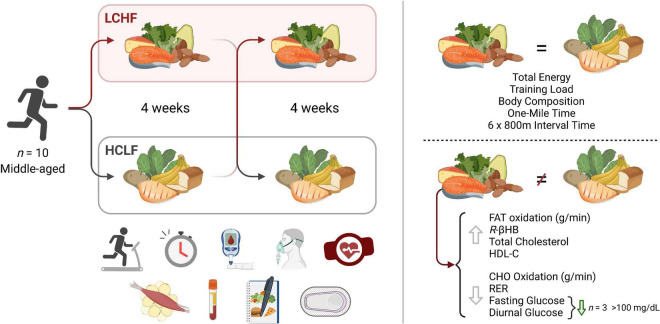
High carbohydrate, low fat (HCLF) diets have been the predominant nutrition strategy for athletic performance, but recent evidence following multi-week habituation has challenged the superiority of HCLF over low carbohydrate, high fat (LCHF) diets, along with growing interest in the potential health and disease implications of dietary choice. Highly trained competitive middle-aged athletes underwent two 31-day isocaloric diets (HCLF or LCHF) in a randomized, counterbalanced, and crossover design while controlling calories and training load. Performance, body composition, substrate oxidation, cardiometabolic, and 31-day minute-by-minute glucose (CGM) biomarkers were assessed. We demonstrated: (i) equivalent high-intensity performance (@∼85%VO), fasting insulin, hsCRP, and HbA without significant body composition changes across groups; (ii) record high peak fat oxidation rates (LCHF:1.58 ± 0.33g/min @ 86.40 ± 6.24%VO; 30% subjects > 1.85 g/min); (iii) higher total, LDL, and HDL cholesterol on LCHF; (iv) reduced glucose mean/median and variability on LCHF. We also found that the 31-day mean glucose on HCLF predicted 31-day glucose reductions on LCHF, and the 31-day glucose reduction on LCHF predicted LCHF peak fat oxidation rates. Interestingly, 30% of athletes had 31-day mean, median and fasting glucose > 100 mg/dL on HCLF (range: 111.68-115.19 mg/dL; consistent with pre-diabetes), also had the largest glycemic and fat oxidation response to carbohydrate restriction. These results: (i) challenge whether higher carbohydrate intake is superior for athletic performance, even during shorter-duration, higher-intensity exercise; (ii) demonstrate that lower carbohydrate intake may be a therapeutic strategy to independently improve glycemic control, particularly in those at risk for diabetes; (iii) demonstrate a unique relationship between continuous glycemic parameters and systemic metabolism.
高碳水化合物、低脂肪(HCLF)饮食一直是提高运动表现的主要营养策略,但最近多项研究发现,在数周的适应性训练后,HCLF饮食并不比低碳水化合物、高脂肪(LCHF)饮食更具优势,人们也越来越关注饮食选择对健康和疾病的潜在影响。训练有素的中年竞技运动员采用随机、平衡和交叉设计,接受两种为期31天的等热量饮食(HCLF或LCHF),同时控制热量和训练负荷。评估了运动表现、身体成分、底物氧化、心脏代谢以及31天逐分钟血糖(CGM)生物标志物。我们的研究结果表明:(i)在高强度运动表现(约85%VO₂)、空腹胰岛素、超敏C反应蛋白(hsCRP)和糖化血红蛋白(HbA)方面,两组相当,且身体成分无显著变化;(ii)LCHF组的峰值脂肪氧化率创历史新高(LCHF组:在86.40±6.24%VO₂时为1.58±0.33克/分钟;30%的受试者>1.85克/分钟);(iii)LCHF组的总胆固醇、低密度脂蛋白胆固醇和高密度脂蛋白胆固醇水平更高;(iv)LCHF组的葡萄糖均值/中位数和变异性降低。我们还发现,HCLF组的31天平均血糖可预测LCHF组的31天血糖降低情况,而LCHF组的31天血糖降低情况可预测LCHF组的峰值脂肪氧化率。有趣的是,30%的运动员在HCLF饮食下的31天平均、中位数和空腹血糖>100毫克/分升(范围:111.68 - 115.19毫克/分升;符合糖尿病前期),他们对碳水化合物限制的血糖和脂肪氧化反应也最大。这些结果:(i)对高碳水化合物摄入是否对运动表现更具优势提出了质疑,即使是在短时间、高强度运动期间;(ii)表明较低的碳水化合物摄入量可能是一种独立改善血糖控制的治疗策略,特别是对有糖尿病风险的人群;(iii)揭示了连续血糖参数与全身代谢之间的独特关系。