Norwitz Nicholas G, Feldman David, Soto-Mota Adrian, Kalayjian Tro, Ludwig David S
Harvard Medical School, Boston, MA, USA.
Citizen Science Foundation, Las Vegas, NV, USA.
Curr Dev Nutr. 2021 Nov 30;6(1):nzab144. doi: 10.1093/cdn/nzab144. eCollection 2022 Jan.
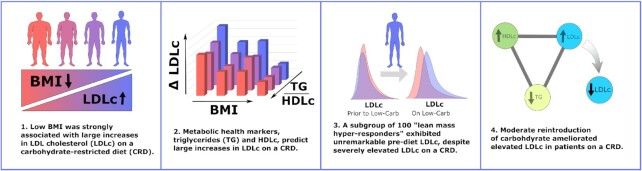
People commencing a carbohydrate-restricted diet (CRD) experience markedly heterogenous responses in LDL cholesterol, ranging from extreme elevations to reductions.
The aim was to elucidate possible sources of heterogeneity in LDL cholesterol response to a CRD and thereby identify individuals who may be at risk for LDL cholesterol elevation.
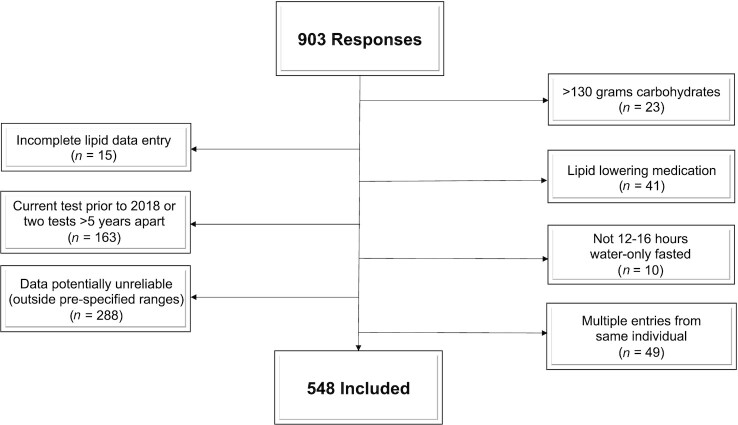
Hypothesis-naive analyses were conducted on web survey data from 548 adults consuming a CRD. Univariate and multivariate regression models and regression trees were built to evaluate the interaction between body mass index (BMI) and baseline lipid markers. Data were also collected from a case series of five clinical patients with extremely high LDL cholesterol consuming a CRD.
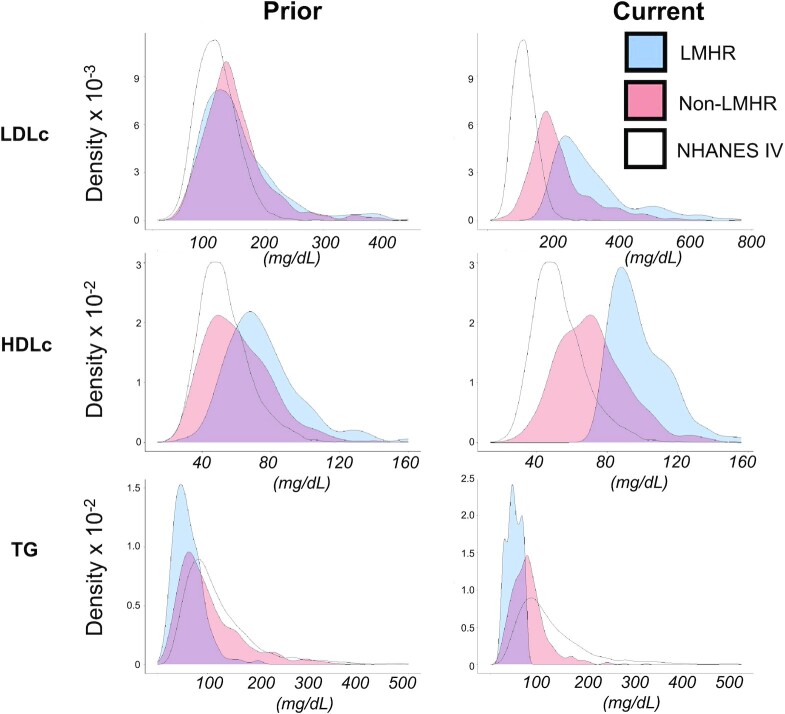
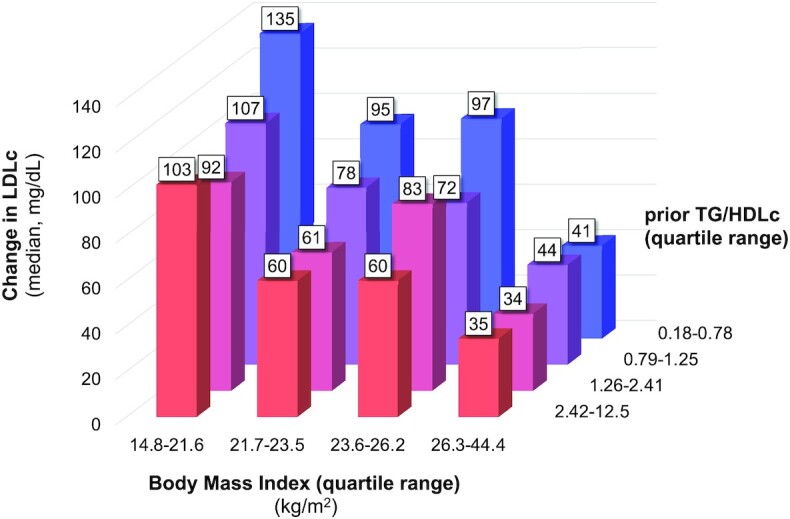
BMI was inversely associated with LDL cholesterol change. Low triglyceride (TG) to HDL cholesterol ratio, a marker of good metabolic health, predicted larger LDL cholesterol increases. A subgroup of respondents with LDL cholesterol ≥200 mg/dL, HDL cholesterol ≥80 mg/dL, and TG ≤70 mg/dL were characterized as "lean mass hyper-responders." Respondents with this phenotype ( = 100) had a lower BMI and, remarkably, similar prior LDL cholesterol versus other respondents. In the case series, moderate reintroduction of carbohydrate produced a marked decrease in LDL cholesterol.
These data suggest that, in contrast to the typical pattern of dyslipidemia, greater LDL cholesterol elevation on a CRD tends to occur in the context of otherwise low cardiometabolic risk.
开始采用碳水化合物限制饮食(CRD)的人群在低密度脂蛋白胆固醇(LDL胆固醇)方面表现出明显的异质性反应,范围从极度升高到降低。
旨在阐明对CRD的LDL胆固醇反应异质性的可能来源,从而识别可能有LDL胆固醇升高风险的个体。
对548名采用CRD的成年人的网络调查数据进行无先验假设分析。构建单变量和多变量回归模型以及回归树,以评估体重指数(BMI)与基线血脂指标之间的相互作用。还从一组五例食用CRD且LDL胆固醇极高的临床患者病例系列中收集了数据。
BMI与LDL胆固醇变化呈负相关。低甘油三酯(TG)与高密度脂蛋白胆固醇比值是良好代谢健康的指标,可预测LDL胆固醇升高幅度更大。LDL胆固醇≥200mg/dL、高密度脂蛋白胆固醇≥80mg/dL且TG≤70mg/dL的一组受访者被归类为“瘦体重高反应者”。具有这种表型的受访者(n = 100)BMI较低,且与其他受访者相比,之前的LDL胆固醇水平明显相似。在病例系列中,适度重新引入碳水化合物可使LDL胆固醇显著降低。
这些数据表明,与典型的血脂异常模式相反,CRD导致的LDL胆固醇升高幅度更大往往发生在心脏代谢风险原本较低的情况下。