Zhao Bo, Kim Ji Eon, Moon Jiyoung, Nam Eun Woo
Department of Health Administration, Graduate School, Yonsei University, 1 Yonseidae-gil, Wonju, Gangwon-do, South Korea.
Yonsei Global Health Center, Yonsei University, 1 Yonseidae-gil, Wonju, Gangwon-do, South Korea.
SSM Popul Health. 2023 Jan 13;21:101341. doi: 10.1016/j.ssmph.2023.101341. eCollection 2023 Mar.
Social engagement serves as the foundation for social connections by providing a sense of belonging, social identity, and fulfillment. Previous studies have mainly focused on the one-way relationship between social engagement and subjective health among older individuals, and little attention has been paid to their mutual relationship. Therefore, this study aimed to examine the mutual association relationship between social engagement and their subjective health in older Koreans.
Seven waves of data samples (aged ≥60 years) from 2006 to 2018 from the Korean Longitudinal Study of Aging (KLoSA) was used in this study. Descriptive analysis, chi-squared tests, 2-year lagged Generalized estimating equation (GEE) model, and cross-lagged panel model were performed to investigate the mutual association between social engagement and subjective health among six survey periods.
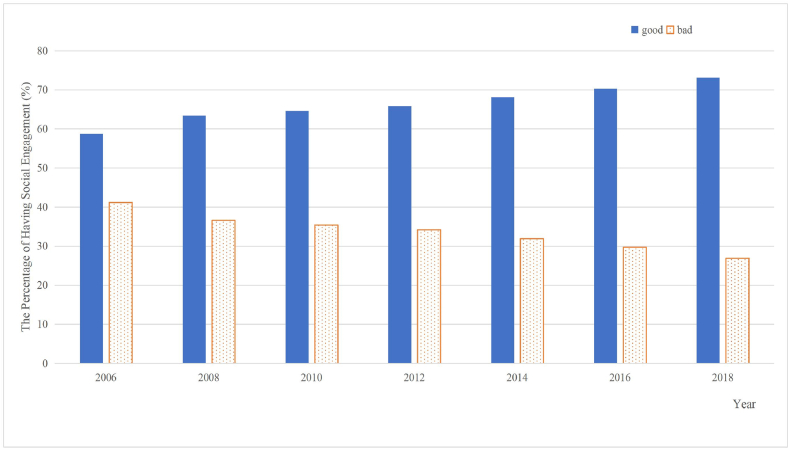
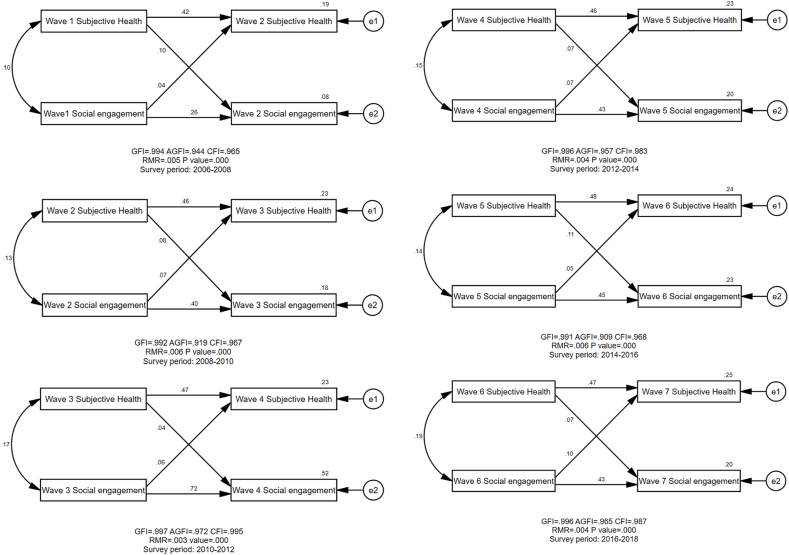
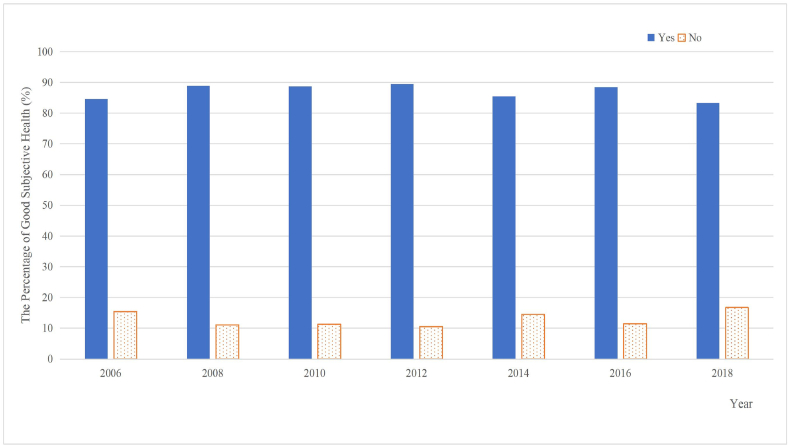
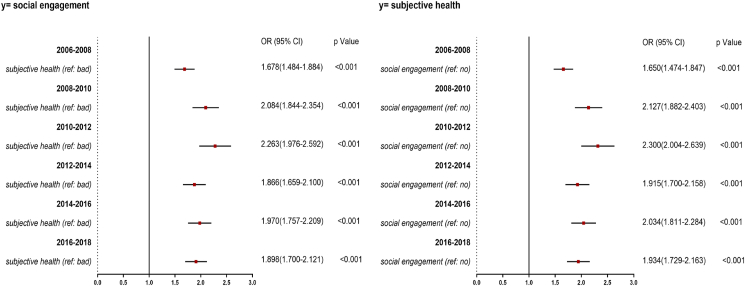
Results of the GEE model revealed when controlling for other variables, older Koreans who reported good subjective health only had a higher OR (1.678 vs. 1.650, p < 0.001) of participating in social engagement than those who had bad subjective health in 2006-2008 period; the occurrence rate of more social engagement was significantly higher among older adults with good subjective health than among those with bad subjective health (five out six survey periods). Cross-lagged analysis showed similar results that coefficients of social engagement on subjective were relatively larger in three survey periods; coefficients of subjective health on social engagement were relatively larger in the other three survey periods. The impact of social engagement on subjective health might be greater than that of subjective health on social engagement.
All-around participation and engagement of older people in society have become a consensus among the international community. In view of the single social engagement activities and less relevant participation channels in Korea, government departments should consider not only regional but also local characteristics to create more social participation opportunities for older individuals.
社会参与通过提供归属感、社会认同感和成就感,成为社会联系的基础。以往的研究主要集中在老年人社会参与和主观健康之间的单向关系上,而对它们之间的相互关系关注较少。因此,本研究旨在探讨韩国老年人社会参与和主观健康之间的相互关联关系。
本研究使用了韩国老年纵向研究(KLoSA)2006年至2018年七轮数据样本(年龄≥60岁)。进行描述性分析、卡方检验、两年滞后广义估计方程(GEE)模型和交叉滞后面板模型,以研究六个调查期内社会参与和主观健康之间的相互关联。
GEE模型结果显示,在控制其他变量时,2006 - 2008年期间,主观健康状况良好的韩国老年人参与社会参与的OR值(1.678对1.650,p < 0.001)高于主观健康状况较差的老年人;主观健康状况良好的老年人中社会参与度更高的发生率在六个调查期中有五个显著高于主观健康状况较差的老年人。交叉滞后分析显示了类似的结果,即社会参与对主观健康的系数在三个调查期相对较大;主观健康对社会参与的系数在其他三个调查期相对较大。社会参与对主观健康的影响可能大于主观健康对社会参与的影响。
老年人全面参与社会已成为国际社会的共识。鉴于韩国社会参与活动单一且相关参与渠道较少,政府部门应兼顾地区和地方特色,为老年人创造更多社会参与机会。