Wang Qiong, Zhang Na, Bai Xue, Liu Jianhua, Bi Xiaobao, Tan Yonghong
Department of Anesthesiology, Guangzhou Women and Children's Medical Center, Guangdong Provincial Clinical Research Center for Child Health, Guangzhou, China.
Ann Transl Med. 2023 Feb 15;11(3):153. doi: 10.21037/atm-22-6639. Epub 2023 Feb 10.
Dexmedetomidine (Dex) is associated with several biological processes. Ischemic stroke has the characteristics of high morbidity and mortality. Herein, we aimed to explore whether Dex ameliorates ischemia-induced injury and determine its mechanism.
Real-time quantitative polymerase chain reaction (qRT-PCR) and western blotting were used to measure gene and protein expression. Cellular viability and proliferation were assessed by Cell Counting Kit-8 (CCK-8) and 5-ethynyl-2'-deoxyuridine (EdU) assays, respectively. Cell apoptosis was detected by flow cytometry. An oxygen-glucose deprivation/reoxygenation model of SK-N-SH and SH-SY5Y cells was constructed. A middle cerebral artery occlusion (MCAO) model was also built to assess Dex function . Neuronal function was assessed using the Bederson Behavior Score and Longa Behavior Score.
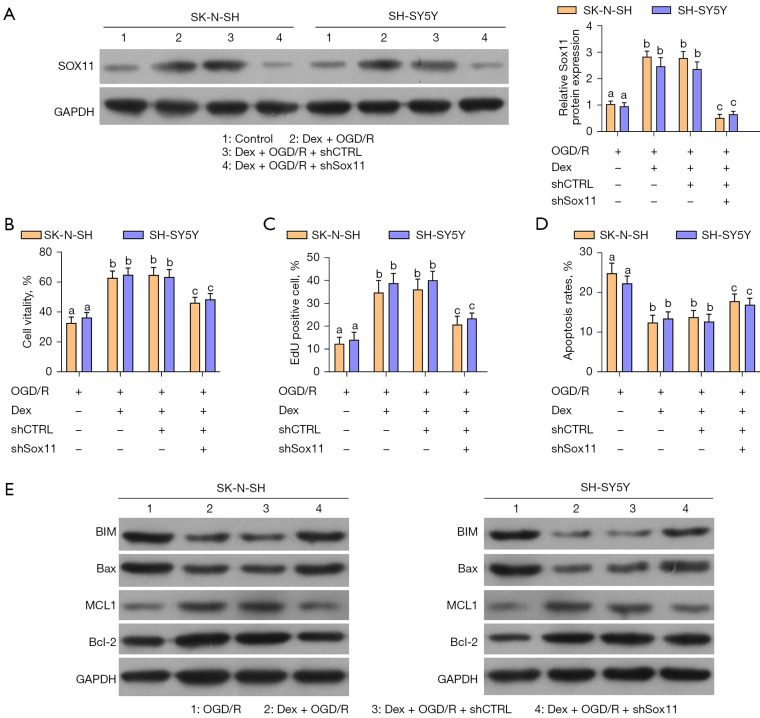
We found that Dex positively and dose-dependently regulated Sox11 expression and prevented damage caused by oxygen-glucose deprivation/reoxygenation (OGD/R), enhancing cell viability and proliferation and reducing apoptosis in SK-N-SH and SH-SY5Y cells. The overexpression of Sox11 antagonized OGD/R-induced SK-N-SH and SH-SY5Y cell apoptosis and promoted cell growth in vitro. Furthermore, cell proliferation was decreased and cell apoptosis was increased after Sox11 knockdown in Dex-treated SK-N-SH and SH-SY5Y cells. We demonstrated that Dex prevented OGD/R-induced cell injury by up-regulating Sox11. Furthermore, we also confirmed that Dex protected rat from ischemia-induced injury in the MCAO model.
The role of Dex in cell viability and survival was verified in this study. Moreover, Dex protected neurons from MCAO-induced injury by up-regulating the expression of Sox11. Our research proposes a potential drug to improve the functional recovery of stroke patients in the clinic.
右美托咪定(Dex)与多种生物学过程相关。缺血性中风具有高发病率和高死亡率的特点。在此,我们旨在探讨Dex是否能改善缺血诱导的损伤并确定其机制。
采用实时定量聚合酶链反应(qRT-PCR)和蛋白质免疫印迹法检测基因和蛋白质表达。分别通过细胞计数试剂盒-8(CCK-8)和5-乙炔基-2'-脱氧尿苷(EdU)检测法评估细胞活力和增殖。通过流式细胞术检测细胞凋亡。构建SK-N-SH和SH-SY5Y细胞的氧糖剥夺/复氧模型。还建立了大脑中动脉闭塞(MCAO)模型以评估Dex的作用。使用贝德森行为评分和龙加行为评分评估神经功能。
我们发现Dex正向且剂量依赖性地调节Sox11表达,并预防氧糖剥夺/复氧(OGD/R)引起的损伤,增强SK-N-SH和SH-SY5Y细胞的活力和增殖并减少细胞凋亡。Sox11的过表达拮抗OGD/R诱导的SK-N-SH和SH-SY5Y细胞凋亡并促进体外细胞生长。此外,在Dex处理的SK-N-SH和SH-SY5Y细胞中敲低Sox11后,细胞增殖减少且细胞凋亡增加。我们证明Dex通过上调Sox11预防OGD/R诱导的细胞损伤。此外,我们还证实Dex在MCAO模型中保护大鼠免受缺血诱导的损伤。
本研究证实了Dex在细胞活力和存活中的作用。此外,Dex通过上调Sox11的表达保护神经元免受MCAO诱导的损伤。我们的研究提出了一种潜在的药物,可改善临床上中风患者的功能恢复。