Zhou Hui, He Yuwen, Yuan Zhen, Zhou Yuan, Yin Jingwen, Chark Robin, Fong Davis Ka Chio, Fong Lawrence Hoc Nang, Wu Anise M S
Department of Psychology, Faculty of Social Sciences, University of Macau, Macao, Macao SAR, China.
Centre for Cognitive and Brain Sciences, Institute of Collaborative Innovation, University of Macau, Macao, Macao SAR, China.
Front Psychiatry. 2023 Feb 9;14:1083465. doi: 10.3389/fpsyt.2023.1083465. eCollection 2023.
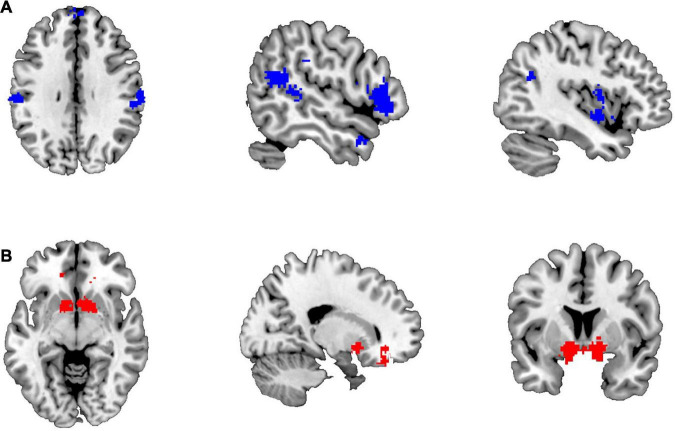
Despite the demonstrated association between empathy and gambling at the behavioral level, limited neuroimaging research on empathy and gambling disorder (GD) has been conducted. Whether and how the brain network of empathy and that of gambling interact in disordered gamblers has not been investigated. This study aimed to address this research gap by examining the hierarchical organizational patterns, in which the differences of causal interactions of these networks between disordered gamblers and healthy controls were revealed.
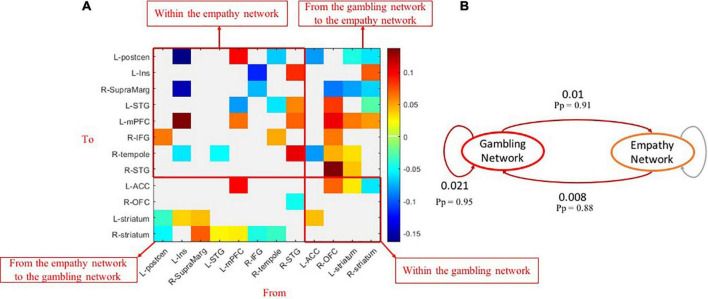
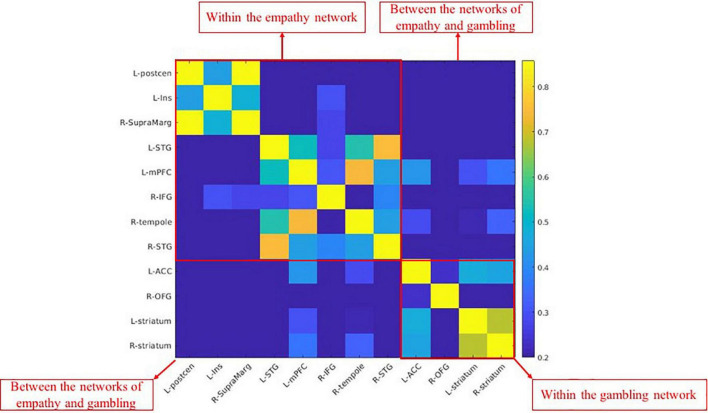
Resting-state functional magnetic resonance imaging (fMRI) data of 32 disordered gamblers and 56 healthy controls were included in the formal analysis. Dynamic causal modeling was used to examine the effective connectivity within and between empathy and gambling networks among all participants.
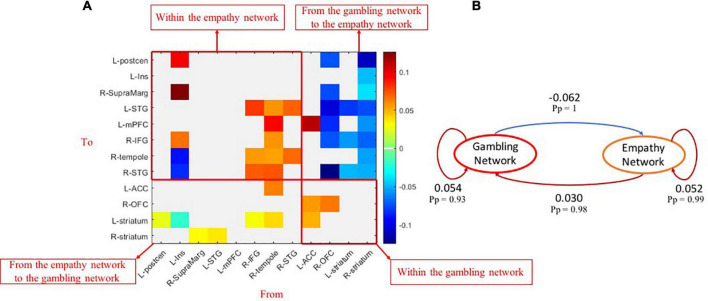
All participants showed significant effective connectivity within and between empathy and gambling networks. However, compared with healthy controls, disordered gamblers displayed more excitatory effective connectivity within the gambling network, the tendency to display more excitatory effective connectivity from the empathy network to the gambling network, and reduced inhibitory effective connectivity from the gambling network to the empathy network.
The exploratory study was the first to examine the effective connectivity within and between empathy and gambling networks among disordered gamblers and healthy controls. These results provided insights into the causal relationship between empathy and gambling from the neuroscientific perspective and further confirmed that disordered gamblers show altered effective connectivity within and between these two brain networks, which may be considered to be a potential neural index for GD identification. In addition, the altered interactions between empathy and gambling networks may also indicate the potential targets for the neuro-stimulation intervention approach (e.g., transcranial magnetic stimulation).
尽管在行为层面已证实共情与赌博之间存在关联,但针对共情与赌博障碍(GD)的神经影像学研究却十分有限。无序赌徒的共情脑网络与赌博脑网络是否以及如何相互作用尚不清楚。本研究旨在通过检验层次组织模式来填补这一研究空白,该模式揭示了无序赌徒与健康对照者之间这些网络因果相互作用的差异。
正式分析纳入了32名无序赌徒和56名健康对照者的静息态功能磁共振成像(fMRI)数据。采用动态因果模型来检验所有参与者共情网络与赌博网络内部及之间的有效连接性。
所有参与者在共情网络与赌博网络内部及之间均表现出显著的有效连接性。然而,与健康对照者相比,无序赌徒在赌博网络内部表现出更多的兴奋性有效连接,从共情网络到赌博网络表现出更多兴奋性有效连接的倾向,以及从赌博网络到共情网络的抑制性有效连接减少。
这项探索性研究首次检验了无序赌徒与健康对照者之间共情网络与赌博网络内部及之间的有效连接性。这些结果从神经科学角度为共情与赌博之间的因果关系提供了见解,并进一步证实无序赌徒在这两个脑网络内部及之间表现出改变的有效连接性,这可能被视为GD识别的潜在神经指标。此外,共情网络与赌博网络之间改变的相互作用也可能表明神经刺激干预方法(如经颅磁刺激)的潜在靶点。