Department of Pharmacology and Toxicology, University of Mississippi Medical Center, Jackson, Mississippi, United States.
Department of Emergency Medicine, University of Mississippi Medical Center, Jackson, Mississippi, United States.
Am J Physiol Regul Integr Comp Physiol. 2023 Apr 1;324(4):R556-R567. doi: 10.1152/ajpregu.00192.2022. Epub 2023 Feb 27.
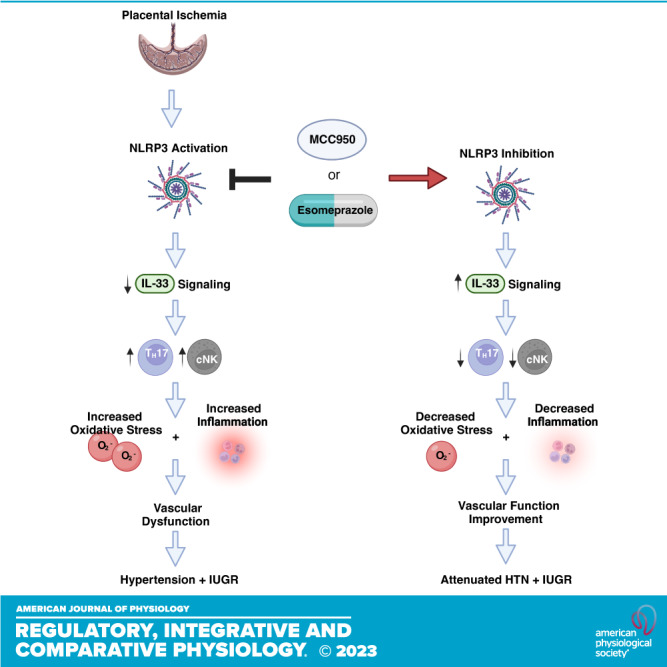
Preeclampsia (PE) is a pregnancy-specific hypertensive disorder with end-organ damage that presents after 20 wk of gestation. PE pathophysiology often includes vascular dysfunction and increased inflammation that continues to damage patient health even after PE resolves. Currently, there is no cure for PE beyond delivery of the fetal-placental unit. Previous clinical studies have identified elevated placental NLRP3 expression in patients with PE and suggest NLRP3 as a potential therapeutic target. In this study, we examined the effect of NLRP3 inhibition on PE pathophysiology in the reduced uterine perfusion pressure (RUPP) model rat using MCC950 (20 mg/kg/day) or esomeprazole (3.5 mg/kg/day). We hypothesized that increased NLRP3 in response to placental ischemia impairs anti-inflammatory IL-33 signaling to induce T-helper 17 cell (T17) and cytolytic NK cell (cNK) activation, which is known to mediate oxidative stress and vascular dysfunction leading to maternal HTN and intrauterine growth restriction. RUPP rats had significantly higher placental NLRP3 expression, maternal blood pressure, fetal reabsorption rate, vascular resistance, oxidative stress, cNKs and T17s, and decreased IL-33 compared with normal pregnant (NP) rats. NLRP3 inhibition, with either treatment, significantly reduced placental NLRP3 expression, maternal blood pressure, fetal reabsorption rates, vascular resistance, oxidative stress, cNK, and T17 populations in RUPP rats. Based on our findings, NLRP3 inhibition reduces PE pathophysiology and esomeprazole may be a potential therapeutic for PE treatment.
子痫前期 (PE) 是一种妊娠特异性高血压疾病,伴有终末器官损伤,在妊娠 20 周后出现。PE 的病理生理学通常包括血管功能障碍和炎症增加,即使在 PE 缓解后,这些仍然会继续损害患者的健康。目前,除了分娩胎儿胎盘单位外,没有治疗 PE 的方法。先前的临床研究已经在患有 PE 的患者中发现了升高的胎盘 NLRP3 表达,并表明 NLRP3 是一个潜在的治疗靶点。在这项研究中,我们使用 MCC950(20mg/kg/天)或埃索美拉唑(3.5mg/kg/天)在低子宫灌注压(RUPP)模型大鼠中检查了 NLRP3 抑制对 PE 病理生理学的影响。我们假设,胎盘缺血引起的 NLRP3 增加会损害抗炎性 IL-33 信号,从而诱导 T 辅助 17 细胞(T17)和细胞毒性 NK 细胞(cNK)的激活,这已知会介导氧化应激和血管功能障碍,导致母体高血压和宫内生长受限。与正常妊娠(NP)大鼠相比,RUPP 大鼠的胎盘 NLRP3 表达、母体血压、胎儿吸收率、血管阻力、氧化应激、cNK 和 T17 显著升高,IL-33 降低。用两种治疗方法中的任何一种抑制 NLRP3 都会显著降低 RUPP 大鼠的胎盘 NLRP3 表达、母体血压、胎儿吸收率、血管阻力、氧化应激、cNK 和 T17 群体。基于我们的发现,NLRP3 抑制可减轻 PE 的病理生理学,埃索美拉唑可能是治疗 PE 的潜在治疗方法。