Pediatrics, Stanford University School of Medicine, Stanford, California, USA
Pediatrics, Stanford University School of Medicine, Stanford, California, USA.
J Immunother Cancer. 2023 Feb;11(2). doi: 10.1136/jitc-2022-004851.
Chimeric antigen receptor (CAR) T cell therapy is an effective salvage therapy for pediatric relapsed B-cell acute lymphoblastic leukemia (B-ALL), yet is challenged by high rates of post-CAR relapse. Literature describing specific relapse patterns and extramedullary (EM) sites of involvement in the post-CAR setting remains limited, and a clinical standard for post-CAR disease surveillance has yet to be established. We highlight the importance of integrating peripheral blood minimal residual disease (MRD) testing and radiologic imaging into surveillance strategies, to effectively characterize and capture post-CAR relapse.
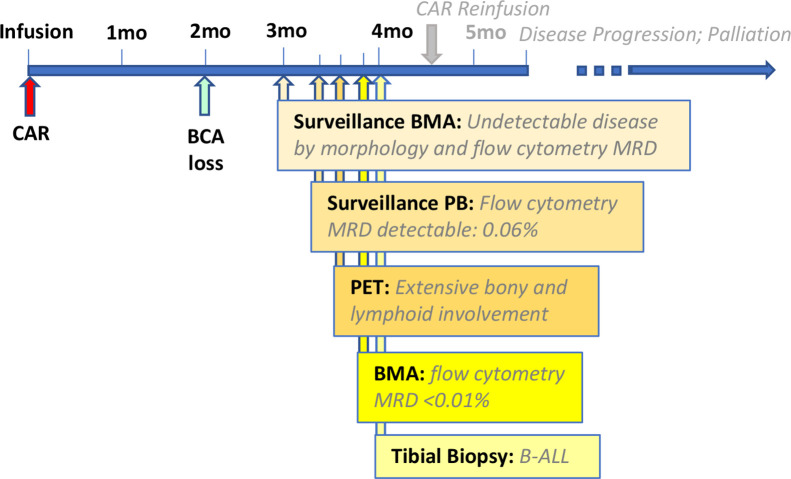
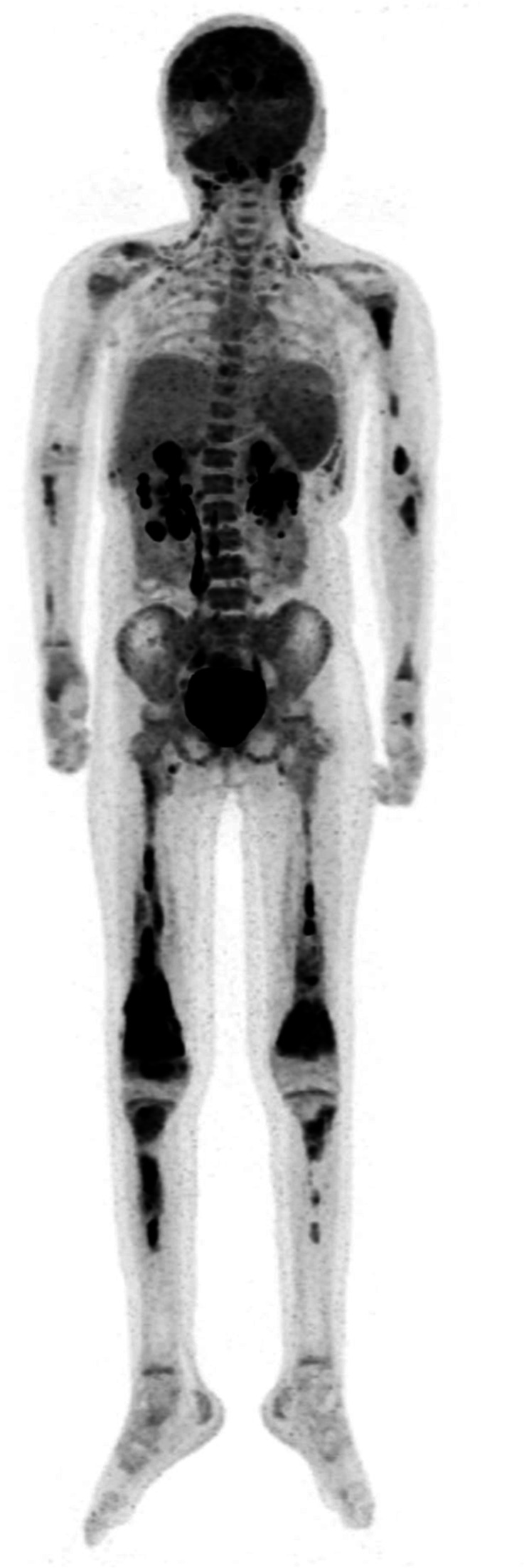
Here, we describe the case of a child with multiply relapsed B-ALL who relapsed in the post-CAR setting with gross non-contiguous medullary and EM disease. Interestingly, her relapse was identified first from peripheral blood flow cytometry MRD surveillance, in context of a negative bone marrow aspirate (MRD <0.01%). Positron emission tomography with 18F-fluorodeoxyglucose revealed diffuse leukemia with innumerable bone and lymph node lesions, interestingly sparing her sacrum, the site of her bone marrow aspirate sampling.
We highlight this case as both peripheral blood MRD and 18F-fluorodeoxyglucose positron emission tomography imaging were more sensitive than standard bone marrow aspirate testing in detecting this patient's post-CAR relapse. Clinical/Biologic Insight: In the multiply relapsed B-ALL setting, where relapse patterns may include patchy medullary and/or EM disease, peripheral blood MRD and/or whole body imaging, may carry increased sensitivity at detecting relapse in patient subsets, as compared with standard bone marrow sampling.
嵌合抗原受体(CAR)T 细胞疗法是治疗儿科复发 B 细胞急性淋巴细胞白血病(B-ALL)的有效挽救疗法,但面临着 CAR 后复发率高的挑战。描述 CAR 后特定复发模式和骨髓外(EM)受累部位的文献仍然有限,并且尚未建立 CAR 后疾病监测的临床标准。我们强调将外周血微小残留病(MRD)检测和影像学纳入监测策略的重要性,以有效描述和捕获 CAR 后的复发。
在这里,我们描述了一例患有多次复发 B-ALL 的儿童,该患者在 CAR 后出现了广泛的非连续骨髓和 EM 疾病。有趣的是,她的复发首先是从外周血流式细胞术 MRD 监测中发现的,当时骨髓抽吸物(MRD<0.01%)呈阴性。18F-氟脱氧葡萄糖正电子发射断层扫描显示弥漫性白血病,伴有无数骨和淋巴结病变,有趣的是,她的骶骨(骨髓抽吸物取样部位)未受累。
我们强调这个病例,因为外周血 MRD 和 18F-氟脱氧葡萄糖正电子发射断层扫描成像比标准骨髓抽吸物检测更敏感,能够检测到该患者的 CAR 后复发。临床/生物学见解:在多次复发的 B-ALL 中,复发模式可能包括斑片状骨髓和/或 EM 疾病,与标准骨髓取样相比,外周血 MRD 和/或全身成像在检测某些患者亚群的复发方面可能具有更高的敏感性。