Centre for Research in Aged Care, School of Nursing and Midwifery, Edith Cowan University, Joondalup, WA, Australia.
Centre for Health Systems and Safety Research, Macquarie University, Sydney, Australia.
Sci Rep. 2023 Feb 27;13(1):3345. doi: 10.1038/s41598-023-29933-x.
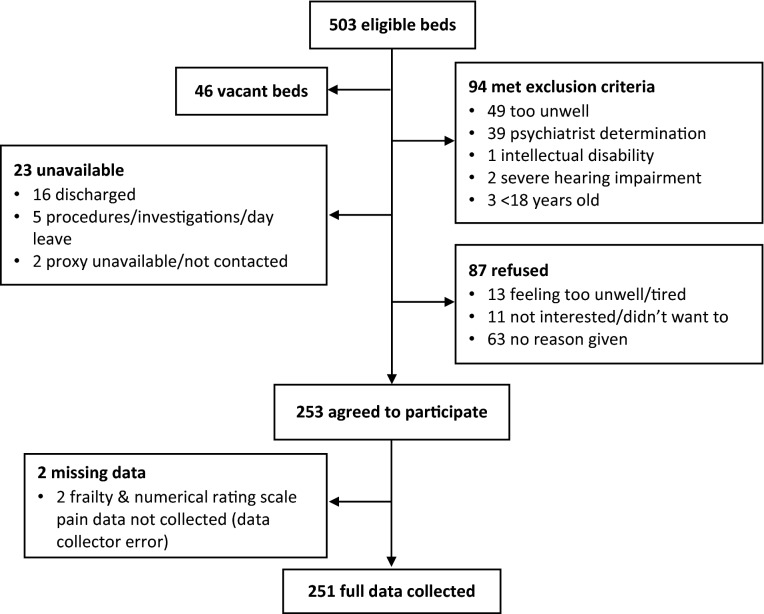
Frailty and pain in hospitalised patients are associated with adverse clinical outcomes. However, there is limited data on the associations between frailty and pain in this group of patients. Understanding the prevalence, distribution and interaction of frailty and pain in hospitals will help to determine the magnitude of this association and assist health care professionals to target interventions and develop resources to improve patient outcomes. This study reports the point prevalence concurrence of frailty and pain in adult patients in an acute hospital. A point prevalence, observational study of frailty and pain was conducted. All adult inpatients (excluding high dependency units) at an acute, private, 860-bed metropolitan hospital were eligible to participate. Frailty was assessed using the self-report modified Reported Edmonton Frail Scale. Current pain and worst pain in the last 24 h were self-reported using the standard 0-10 numeric rating scale. Pain scores were categorised by severity (none, mild, moderate, severe). Demographic and clinical information including admitting services (medical, mental health, rehabilitation, surgical) were collected. The STROBE checklist was followed. Data were collected from 251 participants (54.9% of eligible). The prevalence of frailty was 26.7%, prevalence of current pain was 68.1% and prevalence of pain in the last 24 h was 81.3%. After adjusting for age, sex, admitting service and pain severity, admitting services medical (AOR: 13.5 95% CI 5.7-32.8), mental health (AOR: 6.3, 95% CI 1. 9-20.9) and rehabilitation (AOR: 8.1, 95% CI 2.4-37.1) and moderate pain (AOR: 3.9, 95% CI 1. 6-9.8) were associated with increased frailty. The number of older patients identified in this study who were frail has implications for managing this group in a hospital setting. This indicates a need to focus on developing strategies including frailty assessment on admission, and the development of interventions to meet the care needs of these patients. The findings also highlight the need for increased pain assessment, particularly in those who are frail, for more effective pain management.Trial registration: The study was prospectively registered (ACTRN12620000904976; 14th September 2020).
在住院患者中,衰弱和疼痛与不良临床结局相关。然而,关于这组患者中衰弱和疼痛之间的关联,数据有限。了解医院中衰弱和疼痛的患病率、分布和相互作用将有助于确定这种关联的程度,并帮助医疗保健专业人员确定干预措施的目标,并开发资源以改善患者的结局。本研究报告了在一家急性医院的成年患者中衰弱和疼痛的时点患病率同时存在情况。进行了一项衰弱和疼痛的时点患病率、观察性研究。一家急性、私立、拥有 860 张床位的大都市医院的所有成年住院患者(不包括高度依赖病房)均有资格参加。使用自我报告的改良报告埃德蒙顿虚弱量表评估衰弱。使用标准的 0-10 数字评分量表自我报告当前疼痛和过去 24 小时内的最痛程度。疼痛评分按严重程度(无、轻度、中度、重度)分类。收集人口统计学和临床信息,包括入院科室(内科、精神科、康复科、外科)。研究遵循 STROBE 清单。从 251 名参与者(合格者的 54.9%)中收集数据。衰弱的患病率为 26.7%,当前疼痛的患病率为 68.1%,过去 24 小时内疼痛的患病率为 81.3%。在调整年龄、性别、入院科室和疼痛严重程度后,内科(调整后优势比 [AOR]:13.5,95%置信区间 [CI]:5.7-32.8)、精神科(AOR:6.3,95% CI:1.9-20.9)和康复科(AOR:8.1,95% CI:2.4-37.1)以及中度疼痛(AOR:3.9,95% CI:1.6-9.8)与衰弱程度增加相关。在这项研究中,确定的患有衰弱症的老年患者人数对在医院环境中管理这组患者具有影响。这表明需要专注于制定策略,包括入院时进行衰弱评估,以及开发干预措施以满足这些患者的护理需求。研究结果还强调了需要更加强化疼痛评估,特别是对那些虚弱的患者,以实现更有效的疼痛管理。试验注册:该研究前瞻性注册(ACTRN12620000904976;2020 年 9 月 14 日)。