Department of Pathology, Faculty of Veterinary Science, Bangladesh Agricultural University, Mymensingh 2202, Bangladesh.
Institute of Diagnostic Virology, Friedrich-Loeffler-Institute, Federal Research Institute for Animal Health, Suedufer 10, 17493 Greifswald-Insel Riems, Germany.
Viruses. 2023 Feb 7;15(2):461. doi: 10.3390/v15020461.
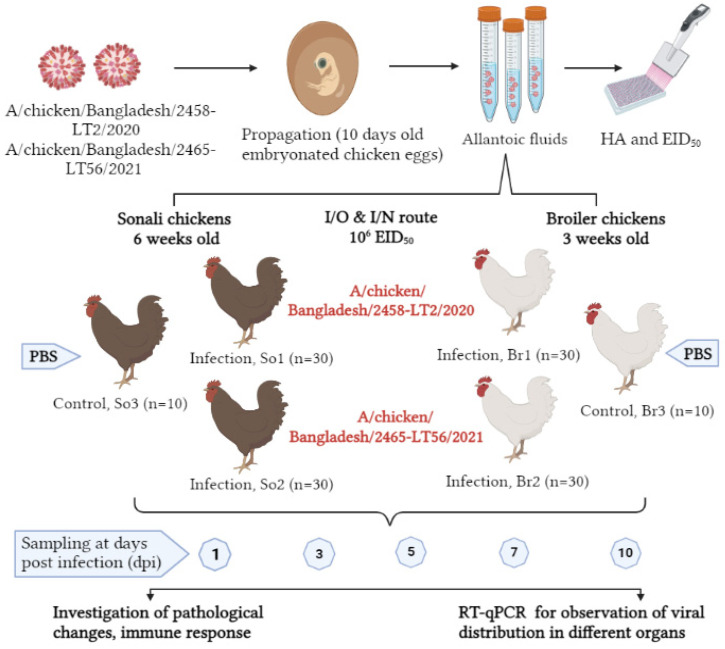
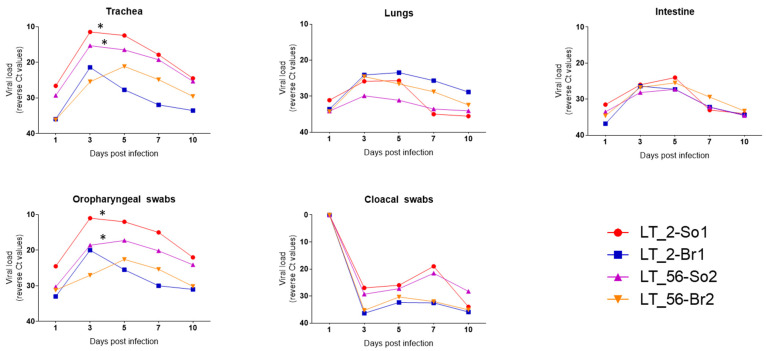
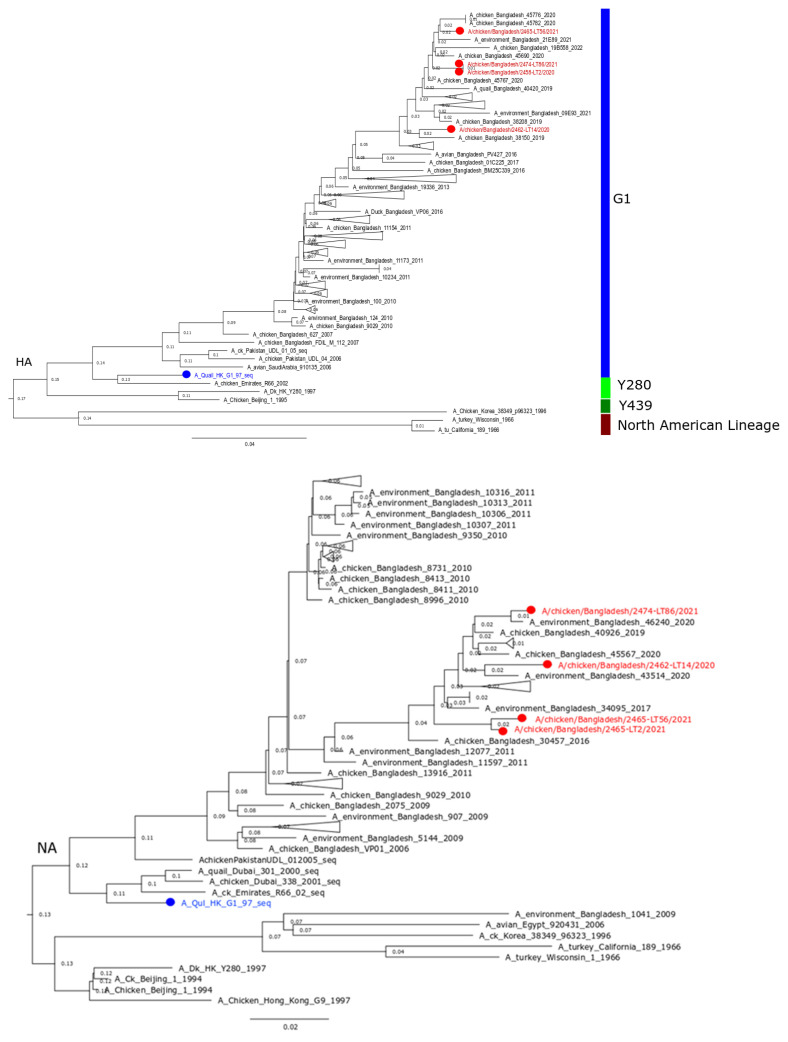
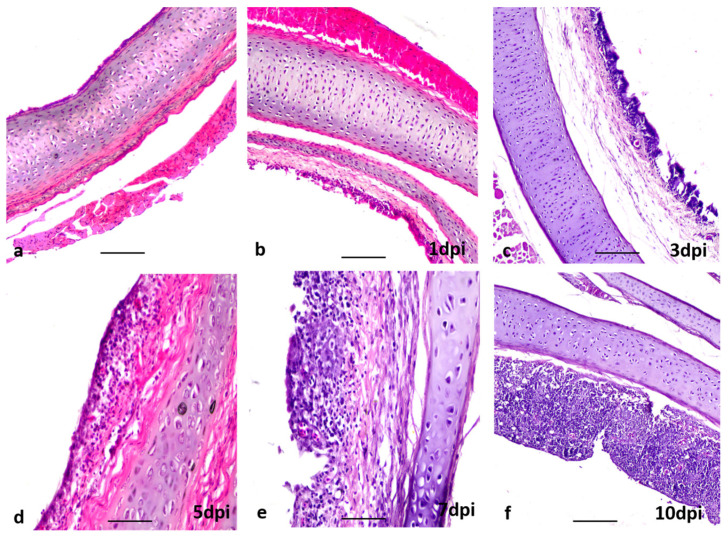
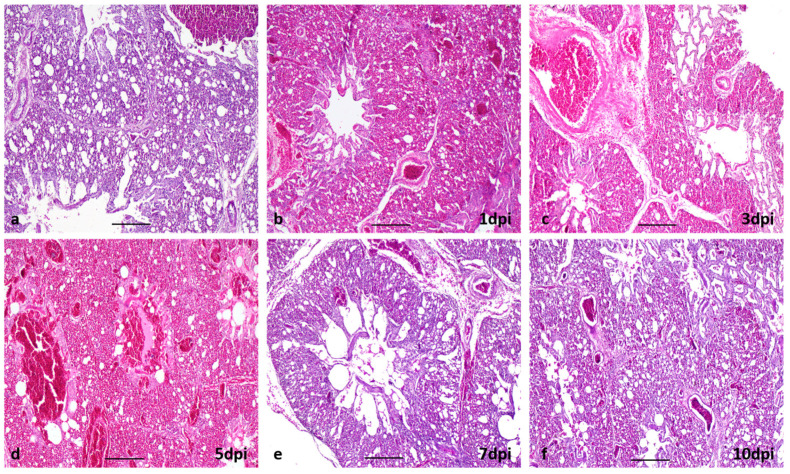
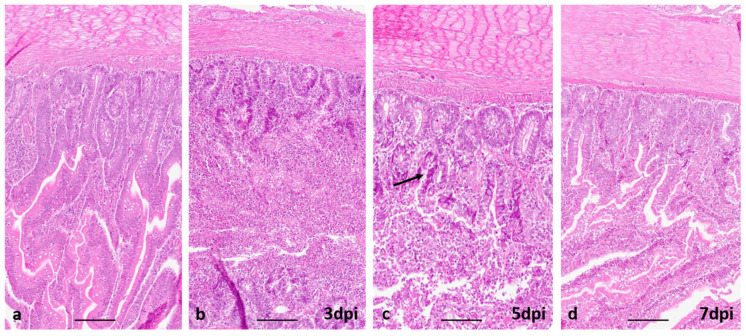
Low-pathogenic avian influenza (LPAI) H9N2 virus is endemic in Bangladesh, causing huge economic losses in the poultry industry. Although a considerable number of Bangladeshi LPAI H9N2 viruses have been molecularly characterized, there is inadequate information on the pathogenicity of H9N2 viruses in commercial poultry. In this study, circulating LPAI H9N2 viruses from recent field outbreaks were characterized, and their pathogenicity in commercial Sonali (crossbred) and broiler chickens was assessed. Phylogenetic analysis of currently circulating field viruses based on the hemagglutinin (HA) and neuraminidase (NA) gene sequences revealed continuous circulation of G1 lineages containing the tri-basic hemagglutinin cleavage site (HACS) motif (PAKSKR*GLF) at the HA protein. Both the LPAI susceptible Sonali and broiler chickens were infected with selected H9N2 isolates A/chicken/Bangladesh/2458-LT2/2020 or A/chicken/Bangladesh/2465-LT56/2021 using intranasal (100 µL) and intraocular (100 µL) routes with a dose of 10 EID/. Infected groups (LT_2-So1 and LT_56-So2; LT_2-Br1 and LT_56-Br2) revealed no mortality or clinical signs. However, at gross and histopathological investigation, the trachea, lungs, and intestine of the LT_2-So1 and LT_56-So2 groups displayed mild to moderate hemorrhages, congestion, and inflammation at different dpi. The LT 2-Br1 and LT 56-Br2 broiler groups showed nearly identical changes in the trachea, lungs, and intestine at various dpi, indicating no influence on pathogenicity in the two commercial bird species under study. Overall, the prominent lesions were observed up to 7 dpi and started to disappear at 10 dpi. The H9N2 viruses predominantly replicated in the respiratory tract, and higher titers of virus were shed through the oropharyngeal route than the cloacal route. Finally, this study demonstrated the continuous evolution of tri-basic HACS containing H9N2 viruses in Bangladesh with a low-pathogenic phenotype causing mild to moderate tracheitis, pneumonia, and enteritis in Sonali and commercial broiler chickens.
低致病性禽流感(LPAI)H9N2 病毒在孟加拉国流行,给家禽业造成巨大经济损失。尽管已经对相当数量的孟加拉国 LPAI H9N2 病毒进行了分子特征描述,但关于商业家禽中 H9N2 病毒的致病性信息仍然不足。在这项研究中,对近期田间暴发的循环 LPAI H9N2 病毒进行了特征描述,并评估了其在商业 Sonali(杂交)和肉鸡中的致病性。基于血凝素(HA)和神经氨酸酶(NA)基因序列对目前流行的田间病毒进行系统发育分析表明,连续循环含有三碱性血凝素裂解位点(HACS)基序(PAKSKR*GLF)的 G1 谱系在 HA 蛋白中。选择的 H9N2 分离株 A/chicken/Bangladesh/2458-LT2/2020 或 A/chicken/Bangladesh/2465-LT56/2021 可通过鼻腔(100 µL)和眼内(100 µL)途径感染易感 LPAI 的 Sonali 和肉鸡,剂量为 10 EID/。感染组(LT_2-So1 和 LT_56-So2;LT_2-Br1 和 LT_56-Br2)未出现死亡或临床症状。然而,在大体和组织病理学检查中,LT_2-So1 和 LT_56-So2 组的气管、肺和肠道在不同 dpi 时显示出轻度至中度出血、充血和炎症。LT_2-Br1 和 LT_56-Br2 肉鸡组在不同 dpi 时的气管、肺和肠道几乎表现出相同的变化,表明这两种商业鸟类的致病性没有受到影响。总体而言,最突出的病变发生在 7dpi 时,10dpi 时开始消失。H9N2 病毒主要在呼吸道中复制,通过口咽途径排出的病毒滴度高于通过泄殖腔途径排出的病毒滴度。最后,本研究表明,含有三碱性 HACS 的低致病性 H9N2 病毒在孟加拉国持续进化,其低致病性表型可导致 Sonali 和商业肉鸡出现轻度至中度气管炎、肺炎和肠炎。