Department of Radiation Oncology, Memorial Sloan Kettering Cancer Center, New York, NY, USA.
Department of Pediatrics, Memorial Sloan Kettering Cancer Center, New York, NY, USA.
J Neurooncol. 2023 Mar;162(1):69-78. doi: 10.1007/s11060-022-04235-w. Epub 2023 Feb 28.
Intraventricular compartmental radioimmunotherapy (cRIT) with 131-I-omburtamab is a potential therapy for recurrent primary brain tumors that can seed the thecal space. These patients often previously received external beam radiotherapy (EBRT) to a portion or full craniospinal axis (CSI) as part of upfront therapy. Little is known regarding outcomes after re-irradiation as part of multimodality therapy including cRIT. This study evaluates predictors of response, patterns of failure, and radiologic events after cRIT.
Patients with recurrent medulloblastoma or ependymoma who received 131-I-omburtamab on a prospective clinical trial were included. Extent of disease at cRIT initiation (no evidence of disease [NED] vs measurable disease [MD]) was assessed as associated with progression-free (PFS) and overall survival (OS) by Kaplan-Meier analysis.
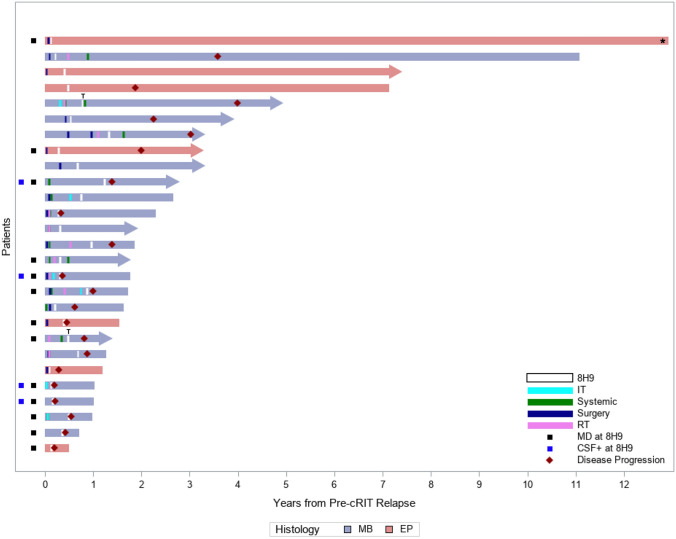
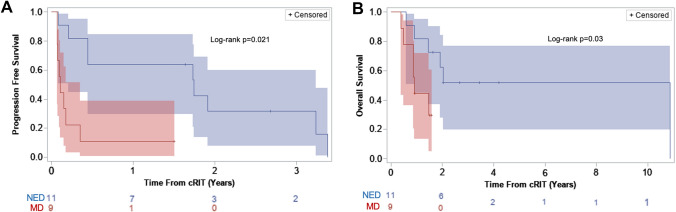
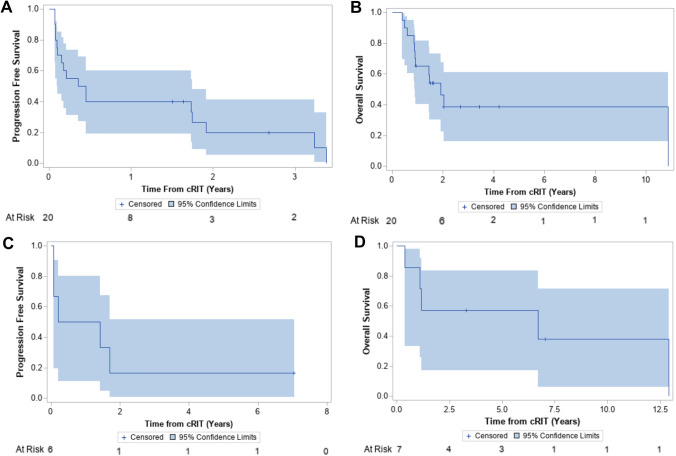
All 27 patients (20 medulloblastoma, 7 ependymoma) had EBRT preceding cRIT: most (22, 81%) included CSI (median dose 2340 cGy, boost to 5400 cGy). Twelve (44%) also received EBRT at relapse as bridging to cRIT. There were no cases of radionecrosis. At cRIT initiation, 11 (55%) medulloblastoma and 3 (43%) ependymoma patients were NED, associated with improved PFS (p = 0.002) and OS (p = 0.048) in medulloblastoma. Most relapses were multifocal. With medium follow-up of 3.0 years (95% confidence interval, 1.8-7.4), 6 patients remain alive with NED.
For patients with medulloblastoma, remission at time of cRIT was associated with significantly improved survival outcomes. Relapses are often multifocal, particularly in the setting of measurable disease at cRIT initiation. EBRT is a promising tool to achieve NED status at cRIT initiation, with no cases of radiation necrosis.
脑室 compartmental 放射性免疫疗法(cRIT)联合 131I-omburtamab 是一种治疗原发性脑肿瘤复发并播散至脊膜腔的潜在疗法。这些患者通常在复发前接受过全脑和全脊髓放射治疗(EBRT),作为初始治疗的一部分。对于包括 cRIT 在内的多模态治疗中再次放疗的结果知之甚少。本研究评估了 cRIT 后反应、失败模式和影像学事件的预测因素。
纳入接受前瞻性临床试验 131I-omburtamab 治疗的复发性髓母细胞瘤或室管膜瘤患者。根据无疾病证据(NED)与可测量疾病(MD)评估 cRIT 开始时疾病的范围与无进展生存期(PFS)和总生存期(OS)的相关性,采用 Kaplan-Meier 分析。
所有 27 例患者(20 例髓母细胞瘤,7 例室管膜瘤)在接受 cRIT 前接受了 EBRT:大多数患者(22 例,81%)包括全脑脊髓照射(中位剂量 2340cGy,局部加量至 5400cGy)。12 例(44%)患者在复发时也接受了 EBRT 作为 cRIT 的桥接治疗。无放射性坏死病例。在 cRIT 开始时,11 例(55%)髓母细胞瘤和 3 例(43%)室管膜瘤患者为 NED,与髓母细胞瘤的 PFS(p=0.002)和 OS(p=0.048)改善相关。大多数复发为多灶性。在 3.0 年的中位随访期(95%置信区间,1.8-7.4)内,6 例患者仍存活且无疾病。
对于髓母细胞瘤患者,cRIT 时的缓解与生存结局的显著改善相关。复发通常为多灶性,尤其是在 cRIT 开始时存在可测量疾病的情况下。EBRT 是一种很有前途的工具,可以使 cRIT 开始时达到 NED 状态,且无放射性坏死。