Division Laboratories, Pharmacy and Biomedical Genetics, Department of Genetics, University Medical Center Utrecht, Utrecht, The Netherlands.
Division of Psychosocial Research and Epidemiology, The Netherlands Cancer Institute, Amsterdam, The Netherlands.
Ann Surg Oncol. 2023 Jun;30(6):3248-3258. doi: 10.1245/s10434-023-13229-5. Epub 2023 Feb 28.
Pre-test genetic counseling for patients with breast cancer is increasingly being provided by nongenetic healthcare professionals. We evaluated the attitudes, knowledge, and self-efficacy of surgeons, oncologists, and nurses regarding mainstream genetic testing and the feasibility to incorporate pre-test genetic counseling into routine care.
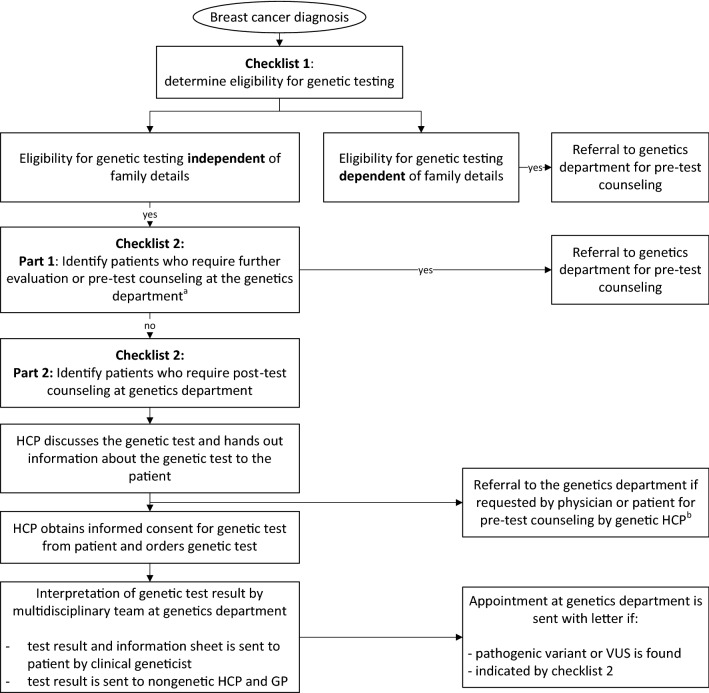
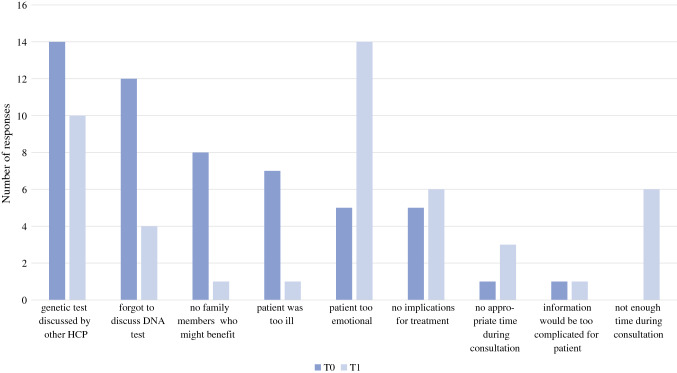
We offered an online training to healthcare professionals from 13 hospitals and implemented a mainstream genetic testing pathway in 11/13 (85%) hospitals. Questionnaires were sent before (T0) and 6 months after (T1) completing the training. Those who did not complete the training received a questionnaire to assess their motivations.
In 11 hospitals, 80 (65%) healthcare professionals completed the training, of whom 70 (88%) completed both questionnaires. The attitudes, (perceived) knowledge and self-efficacy of healthcare professionals were high both at baseline and 6 months after completing the training. After 6 months, their perceived knowledge about the advantages and disadvantages of a genetic test and implications for family members had significantly improved (p = 0.012 and p = 0.021, respectively). For the majority (89%), the time investment for pre-test genetic counseling was less than 15 min per patient and as expected or better. Healthcare professionals considered the total time investment feasible to incorporate mainstream genetic testing into their daily practice. The main barrier to complete the training was lack of time. The online training was considered useful, with a rating of 8/10.
Surgical oncologists and nurses in breast cancer care feel well-equipped and motivated to provide pre-test genetic counseling after completion of an online training module.
越来越多的非遗传健康专业人员为乳腺癌患者提供预测试遗传咨询。我们评估了外科医生、肿瘤医生和护士对主流基因检测的态度、知识和自我效能感,以及将预测试遗传咨询纳入常规护理的可行性。
我们为 13 家医院的医疗保健专业人员提供了在线培训,并在 11/13(85%)家医院实施了主流基因检测途径。在完成培训前后(T0 和 T1)发送了问卷。那些没有完成培训的人收到了一份问卷,以评估他们的动机。
在 11 家医院中,有 80 名(65%)医疗保健专业人员完成了培训,其中 70 名(88%)完成了两份问卷。医护人员的态度、(感知)知识和自我效能感在基线和完成培训后 6 个月都很高。6 个月后,他们对基因检测的优缺点和对家庭成员的影响的感知知识显著提高(p=0.012 和 p=0.021)。对于大多数人(89%)来说,每个患者的预测试遗传咨询时间投入少于 15 分钟,并且与预期或更好。医疗保健专业人员认为,将主流基因检测纳入日常实践的总时间投入是可行的。完成培训的主要障碍是缺乏时间。在线培训被认为是有用的,评分为 8/10。
完成在线培训模块后,乳腺癌护理中的外科肿瘤医生和护士感到有能力并愿意提供预测试遗传咨询。