Department of Oncology and Hematology, Azienda Ospedaliero, Universitaria di Modena Ospedale Civile di Baggiovara, Modena, Italy.
University of California San Francisco Helen Diller Family Comprehensive Cancer Center, San Francisco, CA, USA.
Target Oncol. 2021 May;16(3):255-282. doi: 10.1007/s11523-021-00796-4. Epub 2021 Mar 12.
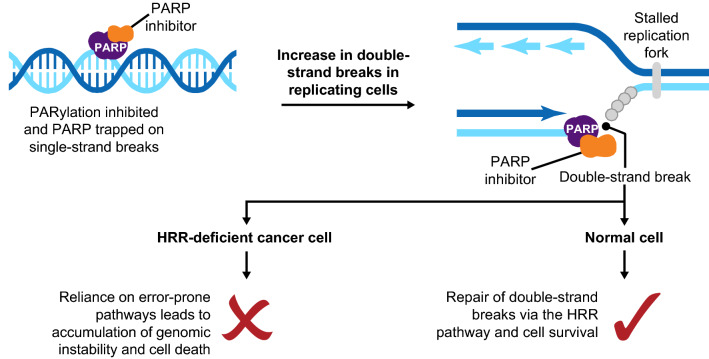
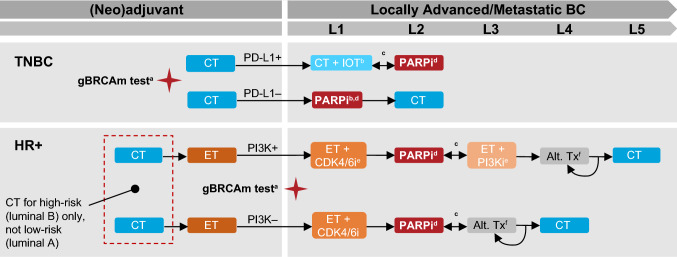
Loss-of-function mutations in BRCA1 and BRCA2 are detected in at least 5% of unselected patients with breast cancer (BC). These BC susceptibility genes encode proteins critical for DNA homologous recombination repair (HRR). This review provides an update on oral poly(ADP-ribose) polymerase (PARP) inhibitors for the treatment of BC. Olaparib and talazoparib are PARP inhibitors approved as monotherapies for deleterious/suspected deleterious germline BRCA-mutated, HER2-negative BC. Olaparib is approved in the USA for metastatic BC and in Europe for locally advanced/metastatic BC. Talazoparib is approved for locally advanced/metastatic BC in the USA and Europe. In phase 3 trials, olaparib and talazoparib monotherapies demonstrated significant progression-free survival benefits compared with chemotherapy. Common toxicities were effectively managed by supportive treatment and dose interruptions/reductions. Veliparib combined with platinum-based chemotherapy has also shown promise for locally advanced/metastatic BC in a phase 3 trial. Differences in efficacy and safety across PARP inhibitors (olaparib, talazoparib, veliparib, niraparib, rucaparib) may relate to differences in potency of PARP trapping on DNA and cytotoxic specificity. PARP inhibitors are being investigated in early BC, in novel combinations, and in patients without germline BRCA mutations, including those with somatic BRCA mutations and other HRR gene mutations. Ongoing phase 2/3 studies include PARP inhibitors combined with immune checkpoint inhibitors for the treatment of triple-negative BC. Wider access to testing for BRCA and other mutations, and to genetic counseling, are required to identify patients who could benefit from PARP inhibitor therapy. The advent of PARP inhibitors has potential benefits for BC treatment beyond the locally advanced/metastatic setting.
BRCA1 和 BRCA2 的功能丧失性突变至少在 5%的未经选择的乳腺癌 (BC) 患者中被检测到。这些 BC 易感性基因编码对 DNA 同源重组修复 (HRR) 至关重要的蛋白质。本文综述了用于治疗 BC 的口服聚 (ADP-核糖) 聚合酶 (PARP) 抑制剂的最新进展。奥拉帕利和他拉唑帕利是获批的 PARP 抑制剂,可作为有害/疑似有害种系 BRCA 突变、HER2 阴性 BC 的单一疗法。奥拉帕利在美国获批用于转移性 BC,在欧洲获批用于局部晚期/转移性 BC。他拉唑帕利在美国和欧洲获批用于局部晚期/转移性 BC。在 3 期临床试验中,奥拉帕利和他拉唑帕利的单一疗法与化疗相比,显著延长了无进展生存期。常见的毒性通过支持性治疗和剂量中断/减少得到有效管理。在 3 期临床试验中,维利帕利联合铂类化疗也显示出对局部晚期/转移性 BC 的疗效。PARP 抑制剂(奥拉帕利、他拉唑帕利、维利帕利、尼拉帕利、鲁卡帕利)之间的疗效和安全性差异可能与 DNA 上 PARP 捕获的效力差异和细胞毒性特异性有关。PARP 抑制剂正在早期 BC 中进行研究,包括新的联合用药以及没有种系 BRCA 突变的患者,包括那些具有体细胞 BRCA 突变和其他 HRR 基因突变的患者。正在进行的 2/3 期研究包括 PARP 抑制剂联合免疫检查点抑制剂用于治疗三阴性 BC。需要更广泛地进行 BRCA 和其他突变的检测以及遗传咨询,以确定能够从 PARP 抑制剂治疗中获益的患者。PARP 抑制剂的出现可能为局部晚期/转移性疾病以外的 BC 治疗带来潜在益处。