Melbourne Veterinary School, Faculty of Science, The University of Melbourne, Parkville, Victoria, Australia.
Hospital for Small Animals, Royal (Dick) School of Veterinary Studies, College of Medicine and Veterinary Medicine, University of Edinburgh, Easter Bush, Midlothian, United Kingdom.
PLoS One. 2023 Feb 28;18(2):e0282440. doi: 10.1371/journal.pone.0282440. eCollection 2023.
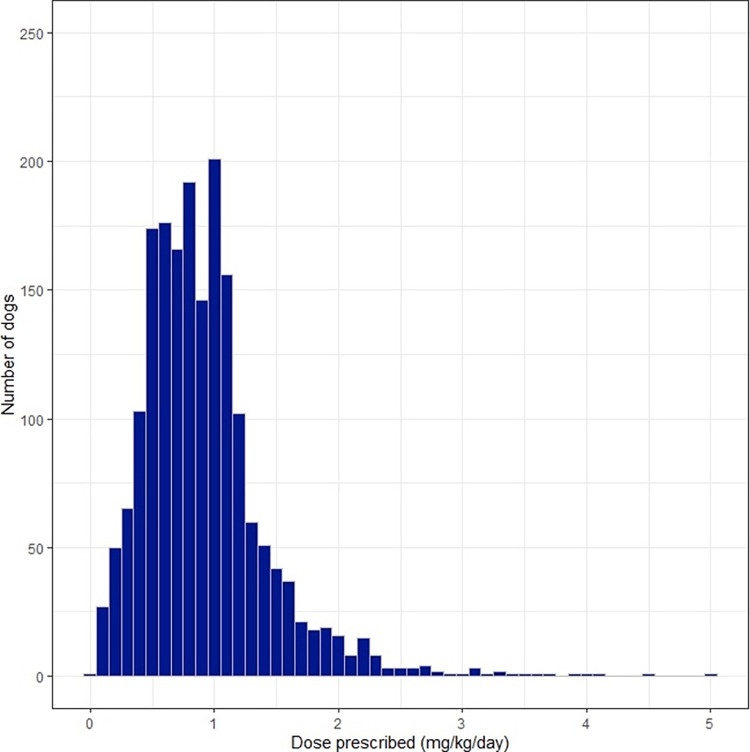
Although prednisolone is a routinely prescribed medication in dogs, there is a lack of information regarding prednisolone prescribing practices by veterinarians. This study aims to describe characteristics of dogs receiving prednisolone, disease processes treated, doses prescribed as well as to identify factors influencing the dose rate in Australia. The VetCompass Australia database was queried to identify dogs prescribed prednisolone between 1 July 2016 to 31 July 2018 (inclusive). A random sample of 2,000 dogs from this population were selected. Dog demographic data, prednisolone dose and indication for prescription were collated. Indicated dose for the condition treated was compared to prescribed dose. Multivariable linear regression was used to identify patient-level characteristics associated with prescribed prednisolone dose. A large and small breed dog cohort, treated for the same disease process, were compared for differences in dosing. Median age of dogs was 73 (range 2 to 247) months and median body weight was 17 (range 1.56 to 90) kg. Median prescribed prednisolone dose was 0.8 mg/kg/day, with most dogs receiving an anti-inflammatory dose (0.3-1 mg/kg/day, 58%). Prednisolone prescriptions were predominantly for diseases of the integument (n = 1645, 82%) followed by unknown indication and respiratory disease. A total of 152 dogs (8%) were prescribed immunosuppressive doses of prednisolone for conditions where an anti-inflammatory dose would be recommended. Increases in bodyweight were associated with lower doses on mg/kg scale but higher doses on a mg/m2 scale (p < 0.001). Overall, prednisolone was primarily used as an anti-inflammatory in this population, with some inappropriate use of immunosuppressive doses. Increasing bodyweight was associated with a small reduction in dose in mg/kg, suggesting that clinicians are adjusting prednisolone dose rates based on dog bodyweight.
尽管泼尼松龙是犬类常规处方药物,但兽医开具泼尼松龙处方的做法相关信息却十分有限。本研究旨在描述接受泼尼松龙治疗的犬的特征、治疗的疾病过程、开具的剂量,并确定影响澳大利亚剂量率的因素。通过查询 VetCompass Australia 数据库,确定了 2016 年 7 月 1 日至 2018 年 7 月 31 日(含)期间开具泼尼松龙处方的犬。从该人群中随机抽取 2000 只犬作为样本。收集了犬的人口统计学数据、泼尼松龙剂量和处方指征。将治疗指征的预期剂量与开具的剂量进行比较。采用多元线性回归分析确定与开具泼尼松龙剂量相关的患者特征。比较了治疗同一疾病过程的大、小品种犬的剂量差异。犬的中位年龄为 73(范围 2-247)个月,中位体重为 17(范围 1.56-90)kg。中位泼尼松龙剂量为 0.8mg/kg/天,大多数犬接受抗炎剂量(0.3-1mg/kg/天,58%)。泼尼松龙处方主要用于皮肤疾病(n=1645,82%),其次是未知指征和呼吸道疾病。共有 152 只(8%)犬因推荐使用抗炎剂量的疾病而开具免疫抑制剂量的泼尼松龙。体重增加与 mg/kg 剂量降低相关,但与 mg/m2 剂量增加相关(p<0.001)。总体而言,该人群中泼尼松龙主要用作抗炎药,存在一些免疫抑制剂量的不当使用。体重增加与 mg/kg 剂量的小幅减少相关,表明临床医生根据犬体重调整泼尼松龙剂量率。