Department of Cardiology, Beijing Anzhen Hospital, Capital Medical University, Beijing Institute of Heart Lung and Blood Vessel Disease, Beijing Key Laboratory of Precision Medicine of Coronary Atherosclerotic Disease, Clinical Center for Coronary Heart Disease, Capital Medical University, No.2 Anzhen Road, ChaoYang District, Beijing, 100029, China.
Division of Cardiology, The First Affiliated Hospital of Soochow University, Suzhou, China.
BMC Med. 2023 Feb 28;21(1):77. doi: 10.1186/s12916-023-02797-8.
Heterozygous familial hypercholesterolemia (HeFH) is largely underdiagnosed and undertreated in China where few patients achieved recommended target levels of low density lipoprotein cholesterol (LDL-C). We conducted the first randomized, placebo-controlled clinical trial in Chinese patients with HeFH to assess the efficacy and safety of tafolecimab, a novel fully human proprotein convertase subtilisin/kexin type 9 (PCSK9) monoclonal antibody.
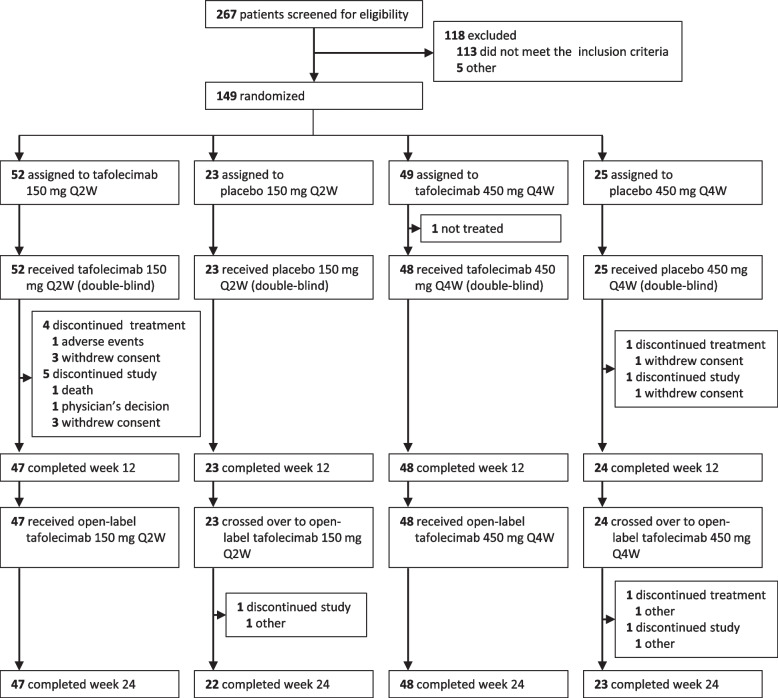
Patients diagnosed with HeFH by Simon Broome criteria and on a stable lipid-lowering therapy for at least 4 weeks were randomized 2:2:1:1 to receive subcutaneous tafolecimab 150 mg every 2 weeks (Q2W), tafolecimab 450 mg every 4 weeks (Q4W), placebo Q2W or placebo Q4W in the 12-week double-blind treatment period. After that, participants received open-label tafolecimab 150 mg Q2W or 450 mg Q4W for 12 weeks. The primary endpoint was the percent change from baseline to week 12 in LDL-C levels. Secondary endpoints included proportion of participants achieving ≥50% LDL-C reductions and proportion of participants with LDL-C <1.8 mmol/L at week 12 and 24, the change from baseline to week 12 in non-high density lipoprotein cholesterol (non-HDL-C), apolipoprotein B and lipoprotein(a) levels, as well as the change from baseline to week 24 in lipid levels.
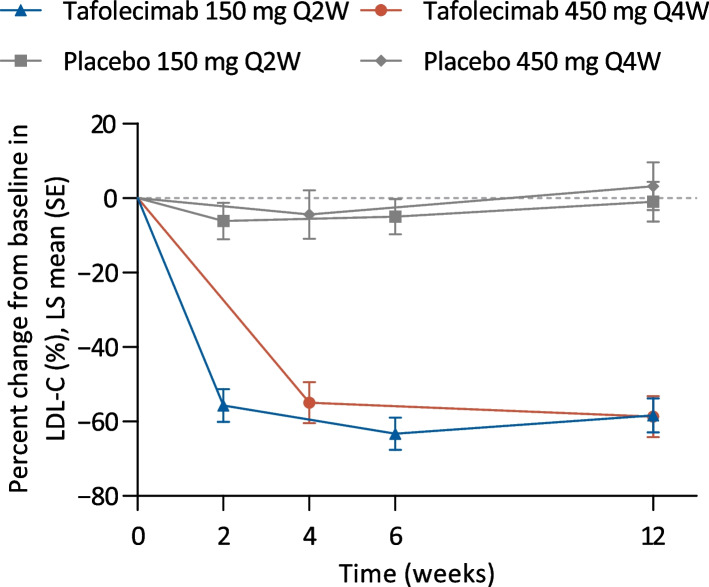
In total, 149 participants were randomized and 148 received at least one dose of the study treatment. At week 12, tafolecimab treatment induced significant reductions in LDL-C levels (treatment difference versus placebo [on-treatment estimand]: -57.4% [97.5% CI, -69.2 to -45.5] for 150 mg Q2W; -61.9% [-73.4 to -50.4] for 450 mg Q4W; both P <0.0001). At both dose regimens, significantly more participants treated with tafolecimab achieved ≥50% LDL-C reductions or LDL-C <1.8 mmol/L at week 12 as compared with corresponding placebo groups (all P <0.0001). Meanwhile, non-HDL-C, apolipoprotein B and lipoprotein(a) levels were significantly reduced in the tafolecimab groups at week 12. The lipid-lowering effects of tafolecimab were maintained till week 24. During the double-blind treatment period, the most commonly-reported adverse events in the tafolecimab groups included upper respiratory tract infection, increased blood creatine phosphokinase, increased alanine aminotransferase, increased aspartate aminotransferase and hypertension.
Tafolecimab administered either 150 mg Q2W or 450 mg Q4W yielded significant and persistent reductions in LDL-C levels and showed a favorable safety profile in Chinese patients with HeFH.
ClinicalTrials.gov, NCT04179669.
杂合子家族性高胆固醇血症(HeFH)在中国很大程度上未被诊断和治疗不足,很少有患者达到推荐的低密度脂蛋白胆固醇(LDL-C)目标水平。我们在中国 HeFH 患者中进行了首次随机、安慰剂对照的临床试验,以评估新型全长人脯氨酸内切酶枯草溶菌素/激肽释放酶 9(PCSK9)单克隆抗体 tafolecimab 的疗效和安全性。
根据 Simon Broome 标准诊断为 HeFH 并接受至少 4 周稳定降脂治疗的患者按 2:2:1:1 的比例随机接受皮下注射tafolecimab 150mg 每 2 周(Q2W)、tafolecimab 450mg 每 4 周(Q4W)、安慰剂 Q2W 或安慰剂 Q4W 的双盲治疗 12 周。此后,参与者接受开放标签tafolecimab 150mg Q2W 或 450mg Q4W 治疗 12 周。主要终点是 LDL-C 水平从基线到第 12 周的变化百分比。次要终点包括 LDL-C 降低≥50%的参与者比例和第 12 周和 24 周 LDL-C<1.8mmol/L的参与者比例,以及从基线到第 12 周非高密度脂蛋白胆固醇(非 HDL-C)、载脂蛋白 B 和脂蛋白(a)水平的变化,以及从基线到第 24 周脂质水平的变化。
共有 149 名患者被随机分组,148 名患者接受了至少一剂研究药物治疗。在第 12 周时,tafolecimab 治疗可显著降低 LDL-C 水平(治疗差异与安慰剂相比[治疗中估计值]:150mg Q2W 组为-57.4%[-69.2 至-45.5];450mg Q4W 组为-61.9%[-73.4 至-50.4];均 P<0.0001)。在两种剂量方案中,与相应的安慰剂组相比,接受 tafolecimab 治疗的患者中有更多患者达到 LDL-C 降低≥50%或 LDL-C<1.8mmol/L(均 P<0.0001)。同时,在第 12 周时,tafolecimab 组的非 HDL-C、载脂蛋白 B 和脂蛋白(a)水平也显著降低。tafolecimab 的降脂作用持续至第 24 周。在双盲治疗期间,tafolecimab 组最常见的不良事件包括上呼吸道感染、肌酸磷酸激酶升高、丙氨酸氨基转移酶升高、天冬氨酸氨基转移酶升高和高血压。
tafolecimab 150mg Q2W 或 450mg Q4W 给药均可显著持续降低 LDL-C 水平,并在中国 HeFH 患者中显示出良好的安全性。
ClinicalTrials.gov,NCT04179669。