Cao Yigeng, Wang Jiali, Jiang Shan, Lyu Mengnan, Zhao Fei, Liu Jia, Wang Mingyang, Pei Xiaolei, Zhai Weihua, Feng Xiaoming, Feng Sizhou, Han Mingzhe, Xu Yuanfu, Jiang Erlie
State Key Laboratory of Experimental Hematology, National Clinical Research Center for Blood Diseases, Haihe Laboratory of Cell Ecosystem, Institute of Hematology & Blood Diseases Hospital Chinese Academy of Medical Sciences & Peking Union Medical College Tianjin China.
Tianjin Institutes of Health Science Tianjin China.
Clin Transl Immunology. 2023 Feb 25;12(2):e1441. doi: 10.1002/cti2.1441. eCollection 2023.
Ruxolitinib, a Janus kinase (JAK) 1/2 inhibitor, demonstrates efficacy for treating steroid-resistant acute graft-versus-host disease (SR-aGVHD) following allogeneic stem cell transplantation (allo-HSCT). Myeloid-derived suppressor cells (MDSCs) have a protective effect on aGVHD via suppressing T cell function. However, the precise features and mechanism of JAK inhibitor-mediated immune modulation on MDSCs subsets remain poorly understood.
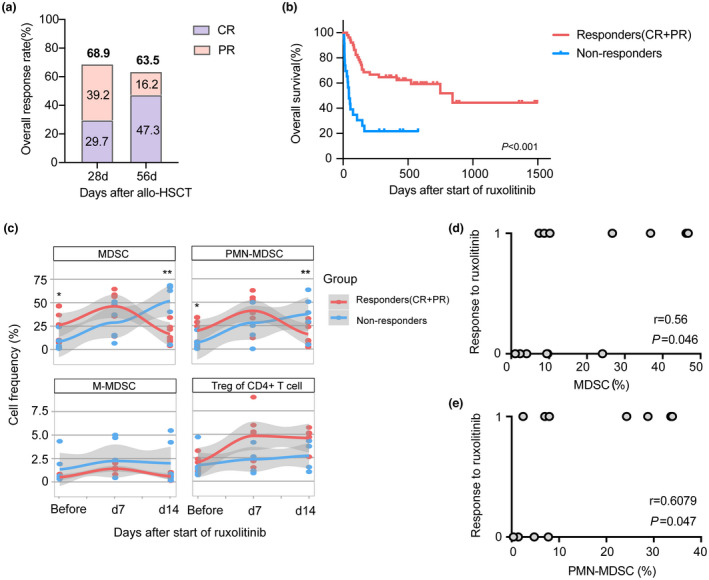
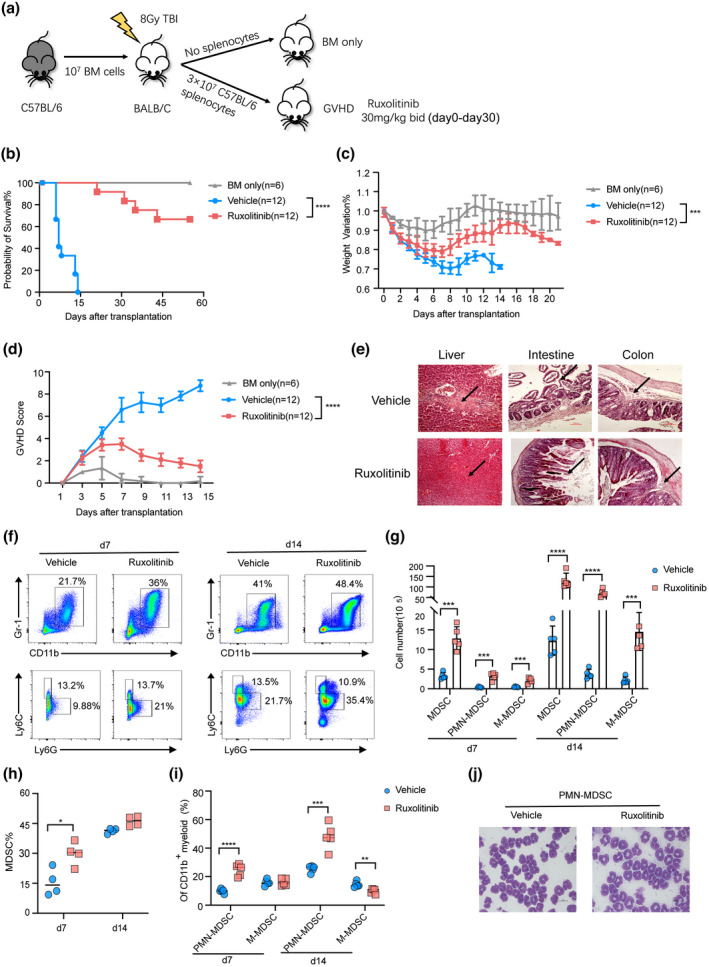
A total of 74 SR-aGVHD patients treated with allo-HSCT and ruxolitinib were enrolled in the present study. The alterations of MDSC and regulatory T cell (Treg) populations were monitored during ruxolitinib treatment in responders and nonresponders. A mouse model of aGVHD was used to evaluate the immunosuppressive activity of MDSCs and related signalling pathways in response to ruxolitinib administration and .
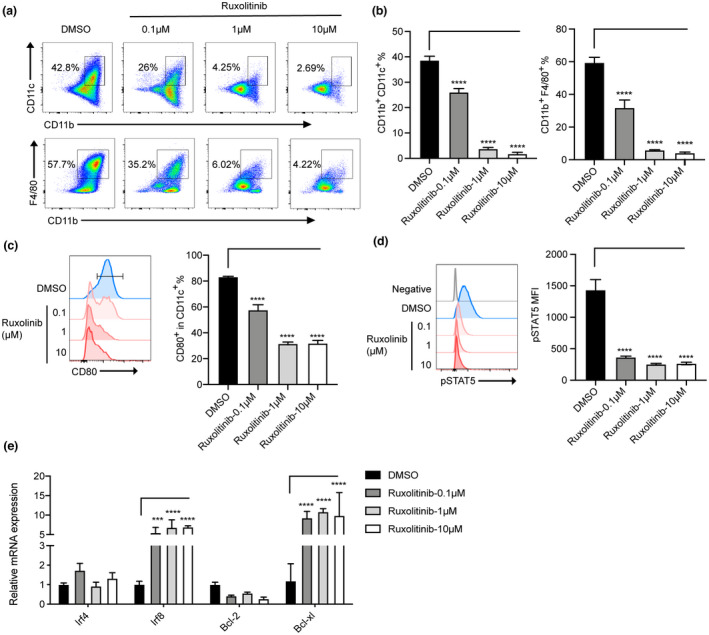
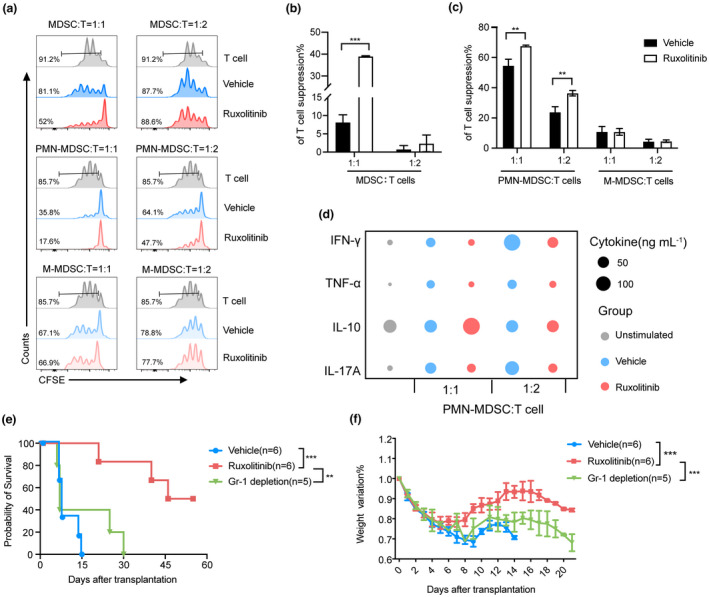
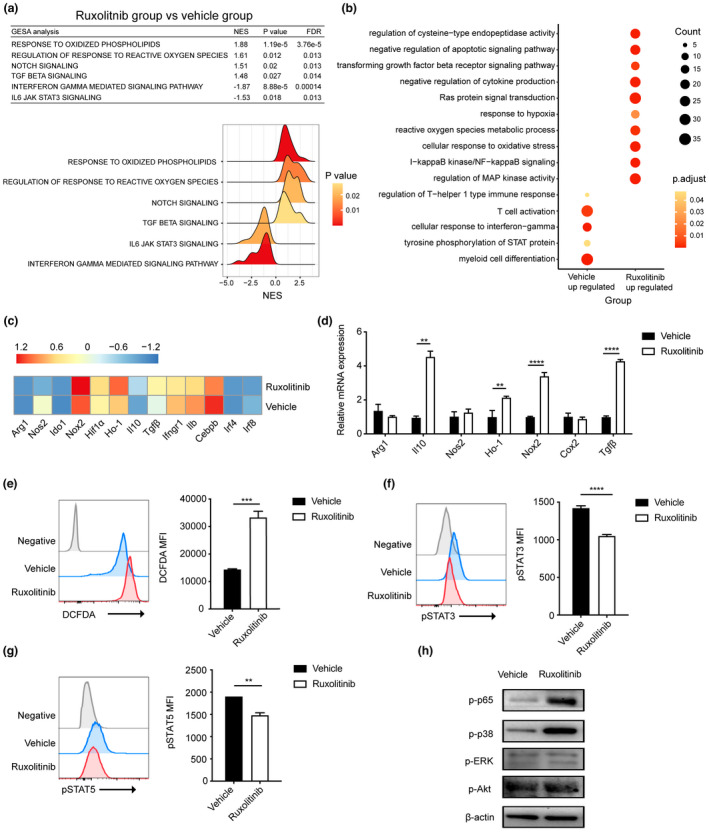
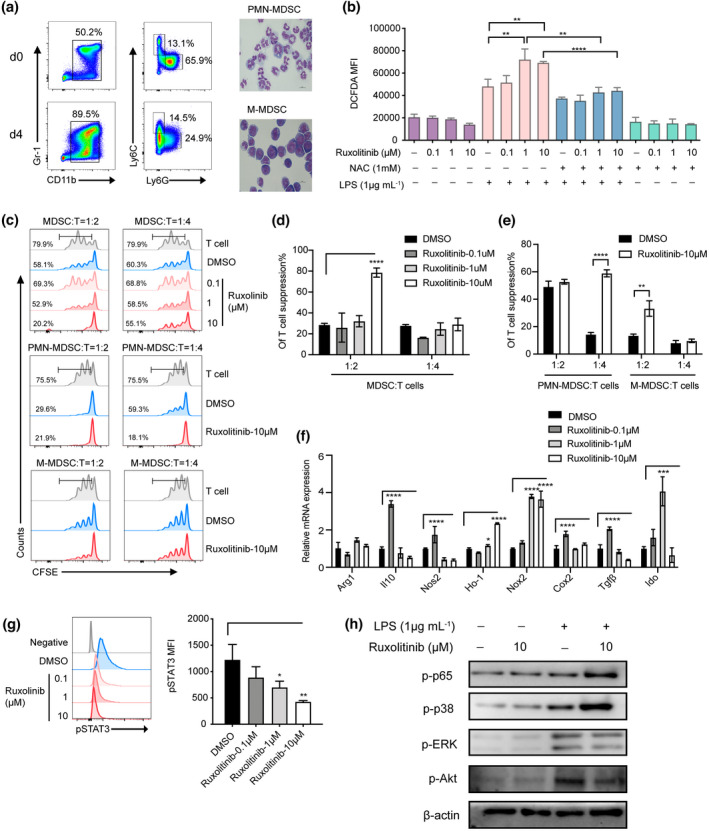
Patients with SR-aGVHD who received ruxolitinib treatment achieved satisfactory outcomes. Elevation proportions of MDSCs before treatment, especially polymorphonuclear-MDSCs (PMN-MDSCs) were better to reflect the response to ruxolitinib than those in Tregs. In the mouse model of aGVHD, the administration of ruxolitinib resulted in the expansion and functional enhancement of PMN-MDSCs and the effects could be partially reversed by an anti-Gr-1 antibody . Ruxolitinib treatment significantly elevated the suppressive function of PMN-MDSCs through reactive oxygen species (ROS) production by Nox2 upregulation as well as bypassing the activated MAPK/NF-κB signalling pathway. Additionally, experiments demonstrated that ruxolitinib prevented the differentiation of mature myeloid cells and promoted the accumulation of MDSCs by inhibiting STAT5.
Ruxolitinib enhances PMN-MDSCs functions through JAK/STAT and ROS-MAPK/NF-κB signalling pathways. Monitoring frequencies and functions of MDSCs can help evaluate treatment responses to ruxolitinib.
芦可替尼是一种Janus激酶(JAK)1/2抑制剂,在治疗异基因干细胞移植(allo-HSCT)后的类固醇难治性急性移植物抗宿主病(SR-aGVHD)方面显示出疗效。髓源性抑制细胞(MDSC)通过抑制T细胞功能对急性移植物抗宿主病具有保护作用。然而,JAK抑制剂介导的对MDSC亚群的免疫调节的确切特征和机制仍知之甚少。
本研究共纳入74例接受allo-HSCT和芦可替尼治疗的SR-aGVHD患者。在芦可替尼治疗期间,监测应答者和无应答者体内MDSC和调节性T细胞(Treg)群体的变化。使用急性移植物抗宿主病小鼠模型来评估MDSC的免疫抑制活性以及对芦可替尼给药的相关信号通路。
接受芦可替尼治疗的SR-aGVHD患者取得了满意的疗效。治疗前MDSC的升高比例,尤其是多形核MDSC(PMN-MDSC)比Treg中的比例更能反映对芦可替尼的反应。在急性移植物抗宿主病小鼠模型中,给予芦可替尼导致PMN-MDSC扩增和功能增强,并且抗Gr-1抗体可部分逆转这些作用。芦可替尼治疗通过上调Nox2产生活性氧(ROS)以及绕过激活的MAPK/NF-κB信号通路,显著提高了PMN-MDSC的抑制功能。此外,实验表明芦可替尼通过抑制STAT5来阻止成熟髓细胞的分化并促进MDSC的积累。
芦可替尼通过JAK/STAT和ROS-MAPK/NF-κB信号通路增强PMN-MDSC功能。监测MDSC的频率和功能有助于评估对芦可替尼的治疗反应。