Sheikh Shakhboot Medical City, Abu Dhabi, United Arab Emirates.
Northwestern University, Chicago, IL, USA.
J Nucl Cardiol. 2023 Oct;30(5):1922-1934. doi: 10.1007/s12350-023-03214-6. Epub 2023 Mar 1.
Planar and single-photon emission computed tomography (SPECT) nuclear imaging techniques with bone seeking radiotracers have been increasingly adopted for diagnosis of ATTR cardiac amyloidosis. However, inherent limitations of these techniques due to lack of anatomical landmarks have been recognized, with consequent high numbers of equivocal or false positive cases. SPECT/computed tomography (CT) fusion imaging offers a significant advantage to overcome these limitations by substantially reducing inaccurate interpretations. The authors present the results of a 3-year imaging quality improvement project that focused on reducing the high number of equivocal studies that were noted in the first two years of the amyloidosis program, comparing SPECT only to SPECT/CT fusion technique.
A retrospective, systematic analysis of 176 patient records was performed to test the premise that SPECT/CT fusion imaging has the potential to reduce equivocal and false positive results.
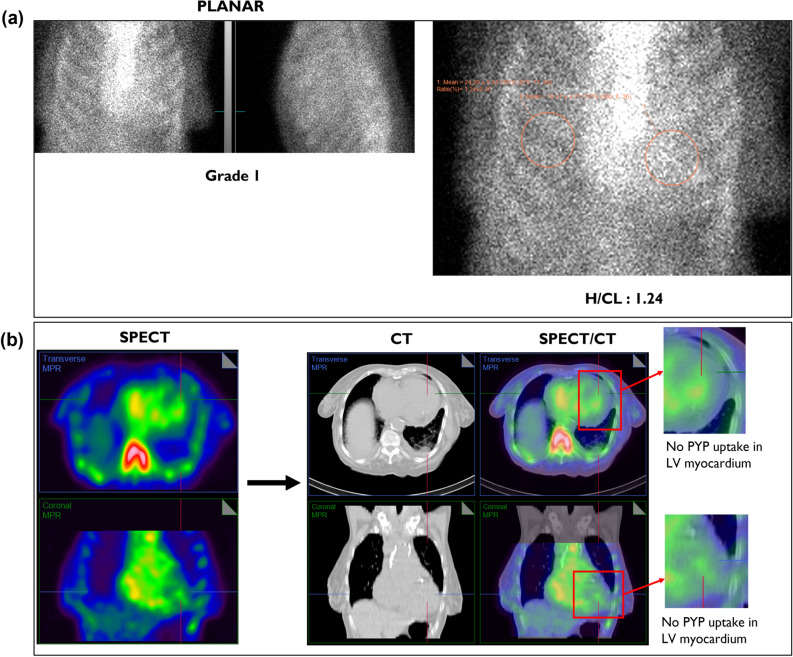
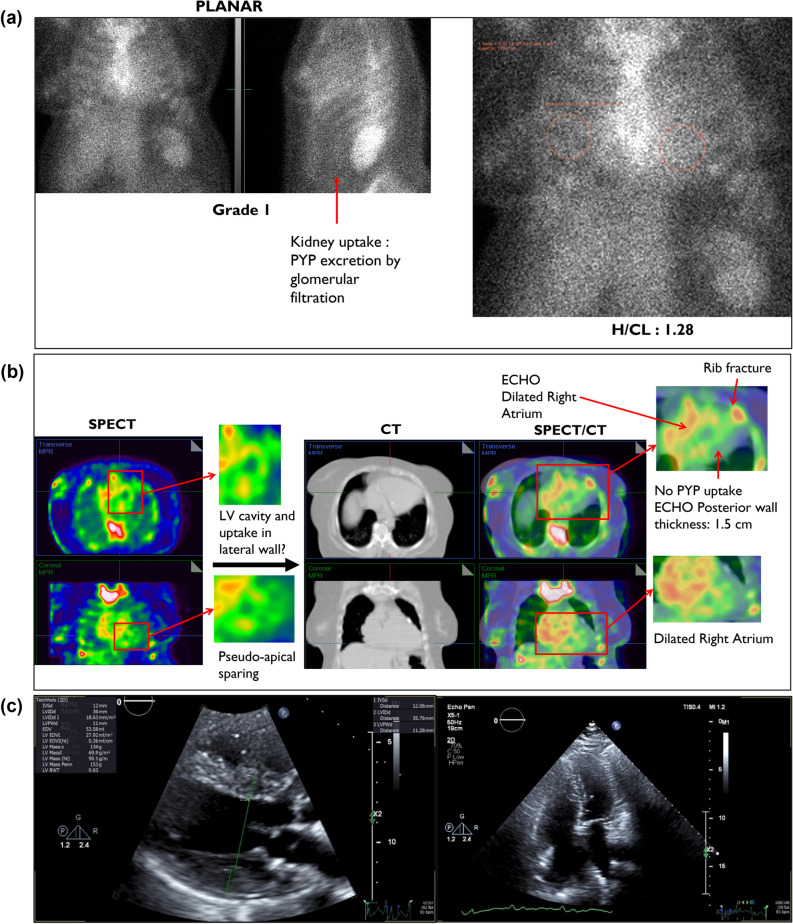
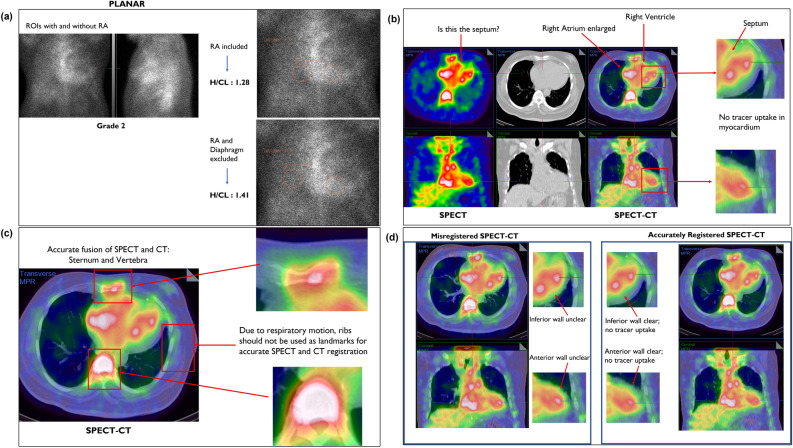
Of a total of 176 patients, 35 equivocal (19.8%), 32 (18.18%) strongly suggestive, and 109 (61.93%) not suggestive cases were identified. Recognizing that this was not consistent with the international data, the authors set out on a comprehensive quality assessment project to reduce the number of equivocal and false positive cases. In patients who initially underwent SPECT only (Group A; n = 78), the addition of SPECT/CT fusion resulted in the net reclassification of 73% of cases: 100% of equivocal cases (n = 35) were reclassified to not suggestive (n = 34) or strongly suggestive (n = 1). 73% of strongly suggestive cases (n = 30) were reclassified to not suggestive (n = 22) while 8 strongly suggestive cases were confirmed as true positives. 13 not suggestive cases remained negative after SPECT/CT fusion. In cases where SPECT/CT fusion was utilized from the beginning (Group B; n = 98), there were no reclassification of any of the cases when these cases were reprocessed as a control group.
Addition of SPECT/CT imaging reduces the false positive or equivocal studies and increases the diagnostic accuracy of the test. All false positive and equivocal studies were eliminated using the fusion technique. Utilizing the fusion imaging technique increases the spatial resolution, with the ability to localize myocardial uptake and accurately differentiate from blood pool, which is a major source of error.
平面和单光子发射计算机断层扫描(SPECT)核成像技术与骨靶向放射性示踪剂已越来越多地用于诊断ATTR 心脏淀粉样变性。然而,由于缺乏解剖学标志物,这些技术存在固有局限性,导致大量不确定或假阳性病例。SPECT/计算机断层扫描(CT)融合成像通过显著减少不准确的解释,具有克服这些局限性的优势。作者介绍了一项为期 3 年的成像质量改进项目的结果,该项目重点是减少淀粉样变性项目前两年中发现的大量不确定研究,将 SPECT 与 SPECT/CT 融合技术进行比较。
对 176 名患者的病历进行回顾性、系统分析,以验证 SPECT/CT 融合成像有可能减少不确定和假阳性结果的假设。
总共 176 名患者中,35 例为不确定(19.8%),32 例为强烈提示(18.18%),109 例为非提示(61.93%)。作者认识到这与国际数据不一致,因此开始进行全面的质量评估项目,以减少不确定和假阳性病例的数量。在最初仅接受 SPECT 检查的患者中(A 组,n=78),添加 SPECT/CT 融合后,有 73%的病例进行了重新分类:100%的不确定病例(n=35)被重新分类为非提示(n=34)或强烈提示(n=1)。73%的强烈提示病例(n=30)被重新分类为非提示(n=22),而 8 例强烈提示病例被确认为真阳性。13 例非提示病例在 SPECT/CT 融合后仍为阴性。在从一开始就使用 SPECT/CT 融合的患者中(B 组,n=98),当这些病例作为对照组重新处理时,没有任何病例进行重新分类。
添加 SPECT/CT 成像可减少假阳性或不确定的研究,并提高测试的诊断准确性。所有假阳性和不确定的研究都通过融合技术消除。使用融合成像技术提高了空间分辨率,能够定位心肌摄取,并准确区分血池,血池是主要的误差源。