Department of Obstetrics, University Hospital Leipzig, Liebigstraße 20a, 04103, Leipzig, Germany.
LIFE Leipzig Research Center for Civilization Diseases, University of Leipzig, 04103, Leipzig, Germany.
Arch Gynecol Obstet. 2024 Mar;309(3):1009-1020. doi: 10.1007/s00404-023-06937-6. Epub 2023 Mar 2.
The physical health and development of an individual are influenced by multiple parameters and shaped by internal and external factors during pregnancy. However, it is unclear whether there is an association between maternal lipid concentrations in the third trimester of pregnancy and infant serum lipids as well as anthropometric growth, and whether these factors are influenced by the socioeconomic status (SES) of the mothers.
Between 2011 and 2021, 982 mother-child pairs were recruited in the LIFE-Child study. To investigate the influence of prenatal factors, pregnant women at the 24th and 36th week of gestation as well as children at the age of 3, 6 and 12 months were examined and serum lipids determined. Socioeconomic status (SES) was assessed using the validated Winkler Index.
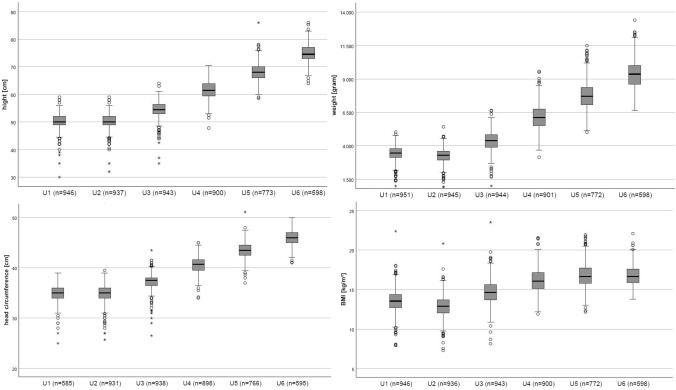
A higher maternal BMI was associated with a significantly lower Winkler score and a higher infant weight, height, head circumference and BMI from birth up to the 4th-5th week of life. In addition, the Winkler Index correlates with maternal HDL cholesterol and ApoA1 levels. There was no relation between the delivery mode and the maternal BMI or SES. For the maternal HDL cholesterol concentration in the third trimester, an inverse relation to children's height, weight, head circumference and BMI up to the first year of life as well as the chest and abdominal circumference to an age of 3 months was found. Children born to mothers with dyslipidemia in pregnancy tended to have a worse lipid profile than those born to normolipidemic mothers.
Serum lipid concentrations and anthropometric parameters of children in the first year of life are affected by multiple factors like maternal BMI, lipid levels and SES.
个体的身体健康和发育受到多种参数的影响,并在妊娠期间受到内外因素的塑造。然而,目前尚不清楚孕妇妊娠晚期的血脂浓度与婴儿血清脂质以及人体测量生长之间是否存在关联,以及这些因素是否受到母亲社会经济地位(SES)的影响。
在 2011 年至 2021 年期间,LIFE-Child 研究共招募了 982 对母婴对。为了研究产前因素的影响,在妊娠第 24 周和第 36 周以及儿童 3 个月、6 个月和 12 个月时检查并测定血清脂质。使用经过验证的 Winkler 指数评估社会经济地位(SES)。
母亲 BMI 较高与 Winkler 评分显著降低和婴儿出生后至第 4-5 周体重、身高、头围和 BMI 较高相关。此外,Winkler 指数与母亲 HDL 胆固醇和 ApoA1 水平相关。分娩方式与母亲 BMI 或 SES 之间没有关系。对于母亲在妊娠晚期的 HDL 胆固醇浓度,与儿童在生命的前 1 年的身高、体重、头围和 BMI 以及 3 个月时的胸围和腹围呈负相关。患有妊娠血脂异常的母亲所生的儿童的血脂状况往往比正常血脂母亲所生的儿童差。
儿童在生命的第一年的血清脂质浓度和人体测量参数受到多种因素的影响,如母亲 BMI、脂质水平和 SES。