Informatics, Decision-Enhancement, and Analytic Sciences (IDEAS) Center of Innovation, VA Salt Lake City Health Care System, Salt Lake City, UT.
Division of Epidemiology, Department of Internal Medicine, University of Utah, Salt Lake City, UT.
Medicine (Baltimore). 2023 Mar 3;102(9):e33134. doi: 10.1097/MD.0000000000033134.
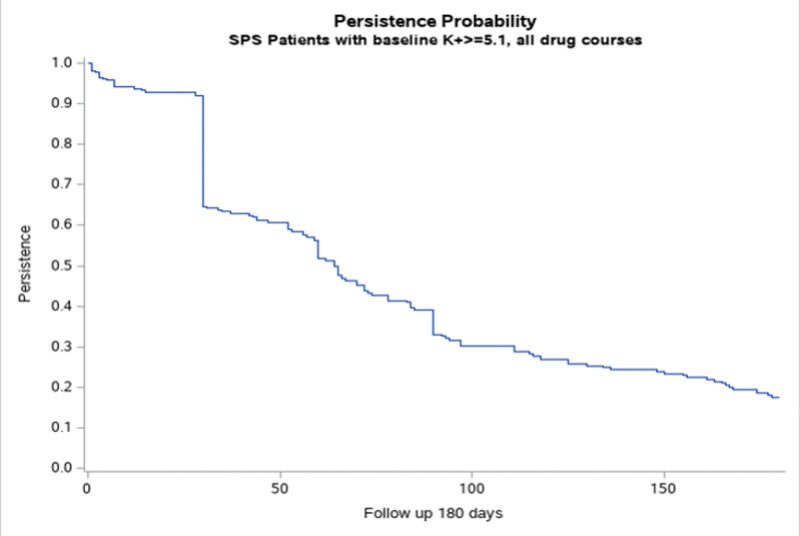
Untreated chronic hyperkalemia is associated with an increased risk of mortality. Novel potassium binders (e.g., patiromer) are new additions to the clinician's armamentarium. Prior to their approval, clinicians often considered trialing sodium polystyrene sulfonate. The study objective was to assess patiromer utilization and associated changes in serum potassium (K+) in US veterans with prior sodium polystyrene sulfonate exposure. This was a real-world observational study of US veterans with chronic kidney disease and a baseline K+ ≥ 5.1 mEq/L, initiated on patiromer between January 1, 2016, and February 28, 2021. The primary endpoints were patiromer utilization (dispensations and treatment courses), and K+ change at 30-, 91-, and 182-day follow-up (FU) intervals. Patiromer utilization was described using Kaplan-Meier probabilities and the proportion of days covered. Descriptive changes in population average K+ were obtained from a pre-post design using single-arm within-patient pre-post lab pairs and paired t tests. Two hundred five veterans met the study criteria. We observed an average of 1.25 (95% CI, 1.19-1.31) treatment courses and a median treatment duration of 64 days. Fifty veterans (24.4%) had >1 course, and 17.6% of patients remained on their initial patiromer treatment course until the end of the 180-day FU. The mean K+ value was 5.73 mEq/L (5.66-5.79) at baseline, 4.95 mEq/L (95% CI, 4.86-5.05) at the 30-day interval, 4.93 mEq/L (95% CI, 4.84-5.03) at the 91-day interval, and 4.9 mEq/L (95% CI, 4.8-4.99) at the 182-day interval. Novel potassium binders (e.g., patiromer) are newer chronic hyperkalemia management tools for clinicians. The average population K+ decreased to <5.1 mEq/L at all follow-up intervals. Patiromer appeared to be well tolerated with nearly 18% of patients remaining on their initial treatment course during the entire 180-day FU period. The median treatment duration was 64 days and approximately 24% of patients initiated a second course during FU.
未经治疗的慢性高钾血症与死亡率增加有关。新型钾结合剂(例如,聚对苯乙烯磺酸钠)是临床医生治疗方法的新补充。在获得批准之前,临床医生通常考虑试用聚苯乙烯磺酸钠。本研究的目的是评估美国退伍军人中聚对苯乙烯磺酸钠暴露后的培特洛默尔的使用情况及其与血清钾(K+)变化的相关性。这是一项针对美国退伍军人的真实世界观察性研究,这些退伍军人患有慢性肾脏病,基线 K+≥5.1mEq/L,于 2016 年 1 月 1 日至 2021 年 2 月 28 日期间开始接受培特洛默尔治疗。主要终点是培特洛默尔的使用情况(配药和治疗疗程)以及 30、91 和 182 天随访(FU)间隔的 K+变化。培特洛默尔的使用情况使用 Kaplan-Meier 概率和覆盖率比例进行描述。通过使用单臂内患者前后实验室配对和配对 t 检验的前后设计,获得人群平均 K+的描述性变化。205 名退伍军人符合研究标准。我们观察到平均 1.25(95%CI,1.19-1.31)个疗程,中位治疗时间为 64 天。50 名退伍军人(24.4%)接受了>1 个疗程,17.6%的患者在 180 天 FU 结束前仍在接受初始培特洛默尔治疗。平均 K+值在基线时为 5.73mEq/L(5.66-5.79),在 30 天间隔时为 4.95mEq/L(95%CI,4.86-5.05),在 91 天间隔时为 4.93mEq/L(95%CI,4.84-5.03),在 182 天间隔时为 4.9mEq/L(95%CI,4.8-4.99)。新型钾结合剂(例如,聚对苯乙烯磺酸钠)是临床医生治疗慢性高钾血症的新工具。所有随访间隔的平均人群 K+均降至<5.1mEq/L。培特洛默尔耐受性良好,近 18%的患者在整个 180 天 FU 期间仍在接受初始治疗。中位治疗持续时间为 64 天,约 24%的患者在 FU 期间开始第二疗程。