Public Health Ontario, 480 University Avenue, Suite 300, M5G 1V2, Toronto, ON, Canada.
Public Health Ontario, 661 University Avenue, Suite 1701, M5G 1M1, Toronto, ON, Canada.
BMC Public Health. 2023 Mar 2;23(1):420. doi: 10.1186/s12889-023-15313-7.
The COVID-19 pandemic continues to demonstrate the risks and profound health impacts that result from infectious disease emergencies. Emergency preparedness has been defined as the knowledge, capacity and organizational systems that governments, response and recovery organizations, communities and individuals develop to anticipate, respond to, or recover from emergencies. This scoping review explored recent literature on priority areas and indicators for public health emergency preparedness (PHEP) with a focus on infectious disease emergencies.
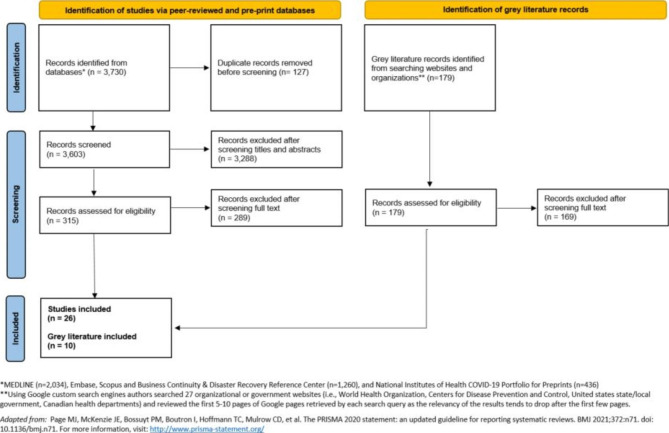
Using scoping review methodology, a comprehensive search was conducted for indexed and grey literature with a focus on records published from 2017 to 2020 onward, respectively. Records were included if they: (a) described PHEP, (b) focused on an infectious emergency, and (c) were published in an Organization for Economic Co-operation and Development country. An evidence-based all-hazards Resilience Framework for PHEP consisting of 11 elements was used as a reference point to identify additional areas of preparedness that have emerged in recent publications. The findings were analyzed deductively and summarized thematically.
The included publications largely aligned with the 11 elements of the all-hazards Resilience Framework for PHEP. In particular, the elements related to collaborative networks, community engagement, risk analysis and communication were frequently observed across the publications included in this review. Ten emergent themes were identified that expand on the Resilience Framework for PHEP specific to infectious diseases. Planning to mitigate inequities was a key finding of this review, it was the most frequently identified emergent theme. Additional emergent themes were: research and evidence-informed decision making, building vaccination capacity, building laboratory and diagnostic system capacity, building infection prevention and control capacity, financial investment in infrastructure, health system capacity, climate and environmental health, public health legislation and phases of preparedness.
The themes from this review contribute to the evolving understanding of critical public health emergency preparedness actions. The themes expand on the 11 elements outlined in the Resilience Framework for PHEP, specifically relevant to pandemics and infectious disease emergencies. Further research will be important to validate these findings, and expand understanding of how refinements to PHEP frameworks and indicators can support public health practice.
新冠疫情持续表明,传染病突发事件会带来风险和深远的健康影响。应急准备的定义是指政府、应对和恢复组织、社区和个人为预测、应对或从突发事件中恢复而开发的知识、能力和组织系统。本范围综述探讨了近期关于公共卫生应急准备(PHEP)优先领域和指标的文献,重点是传染病突发事件。
使用范围综述方法,对索引和灰色文献进行了全面搜索,重点是分别于 2017 年至 2020 年出版的记录。如果记录符合以下条件,则将其纳入:(a) 描述 PHEP,(b) 专注于传染病紧急情况,以及 (c) 在经济合作与发展组织国家出版。使用基于证据的公共卫生应急准备综合韧性框架(包括 11 个要素)作为参考点,以确定近期出版物中出现的其他准备领域。通过演绎分析对研究结果进行分析,并进行主题总结。
纳入的出版物在很大程度上与公共卫生应急准备综合韧性框架的 11 个要素一致。特别是在协作网络、社区参与、风险分析和沟通方面,这些要素在本综述中包含的出版物中经常被观察到。确定了 10 个扩展公共卫生应急准备综合韧性框架特定于传染病的新兴主题。减轻不平等现象的规划是本次综述的一个关键发现,也是最常被确定的新兴主题。其他新兴主题包括:研究和循证决策、建立疫苗接种能力、建立实验室和诊断系统能力、建立感染预防和控制能力、基础设施的财政投资、卫生系统能力、气候和环境卫生、公共卫生立法和准备阶段。
本次综述的主题有助于不断发展的对关键公共卫生应急准备行动的理解。这些主题扩展了公共卫生应急准备综合韧性框架中概述的 11 个要素,特别是与大流行和传染病突发事件相关的要素。进一步的研究对于验证这些发现以及扩展对 PHEP 框架和指标的改进如何支持公共卫生实践的理解将是重要的。