Laboratoire d'Analyse et d'Architecture des Systèmes (LAAS), Toulouse, France.
Institut National de la Santé Et de la Recherche Médicale (INSERM), Toulouse, France.
J Appl Clin Med Phys. 2023 Jun;24(6):e13923. doi: 10.1002/acm2.13923. Epub 2023 Mar 2.
To develop an alternative computational approach for EPID-based non-transit dosimetry using a convolutional neural network model.
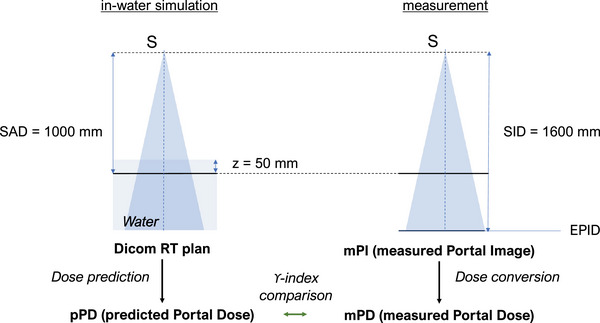
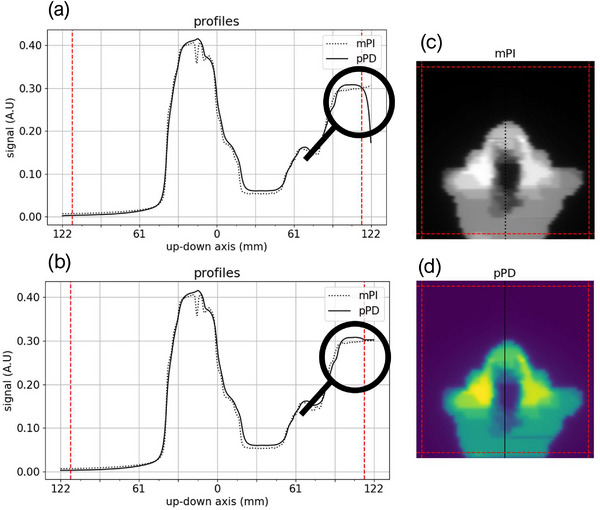
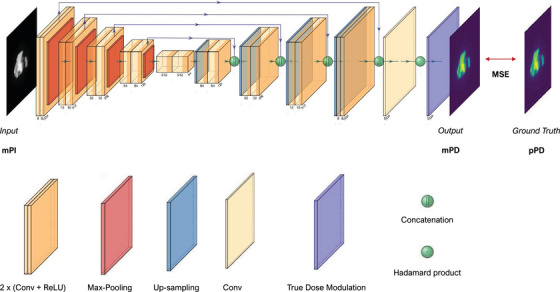
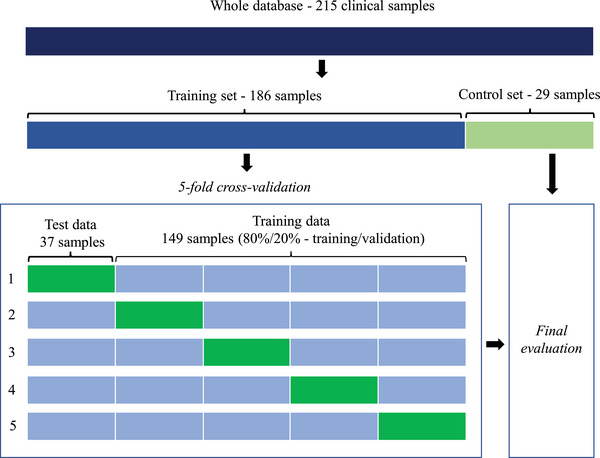
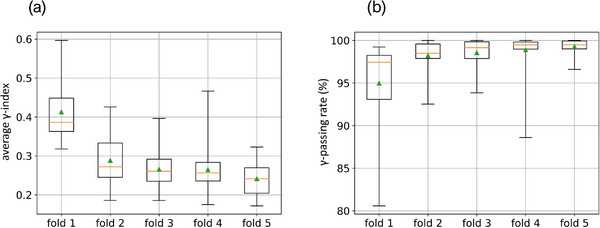
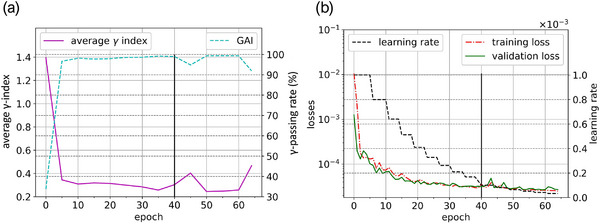
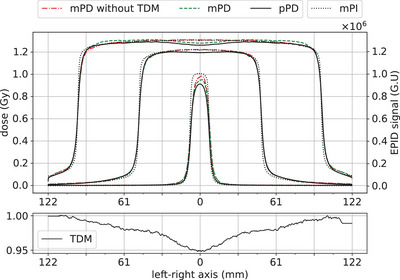
A U-net followed by a non-trainable layer named True Dose Modulation recovering the spatialized information was developed. The model was trained on 186 Intensity-Modulated Radiation Therapy Step & Shot beams from 36 treatment plans of different tumor locations to convert grayscale portal images into planar absolute dose distributions. Input data were acquired from an amorphous-Silicon Electronic Portal Image Device and a 6 MV X-ray beam. Ground truths were computed from a conventional kernel-based dose algorithm. The model was trained by a two-step learning process and validated through a five-fold cross-validation procedure with sets of training and validation of 80% and 20%, respectively. A study regarding the dependance of the amount of training data was conducted. The performance of the model was evaluated from a quantitative analysis based the ϒ-index, absolute and relative errors computed between the inferred dose distributions and ground truths for six square and 29 clinical beams from seven treatment plans. These results were also compared to those of an existing portal image-to-dose conversion algorithm.
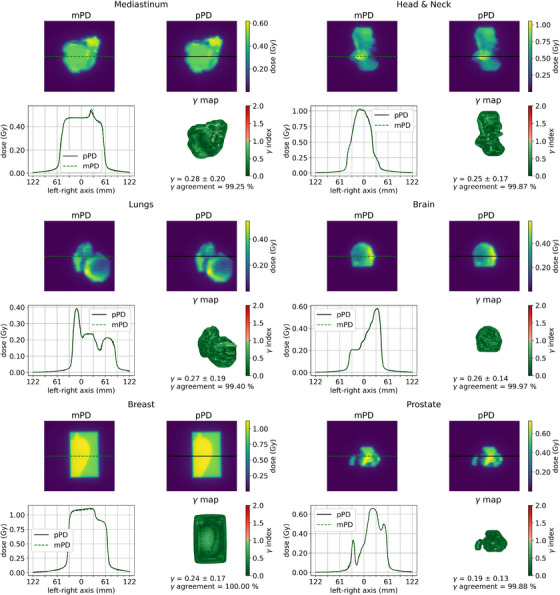
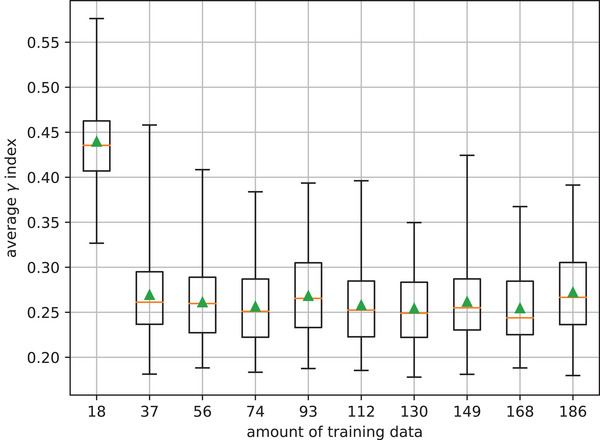
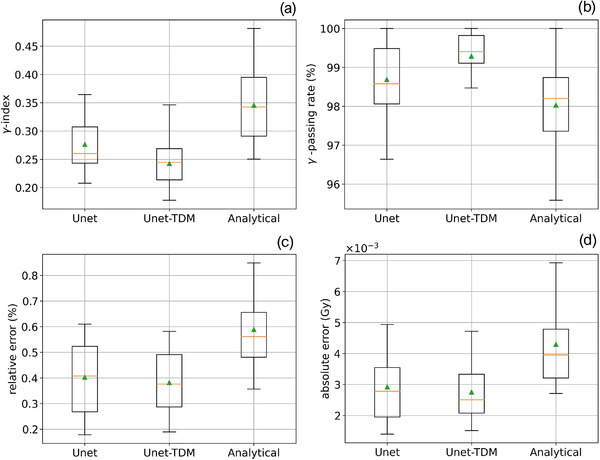
For the clinical beams, averages of ϒ-index and ϒ-passing rate (2%-2mm > 10% D ) of 0.24 (±0.04) and 99.29 (±0.70)% were obtained. For the same metrics and criteria, averages of 0.31 (±0.16) and 98.83 (±2.40)% were obtained with the six square beams. Overall, the developed model performed better than the existing analytical method. The study also showed that sufficient model accuracy can be achieved with the amount of training samples used.
A deep learning-based model was developed to convert portal images into absolute dose distributions. The accuracy obtained shows that this method has great potential for EPID-based non-transit dosimetry.
开发一种基于卷积神经网络模型的 EPID 无传输剂量学的替代计算方法。
开发了一个 U-net 模型,后面跟着一个不可训练的层,称为真剂量调制,用于恢复空间化信息。该模型在 36 个不同肿瘤部位的治疗计划中,对 186 个调强放疗步长和射野的强度调制放射治疗(IMRT)进行了训练,以将灰度门控图像转换为平面绝对剂量分布。输入数据是从非晶硅电子射野影像装置和 6 MV X 射线束中获取的。基准是从基于传统核的剂量算法计算得出的。该模型通过两步学习过程进行训练,并通过五折交叉验证程序进行验证,其中训练集和验证集分别为 80%和 20%。还进行了一项关于训练数据量依赖性的研究。通过基于γ指数的定量分析、推断剂量分布与基准之间的绝对和相对误差,评估模型的性能,对来自七个治疗计划的六个方形和 29 个临床射野进行了评估。这些结果还与现有的门控图像到剂量转换算法的结果进行了比较。
对于临床射野,得到的γ指数和γ通过率(2%-2mm>10% D)平均值分别为 0.24(±0.04)和 99.29(±0.70)%。对于相同的指标和标准,使用六个方形射野得到的平均值分别为 0.31(±0.16)和 98.83(±2.40)%。总体而言,开发的模型比现有的分析方法表现更好。该研究还表明,使用训练样本量可以实现足够的模型精度。
开发了一种基于深度学习的模型,用于将门控图像转换为绝对剂量分布。所获得的准确性表明,该方法在基于 EPID 的无传输剂量学中具有很大的潜力。