D'Oliviera Angel, Dai Xuhang, Mottaghinia Saba, Olson Sophie, Geissler Evan P, Etienne Lucie, Zhang Yingkai, Mugridge Jeffrey S
Department of Chemistry & Biochemistry, University of Delaware, Newark, DE 19716.
Department of Chemistry, New York University, New York, NY 10003.
bioRxiv. 2024 Oct 15:2023.02.20.529306. doi: 10.1101/2023.02.20.529306.
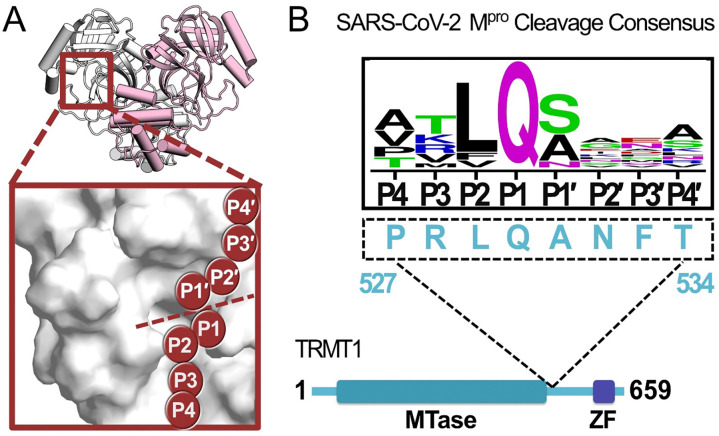
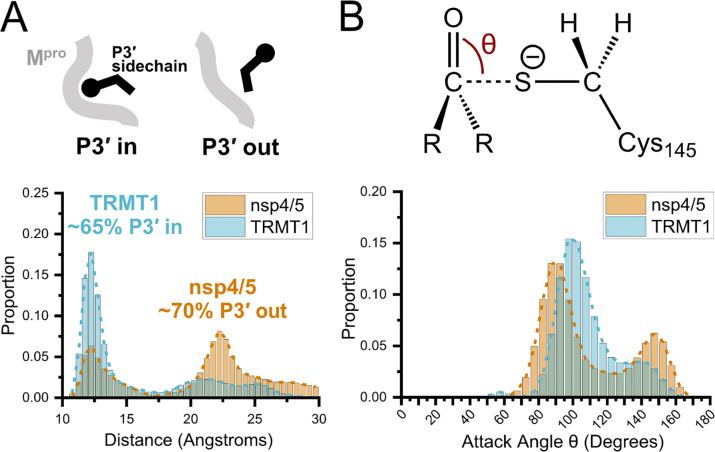
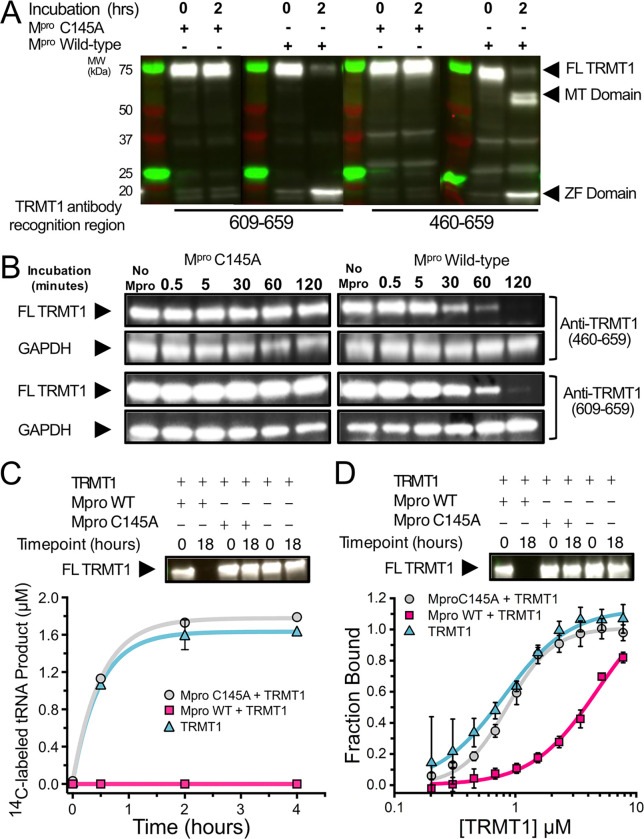
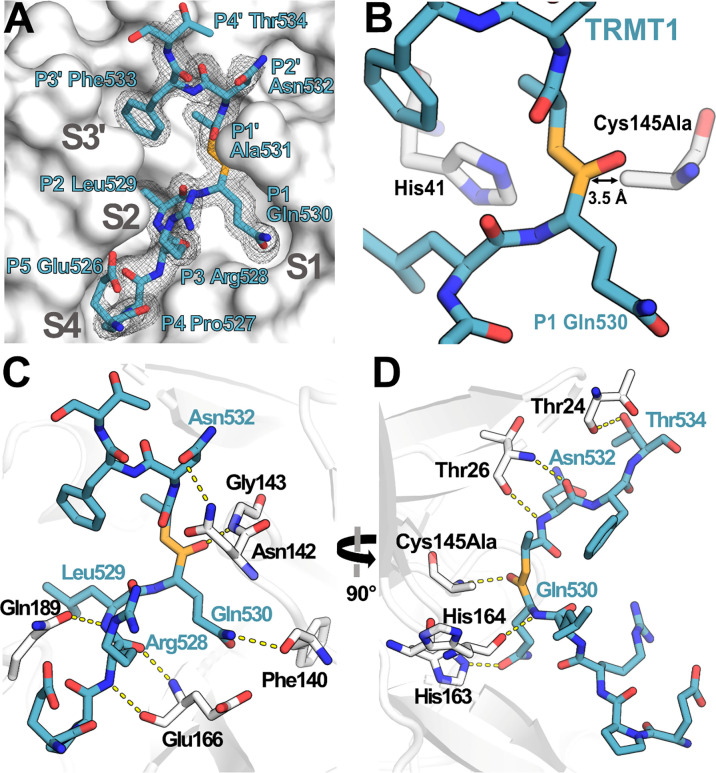
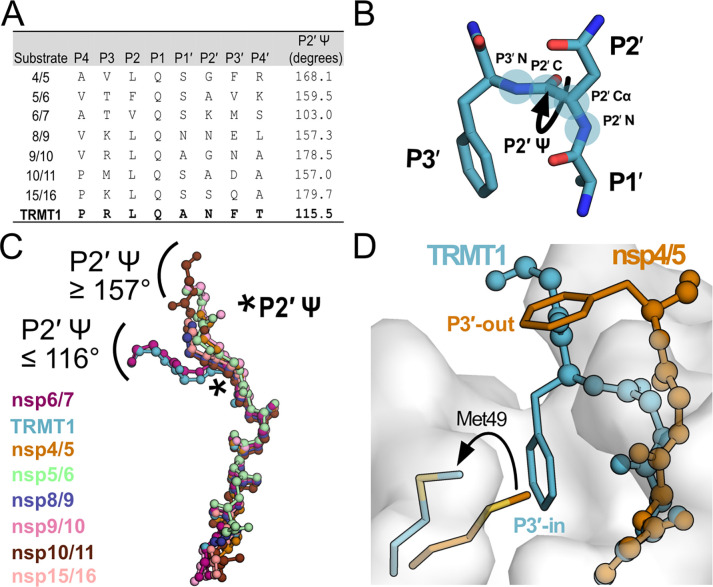
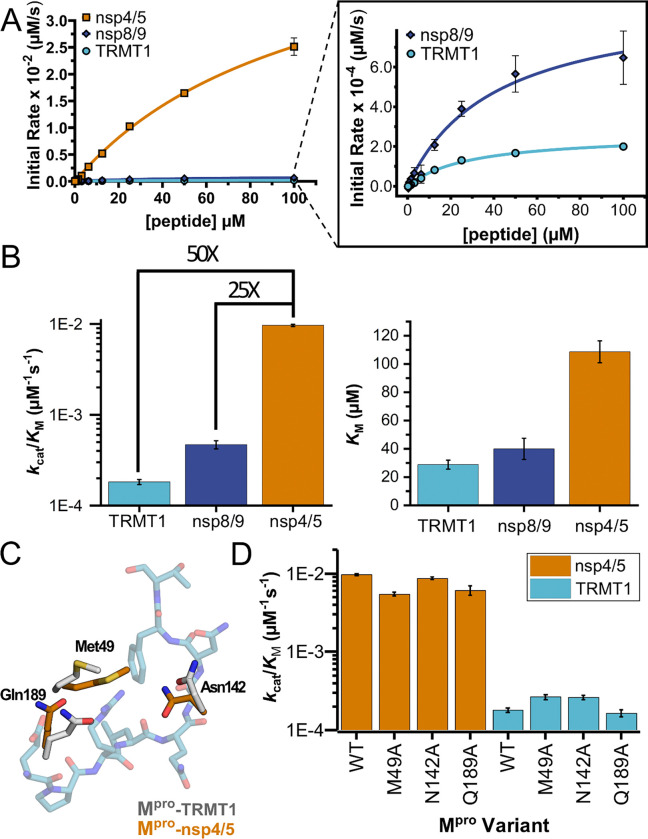
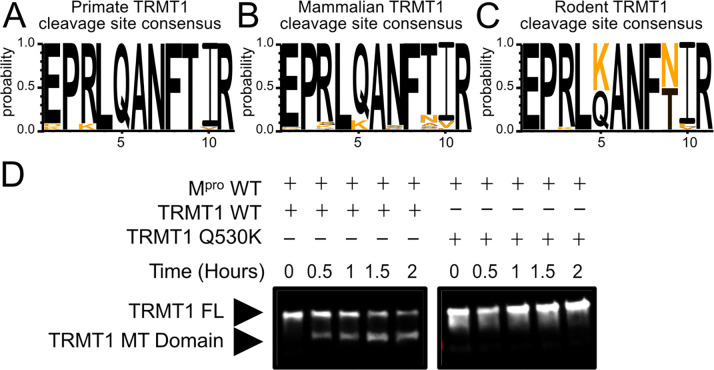
The SARS-CoV-2 main protease (M, or Nsp5) is critical for the production of functional viral proteins during infection and, like many viral proteases, can also target host proteins to subvert their cellular functions. Here, we show that the human tRNA methyltransferase TRMT1 can be recognized and cleaved by SARS-CoV-2 M. TRMT1 installs the , -dimethylguanosine (m2,2G) modification on mammalian tRNAs, which promotes global protein synthesis and cellular redox homeostasis. We find that M can cleave endogenous TRMT1 in human cell lysate, resulting in removal of the TRMT1 zinc finger domain. TRMT1 proteolysis results in elimination of TRMT1 tRNA methyltransferase activity and reduced tRNA binding affinity. Evolutionary analysis shows that the TRMT1 cleavage site is highly conserved in mammals, except in Muroidea, where TRMT1 is likely resistant to cleavage. In primates, regions outside the cleavage site with rapid evolution could indicate adaptation to ancient viral pathogens. Furthermore, we determined the structure of a TRMT1 peptide in complex with M, revealing a substrate binding conformation distinct from the majority of available M-peptide complexes. Kinetic parameters for peptide cleavage show that the TRMT1(526-536) sequence is cleaved with comparable efficiency to the M-targeted nsp8/9 viral cleavage site. Mutagenesis studies and molecular dynamics simulations together indicate that kinetic discrimination occurs during a later step of M-mediated proteolysis that follows substrate binding. Our results provide new information about the structural basis for M substrate recognition and cleavage, the functional roles of the TRMT1 zinc finger domain in tRNA binding and modification, and the regulation of TRMT1 activity by SARS-CoV-2 M. These studies could inform future therapeutic design targeting M and raise the possibility that proteolysis of human TRMT1 during SARS-CoV-2 infection suppresses protein translation and oxidative stress response to impact viral pathogenesis.
Viral proteases can strategically target human proteins to manipulate host biochemistry during infection. Here, we show that the SARS-CoV-2 main protease (M) can specifically recognize and cleave the human tRNA methyltransferase enzyme TRMT1, and that cleavage of TRMT1 cripples its ability to install a key modification on human tRNAs that is critical for protein translation. Our structural and functional analysis of the M-TRMT1 interaction shows how the flexible M active site engages a conserved sequence in TRMT1 in an uncommon binding mode to catalyze its cleavage and inactivation. These studies provide new insights into substrate recognition by SARS-CoV-2 M that could help guide future antiviral therapeutic development and show how proteolysis of TRMT1 during SARS-CoV-2 infection impairs both TRMT1 tRNA binding and tRNA modification activity to disrupt host translation and potentially impact COVID-19 pathogenesis or phenotypes.
严重急性呼吸综合征冠状病毒2(SARS-CoV-2)主蛋白酶(M,即Nsp5)在感染期间对于功能性病毒蛋白的产生至关重要,并且与许多病毒蛋白酶一样,它还可以靶向宿主蛋白以颠覆其细胞功能。在此,我们表明人类tRNA甲基转移酶TRMT1可被SARS-CoV-2 M识别并切割。TRMT1在哺乳动物tRNA上安装N2,N2-二甲基鸟苷(m2,2G)修饰,这促进了整体蛋白质合成和细胞氧化还原稳态。我们发现M可在人细胞裂解物中切割内源性TRMT1,导致TRMT1锌指结构域的去除。TRMT1蛋白水解导致TRMT1 tRNA甲基转移酶活性的消除和tRNA结合亲和力的降低。进化分析表明,TRMT1切割位点在哺乳动物中高度保守,但鼠形亚目除外,在鼠形亚目中TRMT1可能对切割具有抗性。在灵长类动物中,切割位点以外快速进化的区域可能表明对古代病毒病原体的适应。此外,我们确定了与M复合的TRMT1肽的结构,揭示了一种与大多数可用的M-肽复合物不同的底物结合构象。肽切割的动力学参数表明,TRMT1(526-536)序列的切割效率与M靶向的nsp8/9病毒切割位点相当。诱变研究和分子动力学模拟共同表明,动力学区分发生在M介导的蛋白水解底物结合后的后期步骤。我们的结果提供了关于M底物识别和切割结构基础、TRMT1锌指结构域在tRNA结合和修饰中的功能作用以及SARS-CoV-2 M对TRMT1活性调节的新信息。这些研究可为未来靶向M的治疗设计提供信息,并增加了SARS-CoV-2感染期间人类TRMT1的蛋白水解抑制蛋白质翻译和氧化应激反应以影响病毒发病机制的可能性。
病毒蛋白酶可在感染期间策略性地靶向人类蛋白以操纵宿主生物化学。在此,我们表明SARS-CoV-2主蛋白酶(M)可特异性识别并切割人类tRNA甲基转移酶TRMT1,并且TRMT1的切割削弱了其在人类tRNA上安装对蛋白质翻译至关重要的关键修饰的能力。我们对M-TRMT1相互作用的结构和功能分析表明,灵活的M活性位点如何以不常见的结合模式与TRMT1中的保守序列结合以催化其切割和失活。这些研究为SARS-CoV-2 M的底物识别提供了新见解,这可能有助于指导未来抗病毒治疗的开发,并表明SARS-CoV-2感染期间TRMT1的蛋白水解如何损害TRMT1的tRNA结合和tRNA修饰活性,从而破坏宿主翻译并可能影响COVID-19发病机制或表型。