Dasa Marcus Smavik, Friborg Oddgeir, Kristoffersen Morten, Pettersen Gunn, Plasqui Guy, Sundgot-Borgen Jorunn Kaiander, Rosenvinge Jan H
Department of Health and Care Sciences, UiT The Arctic University of Norway, Tromso, Norway.
Department of Psychology, UiT The Arctic University of Norway, Tromso, Norway.
BMJ Open Sport Exerc Med. 2023 Feb 23;9(1):e001553. doi: 10.1136/bmjsem-2023-001553. eCollection 2023.
To quantify energy expenditure and intake in professional female footballers playing on a national and/or international level. Second, to determine the prevalence of low energy availability among these players, defined as <30 kcal/kg fat-free mass (FFM)/day.
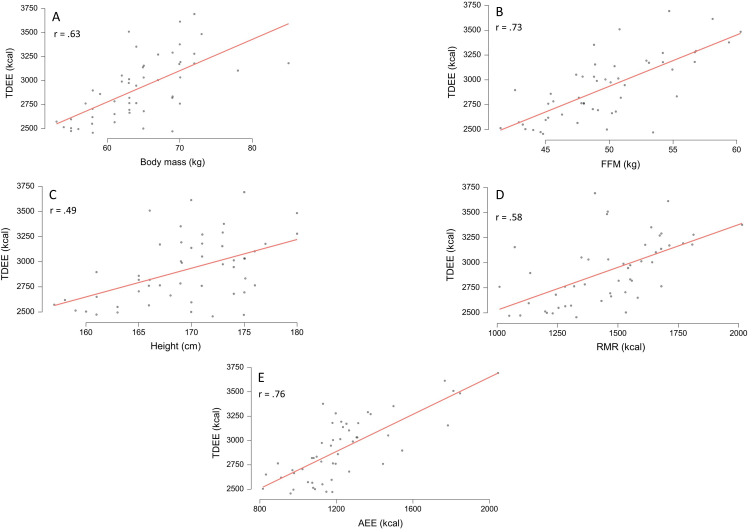
Fifty-one players completed a 14-day prospective observational study during the 2021/2022 football season. Energy expenditure was determined using the doubly labelled water method. Energy intake was assessed using dietary recalls, while global positioning system determined the external physiological load. Descriptive statistics, stratification and the correlation between explainable variables and outcomes were conducted to quantify the energetic demands.
The mean energy expenditure for all players (22±4 years) was 2918±322 kcal. Mean energy intake was 2274±450 kcal, resulting in a discrepancy of ~22%. Carbohydrate intake was below the recommended guidelines on match day at 4.5±1.9 g/kg. The mean energy availability was 36.7±17.7 kcal/kg FFM/day on matchday and 37.9±11.7 kcal/kg FFM/day on training days, resulting in a prevalence of 36% and 23% for low energy availability during the observational period, respectively.
These elite female football players displayed moderate energy expenditure levels and failed to meet the recommended levels of carbohydrate intake. In conjunction with inadequate nutritional periodisation, this will likely hamper performance through inadequate muscle glycogen resynthesis. In addition, we found a considerable prevalence of low energy availability on match and training days.
量化在国家和/或国际层面参赛的职业女足运动员的能量消耗与摄入。其次,确定这些运动员中能量可利用量低(定义为<30千卡/千克去脂体重/天)的患病率。
51名运动员在2021/2022足球赛季期间完成了一项为期14天的前瞻性观察研究。使用双标水法测定能量消耗。通过饮食回顾评估能量摄入,同时利用全球定位系统确定外部生理负荷。进行描述性统计、分层分析以及可解释变量与结果之间的相关性分析,以量化能量需求。
所有运动员(22±4岁)的平均能量消耗为2918±322千卡。平均能量摄入为2274±450千卡,导致约22%的差异。比赛日碳水化合物摄入量低于推荐指南,为4.5±1.9克/千克。比赛日平均能量可利用量为36.7±17.7千卡/千克去脂体重/天,训练日为37.9±11.7千卡/千克去脂体重/天,在观察期内能量可利用量低的患病率分别为36%和23%。
这些精英女足运动员表现出适度的能量消耗水平,且未达到推荐的碳水化合物摄入量。再加上营养分期不足,这可能会因肌肉糖原再合成不足而妨碍运动表现。此外,我们发现比赛日和训练日能量可利用量低的患病率相当高。