Lifespan and Population Health, University of Nottingham, Nottingham, UK
Lifespan and Population Health, University of Nottingham, Nottingham, UK.
BMJ Paediatr Open. 2023 Mar;7(1). doi: 10.1136/bmjpo-2022-001771.
The incidence of childhood cancer has risen by 15% since the 1990s. Early diagnosis is key to optimising outcomes, however diagnostic delays are widely reported. Presenting symptoms are often non-specific causing a diagnostic dilemma for clinicians. This Delphi consensus process was conducted to develop a new clinical guideline for children and young people presenting with signs/symptoms suggestive of a bone or abdominal tumour.
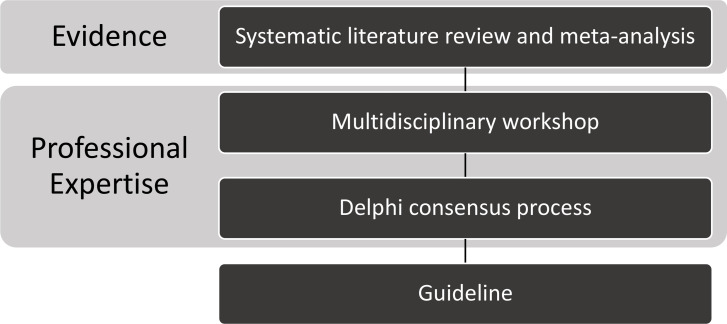
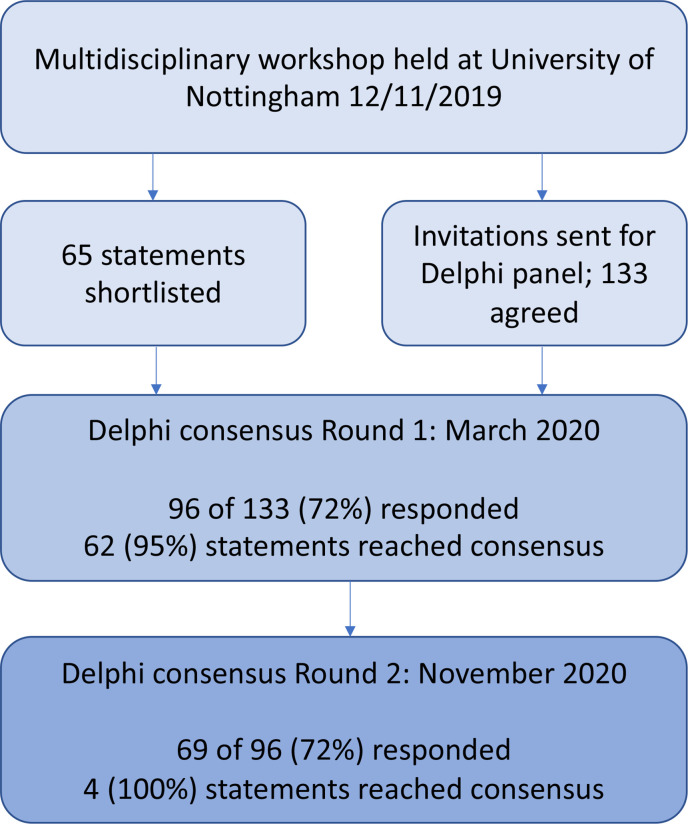
Invitation emails were sent to primary and secondary healthcare professionals to join the Delphi panel. 65 statements were derived from evidence review by a multidisciplinary team. Participants were asked to rank their level of agreement with each statement on a 9-point Likert scale (1=strongly disagree, 9=strongly agree), with responses ≥7 taken to indicate agreement. Statements not reaching consensus were rewritten and reissued in a subsequent round.
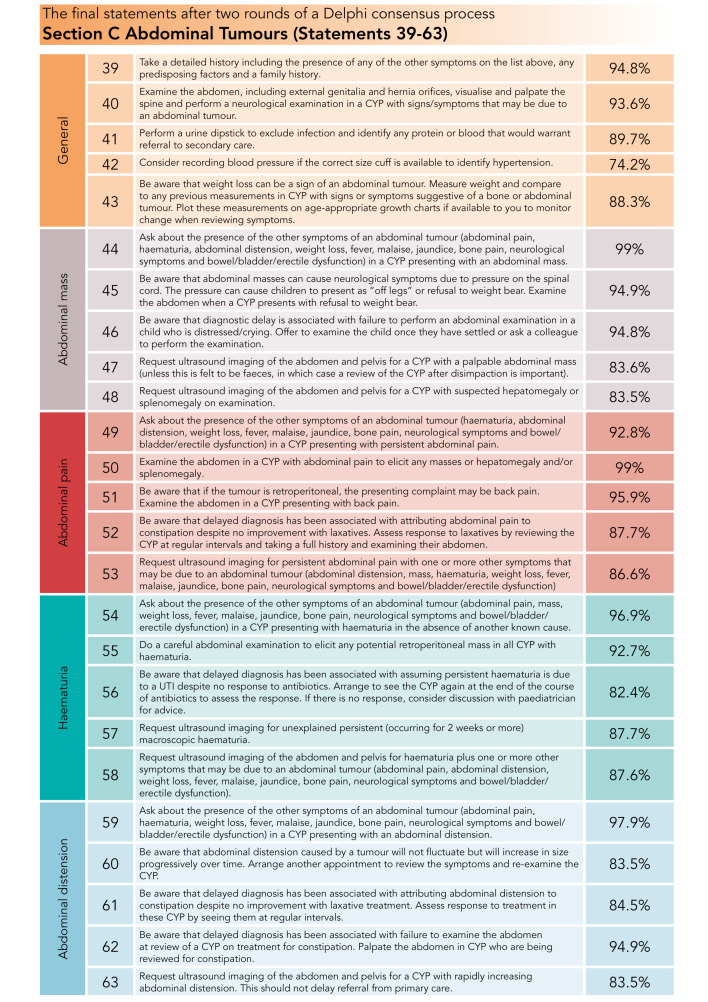
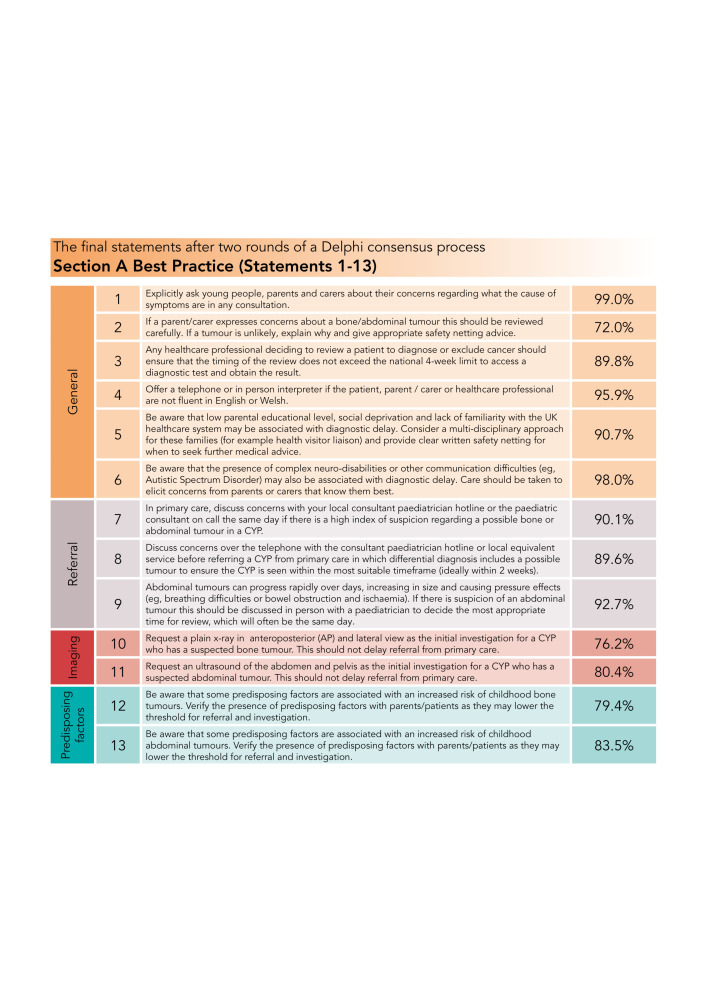
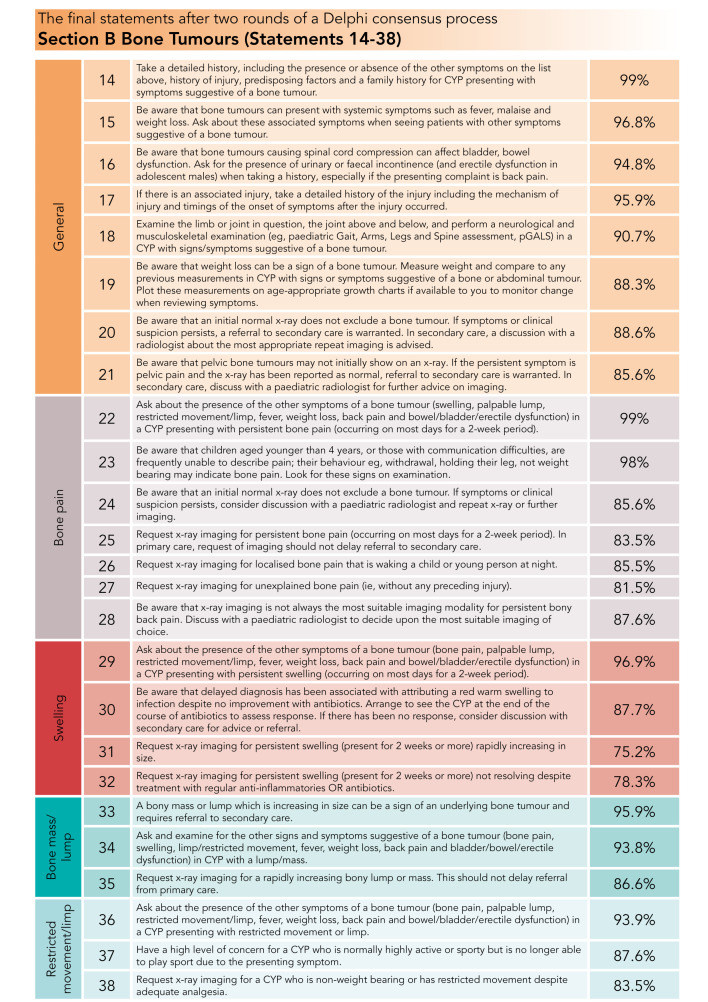
All statements achieved consensus after two rounds. 96/133 (72%) participants responded to round 1 (R1) and 69/96 (72%) completed round 2 (R2). 62/65 (94%) statements achieved consensus in R1 with 29/65 (47%) gaining more than 90% consensus. Three statements did not reach consensus scoring between 61% and 69%. All reached numerical consensus at the end of R2. Strong consensus was reached on best practice of conducting the consultation, acknowledging parental instinct and obtaining telephone advice from a paediatrician to decide the timing and place of review, rather than adult cancer urgent referral pathways. Dissensus in statements was due to unachievable targets within primary care and valid concerns over a potential overinvestigation of abdominal pain.
This consensus process has consolidated statements that will be included in a new clinical guideline for suspected bone and abdominal tumours for use in both primary and secondary care. This evidence base will be translated into awareness tools for the public as part of the Child Cancer Smart national awareness campaign.
自 20 世纪 90 年代以来,儿童癌症的发病率上升了 15%。早期诊断是优化治疗效果的关键,然而诊断延迟的情况广泛存在。儿童癌症的早期症状往往不具有特异性,这给临床医生带来了诊断难题。本德尔菲共识过程旨在为出现疑似骨或腹部肿瘤症状的儿童和青少年制定新的临床指南。
向初级和二级保健专业人员发送邀请电子邮件,邀请他们加入德尔菲小组。65 项声明是由多学科团队对证据进行审查后得出的。参与者被要求在 9 分制李克特量表上对每个声明的同意程度进行评分(1=强烈不同意,9=强烈同意),得分≥7 表示同意。未达成共识的声明被重新编写并在下一轮中重新发布。
两轮后所有声明均达成共识。第一轮(R1)有 133 名参与者中的 96 名(72%)做出了回应,69 名/96 名(72%)完成了第二轮(R2)。R1 中有 62/65(94%)项声明达成共识,其中 29/65(47%)项声明获得了超过 90%的共识。有 3 项声明的得分在 61%至 69%之间,未达成共识。在 R2 结束时,所有声明均达到了数值共识。在进行咨询、承认父母本能以及从儿科医生处获得电话建议以决定评估的时间和地点,而不是采用成人癌症紧急转诊途径方面达成了强烈共识。在声明中存在分歧是因为在初级保健中难以实现既定目标,以及对潜在过度调查腹痛的合理担忧。
本共识过程整合了将包含在疑似骨和腹部肿瘤新临床指南中的声明,供初级和二级保健使用。该证据基础将被转化为公众意识工具,作为儿童癌症智慧国家宣传活动的一部分。