Museum für Naturkunde, Leibniz Institute for Evolution and Biodiversity Science, Center for Integrative Biodiversity Discovery, Invalidenstraße 43, Berlin, 10115, Germany.
National Museum of Natural History, Smithsonian Institution, 10th & Constitution Ave. NW, Washington, DC, USA.
Nat Commun. 2023 Mar 3;14(1):1212. doi: 10.1038/s41467-023-36868-4.
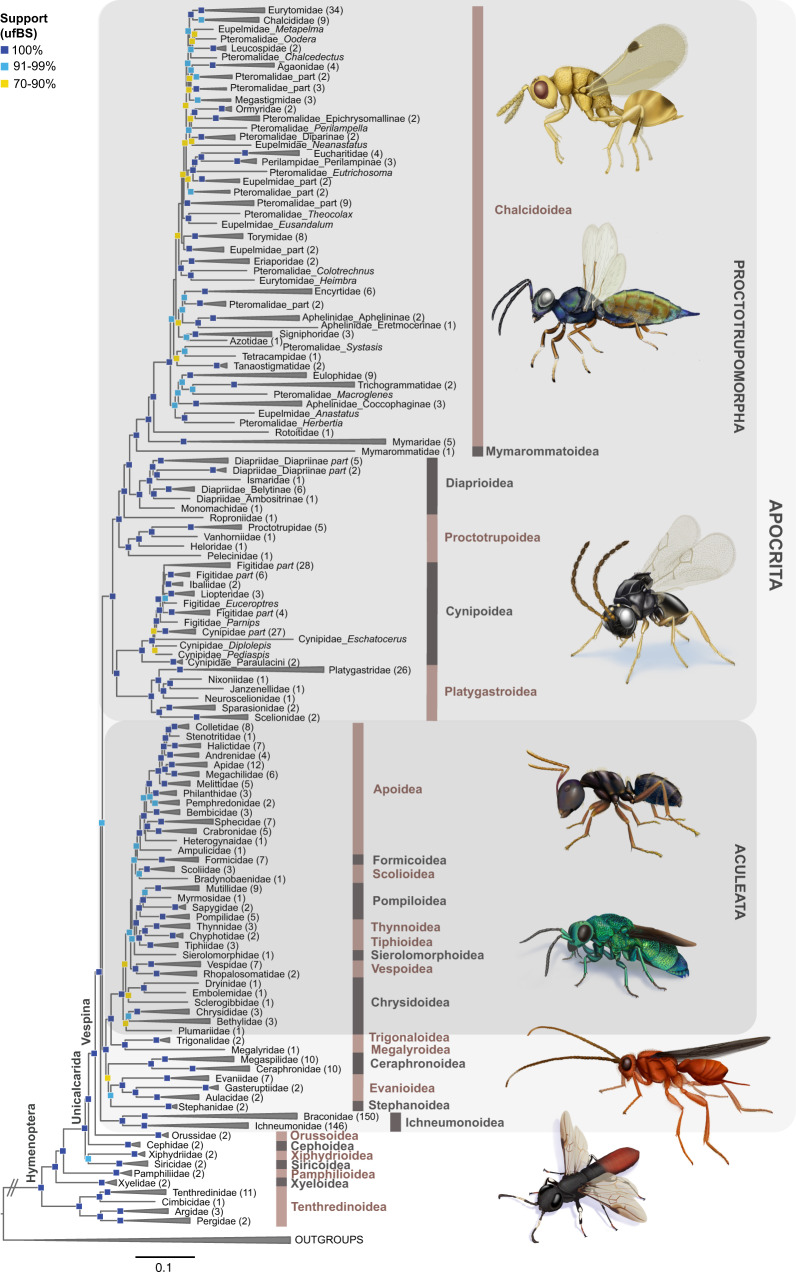
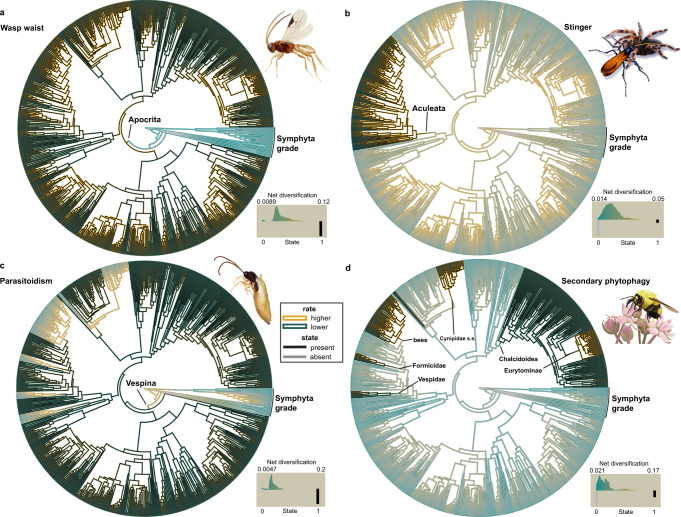
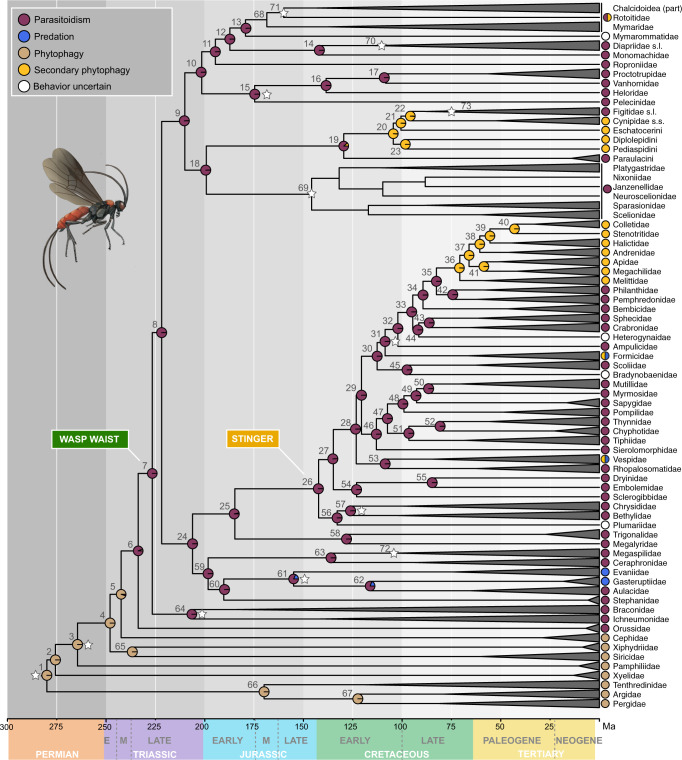
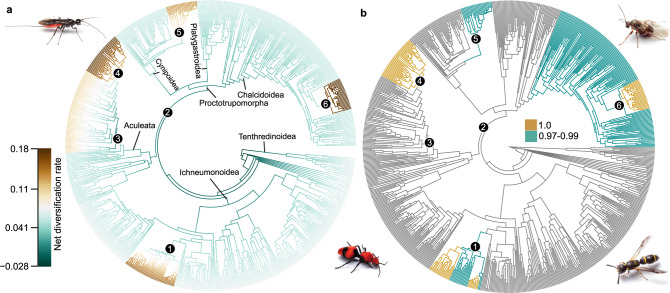
The order Hymenoptera (wasps, ants, sawflies, and bees) represents one of the most diverse animal lineages, but whether specific key innovations have contributed to its diversification is still unknown. We assembled the largest time-calibrated phylogeny of Hymenoptera to date and investigated the origin and possible correlation of particular morphological and behavioral innovations with diversification in the order: the wasp waist of Apocrita; the stinger of Aculeata; parasitoidism, a specialized form of carnivory; and secondary phytophagy, a reversal to plant-feeding. Here, we show that parasitoidism has been the dominant strategy since the Late Triassic in Hymenoptera, but was not an immediate driver of diversification. Instead, transitions to secondary phytophagy (from parasitoidism) had a major influence on diversification rate in Hymenoptera. Support for the stinger and the wasp waist as key innovations remains equivocal, but these traits may have laid the anatomical and behavioral foundations for adaptations more directly associated with diversification.
膜翅目(黄蜂、蚂蚁、叶蜂和蜜蜂)是动物谱系中最多样化的代表之一,但特定的关键创新是否有助于其多样化仍然未知。我们构建了迄今为止最大的膜翅目时间校准系统发育,并研究了特定形态和行为创新的起源及其与该目中多样化的可能相关性:细腰亚目黄蜂的蜂腰;螫针,一种特殊形式的肉食性;以及次生植食性,对植物取食的逆转。在这里,我们表明,寄生性自三叠纪晚期以来一直是膜翅目的主要策略,但不是多样化的直接驱动因素。相反,向次生植食性(从寄生性)的转变对膜翅目多样化的速度有重大影响。对螫针和蜂腰作为关键创新的支持仍然存在争议,但这些特征可能为与多样化更直接相关的适应奠定了解剖学和行为基础。