• 文献检索
  • 文档翻译
  • 深度研究
  • 学术资讯
  • Suppr Zotero 插件Zotero 插件
  • 邀请有礼
  • 套餐&价格
  • 历史记录
应用&插件
Suppr Zotero 插件Zotero 插件浏览器插件Mac 客户端Windows 客户端微信小程序
定价
高级版会员购买积分包购买API积分包
服务
文献检索文档翻译深度研究API 文档MCP 服务
关于我们
关于 Suppr公司介绍联系我们用户协议隐私条款
关注我们

Suppr 超能文献

核心技术专利:CN118964589B侵权必究
粤ICP备2023148730 号-1Suppr @ 2026

文献检索

告别复杂PubMed语法,用中文像聊天一样搜索,搜遍4000万医学文献。AI智能推荐,让科研检索更轻松。

立即免费搜索

文件翻译

保留排版,准确专业,支持PDF/Word/PPT等文件格式,支持 12+语言互译。

免费翻译文档

深度研究

AI帮你快速写综述,25分钟生成高质量综述,智能提取关键信息,辅助科研写作。

立即免费体验

新西兰奥克兰族裔之间的中风结果差异:一项全国性关联研究。

Ethnic differences in stroke outcomes in Aotearoa New Zealand: A national linkage study.

机构信息

Research Centre for Hauora and Health, Massey University, Wellington, New Zealand.

Department of Medicine, University of Otago Wellington, Wellington, New Zealand.

出版信息

Int J Stroke. 2023 Jul;18(6):663-671. doi: 10.1177/17474930231164024. Epub 2023 Mar 24.

DOI:10.1177/17474930231164024
PMID:36872640
原文链接:https://pmc.ncbi.nlm.nih.gov/articles/PMC10311930/
Abstract

BACKGROUND

Ethnic differences in post-stroke outcomes have been largely attributed to biological and socioeconomic characteristics resulting in differential risk factor profiles and stroke subtypes, but evidence is mixed.

AIMS

This study assessed ethnic differences in stroke outcome and service access in New Zealand (NZ) and explored underlying causes in addition to traditional risk factors.

METHODS

This national cohort study used routinely collected health and social data to compare post-stroke outcomes between NZ Europeans, Māori, Pacific Peoples, and Asians, adjusting for differences in baseline characteristics, socioeconomic deprivation, and stroke characteristics. First and principal stroke public hospital admissions during November 2017 to October 2018 were included (N = 6879). Post-stroke unfavorable outcome was defined as being dead, changing residence, or becoming unemployed.

RESULTS

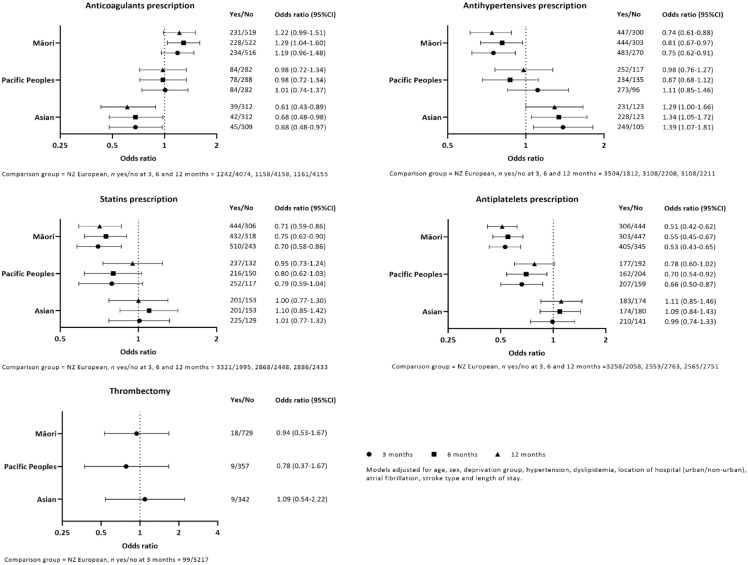
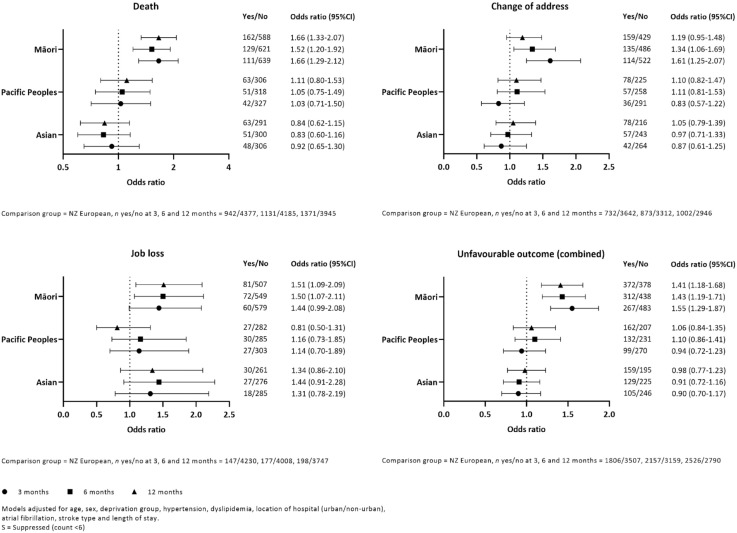
In total, 5394 NZ Europeans, 762 Māori, 369 Pacific Peoples, and 354 Asians experienced a stroke during the study period. Median age was 65 years for Māori and Pacific Peoples, and 71 and 79 years for Asians and NZ Europeans, respectively. Compared with NZ Europeans, Māori were more likely to have an unfavorable outcome at all three time-points (odds ratio (OR) = 1.6 (95% confidence interval (CI) = 1.3-1.9); 1.4 (1.2-1.7); 1.4 (1.2-1.7), respectively). Māori had increased odds of death at all time-points (1.7 (1.3-2.1); 1.5 (1.2-1.9); 1.7 (1.3-2.1)), change in residence at 3 and 6 months (1.6 (1.3-2.1); 1.3 (1.1-1.7)), and unemployment at 6 and 12 months (1.5 (1.1-2.1); 1.5 (1.1-2.1)). There was evidence of differences in post-stroke secondary prevention medication by ethnicity.

CONCLUSION

We found ethnic disparities in care and outcomes following stroke which were independent of traditional risk factors, suggesting they may be attributable to stroke service delivery rather than patient factors.

摘要

背景

脑卒中后结局的种族差异主要归因于生物学和社会经济特征,导致不同的危险因素谱和脑卒中亚型,但证据不一。

目的

本研究评估了新西兰(NZ)脑卒中结局和服务获取方面的种族差异,并探讨了除传统危险因素以外的潜在原因。

方法

本项全国性队列研究使用常规收集的健康和社会数据,比较了 2017 年 11 月至 2018 年 10 月期间 NZ 欧洲人、毛利人、太平洋岛民和亚洲人之间的脑卒中后结局,调整了基线特征、社会经济剥夺和脑卒中特征的差异。纳入首次和主要因脑卒中住院的患者(N=6879)。脑卒中后不良结局定义为死亡、改变居住地或失业。

结果

研究期间,共有 5394 名 NZ 欧洲人、762 名毛利人、369 名太平洋岛民和 354 名亚洲人发生脑卒中。毛利人和太平洋岛民的中位年龄为 65 岁,亚洲人和 NZ 欧洲人的中位年龄分别为 71 岁和 79 岁。与 NZ 欧洲人相比,毛利人在所有三个时间点都更有可能出现不良结局(优势比(OR)=1.6(95%置信区间(CI)=1.3-1.9);1.4(1.2-1.7);1.4(1.2-1.7))。毛利人在所有时间点的死亡风险都更高(1.7(1.3-2.1);1.5(1.2-1.9);1.7(1.3-2.1)),3 个月和 6 个月时居住地改变的风险(1.6(1.3-2.1);1.3(1.1-1.7)),6 个月和 12 个月时失业风险(1.5(1.1-2.1);1.5(1.1-2.1))。不同种族在脑卒中二级预防药物治疗方面存在差异。

结论

我们发现脑卒中后护理和结局存在种族差异,这与传统危险因素无关,表明这可能归因于脑卒中服务提供而非患者因素。
https://cdn.ncbi.nlm.nih.gov/pmc/blobs/adba/10311930/ce55b4fb8973/10.1177_17474930231164024-fig2.jpg
https://cdn.ncbi.nlm.nih.gov/pmc/blobs/adba/10311930/bed327bd009d/10.1177_17474930231164024-fig1.jpg
https://cdn.ncbi.nlm.nih.gov/pmc/blobs/adba/10311930/ce55b4fb8973/10.1177_17474930231164024-fig2.jpg
https://cdn.ncbi.nlm.nih.gov/pmc/blobs/adba/10311930/bed327bd009d/10.1177_17474930231164024-fig1.jpg
https://cdn.ncbi.nlm.nih.gov/pmc/blobs/adba/10311930/ce55b4fb8973/10.1177_17474930231164024-fig2.jpg

相似文献

1
Ethnic differences in stroke outcomes in Aotearoa New Zealand: A national linkage study.新西兰奥克兰族裔之间的中风结果差异:一项全国性关联研究。
Int J Stroke. 2023 Jul;18(6):663-671. doi: 10.1177/17474930231164024. Epub 2023 Mar 24.
2
Ethnic disparities in incidence of stroke subtypes: Auckland Regional Community Stroke Study, 2002-2003.中风亚型发病率的种族差异:奥克兰地区社区中风研究,2002 - 2003年
Lancet Neurol. 2006 Feb;5(2):130-9. doi: 10.1016/S1474-4422(05)70325-2.
3
Impact of the first wave of COVID-19 on the health and psychosocial well-being of Māori, Pacific Peoples and New Zealand Europeans living in aged residential care.新冠疫情第一波对居住在老年护理机构的毛利人、太平洋岛民和新西兰欧洲人的健康及社会心理健康的影响。
Australas J Ageing. 2022 Jun;41(2):293-300. doi: 10.1111/ajag.13025. Epub 2021 Dec 2.
4
Ethnic disparities in the incidence and outcome from out-of-hospital cardiac arrest: A New Zealand observational study.院外心脏骤停发病和结局的种族差异:新西兰观察性研究。
Resuscitation. 2019 Dec;145:56-62. doi: 10.1016/j.resuscitation.2019.09.026. Epub 2019 Oct 1.
5
Do community-dwelling Māori and Pacific peoples present with dementia at a younger age and at a later stage compared with NZ Europeans?与新西兰欧洲人相比,居住在社区中的毛利人和太平洋岛民是否会更早出现痴呆症,且在更晚期才被诊断出痴呆症?
Int J Geriatr Psychiatry. 2018 Aug;33(8):1098-1104. doi: 10.1002/gps.4898. Epub 2018 May 15.
6
Understanding ethnic inequities associated with tobacco use in Aotearoa New Zealand: a quantitative analysis.了解新西兰奥塔哥与烟草使用相关的种族不平等现象:一项定量分析。
Health Promot Int. 2024 Jun 1;39(3). doi: 10.1093/heapro/daae060.
7
Determinants of ethnic differences in the uptake of child healthcare services in New Zealand: a decomposition analysis.新西兰儿童保健服务利用的民族差异决定因素:分解分析。
Int J Equity Health. 2023 Jan 16;22(1):13. doi: 10.1186/s12939-022-01812-3.
8
An in-depth analysis of perinatal related mortality among women of South Asian ethnicity in Aotearoa New Zealand.新西兰奥克兰地区南亚裔产妇围生期相关死亡率的深入分析。
BMC Pregnancy Childbirth. 2023 Jul 24;23(1):535. doi: 10.1186/s12884-023-05840-x.
9
Māori Health Outcomes in Intensive Care Following Cardiac Surgery in Aotearoa New Zealand.新西兰心脏手术后重症监护中的毛利人健康结局。
Heart Lung Circ. 2022 Jul;31(7):1037-1044. doi: 10.1016/j.hlc.2021.11.015. Epub 2022 Mar 4.
10
Widening ethnic inequities in heart failure incidence in New Zealand.新西兰心力衰竭发病率的种族差异日益扩大。
Heart. 2024 Jan 29;110(4):281-289. doi: 10.1136/heartjnl-2023-322795.

引用本文的文献

1
Assessing the gaps in cardiovascular disease risk assessment and management in primary care for Māori and Pacific peoples in Aotearoa New Zealand- a systematic review.评估新西兰奥特亚罗瓦毛利人和太平洋岛民初级保健中心血管疾病风险评估与管理的差距——一项系统评价。
Lancet Reg Health West Pac. 2025 Mar 17;56:101511. doi: 10.1016/j.lanwpc.2025.101511. eCollection 2025 Mar.
2
Trends in stroke incidence, death, and disability outcomes in a multi-ethnic population: Auckland regional community stroke studies (1981-2022).多民族人群中中风发病率、死亡率和残疾结局的趋势:奥克兰地区社区中风研究(1981 - 2022年)
Lancet Reg Health West Pac. 2025 Mar 10;56:101508. doi: 10.1016/j.lanwpc.2025.101508. eCollection 2025 Mar.
3

本文引用的文献

1
Geographic Disparities in Stroke Outcomes and Service Access: A Prospective Observational Study.地理差异对脑卒中结局和服务获取的影响:一项前瞻性观察性研究。
Neurology. 2022 Jul 25;99(4):e414-e426. doi: 10.1212/WNL.0000000000200526.
2
The impact of ethnicity on stroke care access and patient outcomes: a New Zealand nationwide observational study.种族对中风护理可及性和患者结局的影响:一项新西兰全国性观察性研究。
Lancet Reg Health West Pac. 2022 Jan 3;20:100358. doi: 10.1016/j.lanwpc.2021.100358. eCollection 2022 Mar.
3
Reducing Ethnic and Geographic Inequities to Optimise New Zealand Stroke Care (REGIONS Care): Protocol for a Nationwide Observational Study.
Supporting Long-Term Meaningful Outcomes in Stroke Rehabilitation.
支持中风康复的长期有意义的结果。
Curr Neurol Neurosci Rep. 2025 Feb 3;25(1):17. doi: 10.1007/s11910-025-01403-z.
减少种族和地理不平等以优化新西兰中风护理(REGIONS护理):一项全国性观察性研究的方案
JMIR Res Protoc. 2021 Jan 12;10(1):e25374. doi: 10.2196/25374.
4
Metformin adherence in patients with type 2 diabetes and its association with glycated haemoglobin levels.二甲双胍在 2 型糖尿病患者中的依从性及其与糖化血红蛋白水平的关系。
J Prim Health Care. 2020 Dec;12(4):318-326. doi: 10.1071/HC20043.
5
Interventions Targeting Racial/Ethnic Disparities in Stroke Prevention and Treatment.针对卒中预防和治疗中的种族/民族差异的干预措施。
Stroke. 2020 Nov;51(11):3425-3432. doi: 10.1161/STROKEAHA.120.030427. Epub 2020 Oct 26.
6
Socioeconomic status and stroke incidence, prevalence, mortality, and worldwide burden: an ecological analysis from the Global Burden of Disease Study 2017.社会经济地位与卒中发病率、患病率、死亡率及全球负担:2017 年全球疾病负担研究的生态学分析。
BMC Med. 2019 Oct 24;17(1):191. doi: 10.1186/s12916-019-1397-3.
7
Management of stroke in the Australian Indigenous population: from hospitals to communities.澳大利亚原住民人群的中风管理:从医院到社区。
Intern Med J. 2019 Aug;49(8):962-968. doi: 10.1111/imj.14303.
8
Data Resource Profile: The New Zealand Integrated Data Infrastructure (IDI).数据资源简介:新西兰综合数据基础设施(IDI)
Int J Epidemiol. 2019 Jun 1;48(3):1027. doi: 10.1093/ije/dyz054.
9
Global, regional, and national burden of stroke, 1990-2016: a systematic analysis for the Global Burden of Disease Study 2016.全球、区域和国家卒中负担,1990-2016 年:2016 年全球疾病负担研究的系统分析。
Lancet Neurol. 2019 May;18(5):439-458. doi: 10.1016/S1474-4422(19)30034-1. Epub 2019 Mar 11.
10
Racial/ethnic disparities in hospital utilization in intracerebral hemorrhage.颅内出血住院利用的种族/民族差异。
Int J Stroke. 2019 Oct;14(7):686-695. doi: 10.1177/1747493019835335. Epub 2019 Mar 14.