Feigin Valery L, Krishnamurthi Rita, Nair Balakrishnan, Rautalin Ilari, Parag Varsha, Anderson Craig S, Arroll Bruce, Barber P Alan, Barker-Collo Suzanne, Bennett Derrick, Brown Paul, Cadilhac Dominque A, Douwes Jeroen, Exeter Daniel, Ranta Anna, Ratnasabapathy Yogini, Swain Andrew, Tautolo El-Shadan, Te Ao Braden, Thrift Amanda, Tunnage Bronwyn
National Institute for Stroke and Applied Neurosciences, Faculty of Health and Environmental Sciences, AUT University, Private Bag 92006, Auckland, New Zealand.
University of Helsinki, Finland.
Lancet Reg Health West Pac. 2025 Mar 10;56:101508. doi: 10.1016/j.lanwpc.2025.101508. eCollection 2025 Mar.
Reliable data on trends of stroke incidence and outcomes over time are necessary for assessing the effectiveness of public health and clinical strategies, and for allocating healthcare resources. We assessed the levels and trends in incidence, mortality, early case fatality and disability for stroke in a defined, ethnically mixed population over 40 years.
To analyse data from five population-based stroke incidence studies in adult residents (age ≥15 years) of the Greater Auckland Region of New Zealand (NZ) (1.35 million) over 12-month calendar periods for 1981-1982, 1991-1992, 2002-2003, 2011-2012, and 2021-2022. Fatal and non-fatal, hospitalised and non-hospitalised stroke events (first-ever and recurrent) were identified through multiple overlapping sources using clinical World Health Organization (WHO) diagnostic criteria and neuroimaging to define three major pathological types of stroke: ischaemic stroke (IS), primary intracerebral haemorrhage (PICH), subarachnoid haemorrhage (SAH), and stroke of undetermined type (SUT). Crude and age-standardised annual incidence, mortality, 28-day case fatality and disability level, and 40-year trends were calculated by age, sex, and ethnicity assuming a Poisson distribution. For comparison of our findings, we carried out a pooled analysis of methodologically comparable population-based stroke epidemiology estimates in high-income countries over the last two decades.
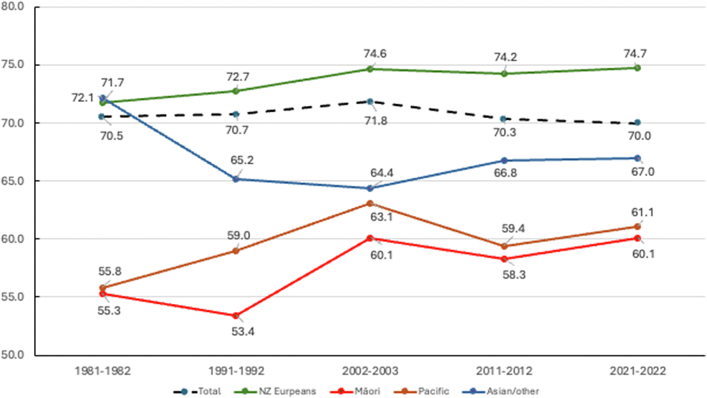
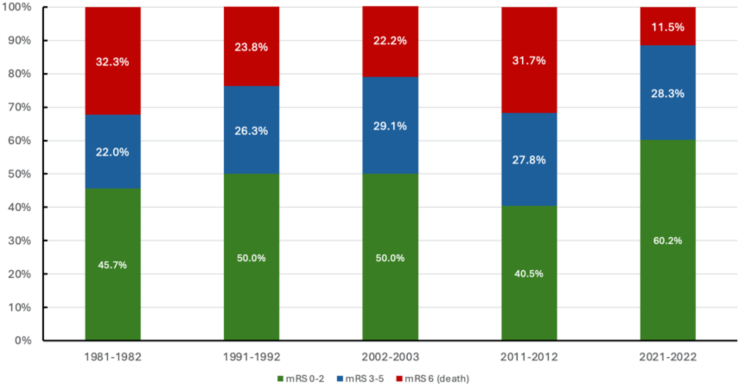
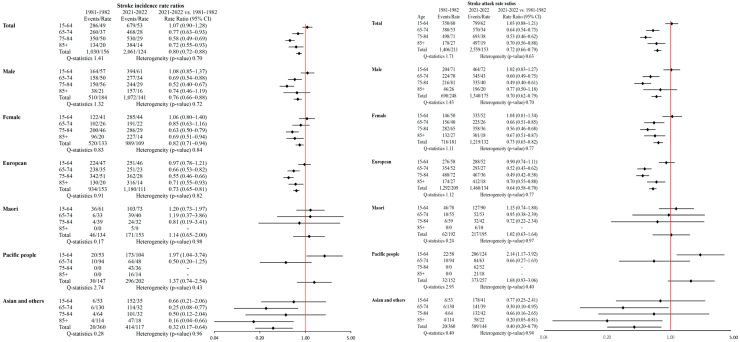
Overall, there were 7462 first-ever strokes (9917 events) over the 40-year period (4,682,012 person-years). From 1981-1982 to 2021-2022, age-standardised stroke incidence rates decreased from 156/100,000 (95% confidence interval [CI] 143; 170) to 124/100,000 (119; 130) and mortality rates from 98/100,000 (88; 110) to 28/100,000 (26; 31) in nearly all age, sex, and ethnic groups. Moreover, from 2002-2003 to 2021-2022, there was an increase in stroke incidence of 1.28% per year (95% CI 0.38-2.17) in people aged 15-54 years, with the mean age of people with stroke decreasing from 73.0 (SD ± 13.8) in 2002-2003 to 71.6 (SD ± 14.9) in 2011-2012 and 70.7 (SD ± 15.2) years in 2021-2022 (p for trend <0.0001). The risk of stroke in Māori and Pacific people in 2021-2022 was almost 1.5 and 2.0 times greater than that in NZ Europeans. Ethnic disparities in the risk of stroke and age of stroke onset remained stable over the study period. From 1981-1982 to 2021-2022, 28-day stroke case fatality declined from 33.1% to 12.1% (p < 0.0001). There was a trend towards reducing 28-day case-fatality (from 31.6% [95% CI 27.6; 35.7] in 1981-1982 to 11.4% [10.0; 12.7] in 2021-2022) and an increasing proportion of stroke survivors with good functional outcome at discharge/28-days post-stroke (increased from 45.7% (95% CI 41.3; 50.0) in 1981-1982 to 60.2% (58.1; 62.3) in 2021-2022).
Stroke incidence, 1-year mortality and 28-day case-fatality and disability have decreased in Auckland, NZ over the last 4 decades. However, over the last decade (2011-2022) there was a stagnation in the decline in the age-standardised stroke incidence rates. The absolute numbers of people with strokes, and those who have died or remained disabled from stroke, have significantly increased from 1981 to 2022. Ethnic disparities in the risk and burden of stroke persist. Effective prevention strategies for stroke must remain a high priority.
Health Research Council of New Zealand.
关于中风发病率和随时间变化的结果的可靠数据对于评估公共卫生和临床策略的有效性以及分配医疗资源是必要的。我们评估了一个特定的、种族混合的人群在40年中中风的发病率、死亡率、早期病死率和残疾情况及趋势。
分析来自新西兰(NZ)大奥克兰地区(135万)成年居民(年龄≥15岁)的五项基于人群的中风发病率研究的数据,研究时间为1981 - 1982年、1991 - 1992年、2002 - 2003年、2011 - 2012年和2021 - 2022年的12个日历月期间。使用世界卫生组织(WHO)临床诊断标准和神经影像学,通过多个重叠来源识别致命和非致命、住院和非住院的中风事件(首次发作和复发),以定义三种主要的中风病理类型:缺血性中风(IS)、原发性脑出血(PICH)、蛛网膜下腔出血(SAH)和未定型中风(SUT)。假设为泊松分布,按年龄、性别和种族计算粗发病率和年龄标准化发病率、死亡率、28天病死率和残疾水平以及40年趋势。为了比较我们的研究结果,我们对过去二十年中高收入国家基于人群的中风流行病学估计进行了汇总分析,这些估计在方法上具有可比性。
总体而言,在40年期间(4,682,012人年)有7462例首次中风(9917次事件)。从1981 - 1982年到2021 - 2022年,几乎所有年龄、性别和种族组的年龄标准化中风发病率从156/100,000(95%置信区间[CI]143;170)降至124/100,000(119;130),死亡率从98/100,000(88;110)降至28/100,000(26;31)。此外,从2002 - 2003年到2021 - 2022年,15 - 54岁人群的中风发病率每年增加1.28%(95% CI 0.38 - 2.17),中风患者平均年龄从2002 - 2003年的73.0(标准差±13.8)岁降至2011 - 2012年的71.6(标准差±14.9)岁和2021 - 2022年的70.7(标准差±15.2)岁(趋势p<0.0001)。2021 - 2022年毛利人和太平洋岛民中风风险几乎是新西兰欧洲人的1.5倍和2.0倍。在研究期间,中风风险和中风发病年龄的种族差异保持稳定。从1981 - 1982年到2021 - 2022年,28天中风病死率从33.1%降至12.1%(p<0.0001)。28天病死率有下降趋势(从1981 - 1982年的31.6%[95% CI 27.6;35.7]降至2021 - 2022年的11.4%[10.0;12.7]),中风幸存者出院时/中风后28天功能良好结局的比例增加(从1981 - 1982年的45.7%(95% CI 41.3;50.0)增至2021 - 2022年的60.2%(58.1;62.3))。
在过去40年中,新西兰奥克兰的中风发病率、1年死亡率、28天病死率和残疾率均有所下降。然而,在过去十年(2011 - 2022年),年龄标准化中风发病率下降趋势停滞。从1981年到2022年,中风患者、中风死亡或致残的绝对人数显著增加。中风风险和负担的种族差异仍然存在。有效的中风预防策略必须仍然是高度优先事项。
新西兰卫生研究委员会。