St Marie Barbara, Perkhounkova Yelena, Gedney-Lose Amalia, Jimmerson Andrea, Porter Brooke, Herr Keela, Nadkarni Prakash
College of Nursing, University of Iowa, 50 Newton Road, Iowa City, IA 52242 USA.
College of Nursing, Biostatistics, University of Iowa, 50 Newton Road, Iowa City, IA 52242 USA.
SN Compr Clin Med. 2023;5(1):91. doi: 10.1007/s42399-023-01423-1. Epub 2023 Feb 27.
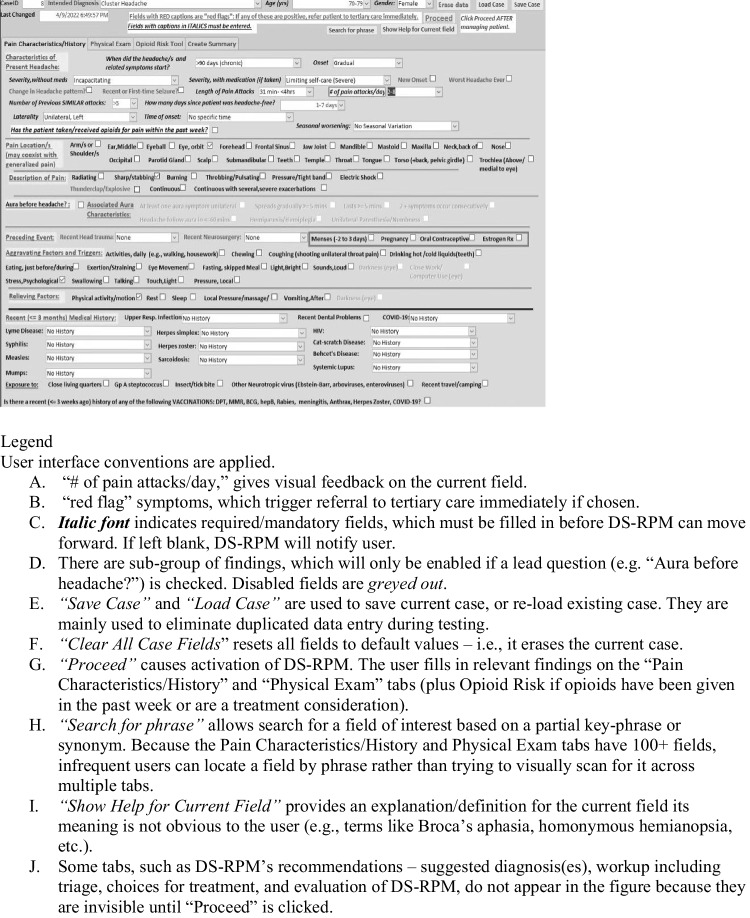
In primary and urgent care, headache and facial pain are common and challenging to diagnose and manage, especially with using opioids appropriately. We therefore developed the Decision Support Tool for Responsible Pain Management (DS-RPM) to assist healthcare providers in diagnosis (including multiple simultaneous diagnoses), workup (including triage), and opioid-risk-informed treatment. A primary goal was to supply sufficient explanations of DS-RPM's functions allowing critique. We describe the process of iteratively designing DS-RPM adding clinical content and testing/defect discovery. We tested DS-RPM remotely with 21 clinician-participants using three vignettes-cluster headache, migraine, and temporal arteritis-after first training to use DS-RPM with a trigeminal-neuralgia vignette. Their evaluation was both quantitative (usability/acceptability) and qualitative using semi-structured interviews. The quantitative evaluation used 12 Likert-type questions on a 1-5 scale, where 5 represented the highest rating. The mean ratings ranged from 4.48 to 4.95 (SDs ranging 0.22-1.03). Participants initially found structured data entry intimidating but adapted and appreciated its comprehensiveness and speed of data capture. They perceived DS-RPM as useful for teaching and clinical practice, making several enhancement suggestions. The DS-RPM was designed, created, and tested to facilitate best practice in management of patients with headaches and facial pain. Testing the DS-RPM with vignettes showed strong functionality and high usability/acceptability ratings from healthcare providers. Risk stratifying for opioid use disorder to develop a treatment plan for headache and facial pain is possible using vignettes. During testing, we considered the need to adapt usability/acceptability evaluation tools for clinical decision support, and future directions.
在初级和紧急护理中,头痛和面部疼痛很常见,诊断和管理颇具挑战性,尤其是在合理使用阿片类药物方面。因此,我们开发了负责任疼痛管理决策支持工具(DS-RPM),以协助医疗服务提供者进行诊断(包括多重同时诊断)、检查(包括分诊)以及基于阿片类药物风险的治疗。一个主要目标是对DS-RPM的功能提供充分解释以便进行评估。我们描述了迭代设计DS-RPM并添加临床内容以及测试/缺陷发现的过程。在首先使用三叉神经痛病例对21名临床医生参与者进行DS-RPM使用培训后,我们使用丛集性头痛、偏头痛和颞动脉炎三个病例远程测试了DS-RPM。他们的评估包括定量(可用性/可接受性)和定性(使用半结构化访谈)。定量评估使用了12个1-5级的李克特式问题,其中5表示最高评分。平均评分范围为4.48至4.95(标准差范围为0.22-1.03)。参与者最初觉得结构化数据录入令人生畏,但后来适应了并赞赏其全面性和数据捕获速度。他们认为DS-RPM对教学和临床实践有用,并提出了一些改进建议。DS-RPM的设计、创建和测试旨在促进头痛和面部疼痛患者管理的最佳实践。用病例测试DS-RPM显示出强大的功能以及医疗服务提供者的高可用性/可接受性评分。使用病例对阿片类药物使用障碍进行风险分层以制定头痛和面部疼痛的治疗计划是可行的。在测试过程中,我们考虑了为临床决策支持调整可用性/可接受性评估工具的必要性以及未来的方向。