Department of Medical Biotechnology, Faculty of Medical Sciences, Tarbiat Modares University, Tehran, Iran.
Research and Development Center of Biotechnology, Tarbiat Modares University, Tehran, Iran.
Front Immunol. 2023 Feb 16;14:1063838. doi: 10.3389/fimmu.2023.1063838. eCollection 2023.
Chimeric antigen receptor (CAR)-T cell therapy has established itself as a potent therapeutic option for certain patients with relapsed/refractory (R/R) hematologic malignancies. To date, four CD19-redirected CAR-T cell products have been granted the United States Food and Drug Administration (FDA) approval for medical use. However, all of these products are equipped with a single-chain fragment variable (scFv) as their targeting domains. Camelid single-domain antibodies (VHH or nanobody) can also be used as alternatives to scFvs. In this study, we developed VHH-based CD19-redirected CAR-Ts, and compared them with their FMC63 scFv-based counterpart.
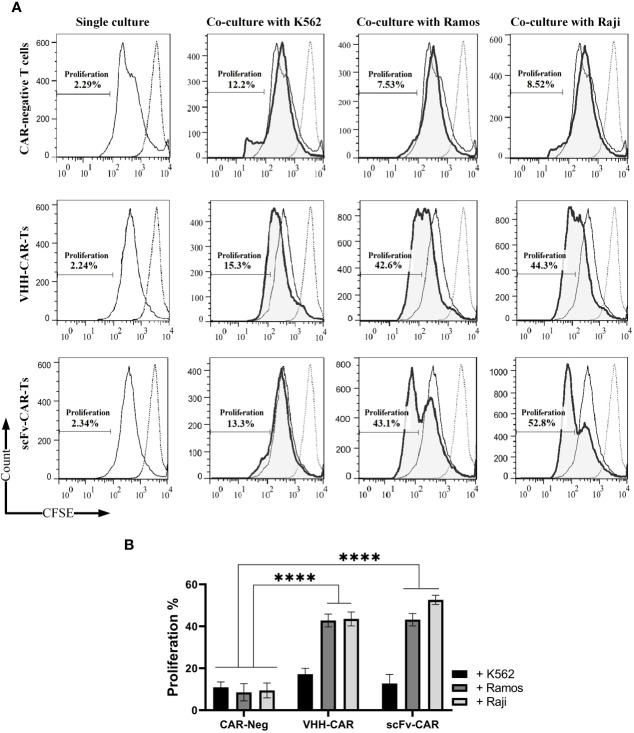
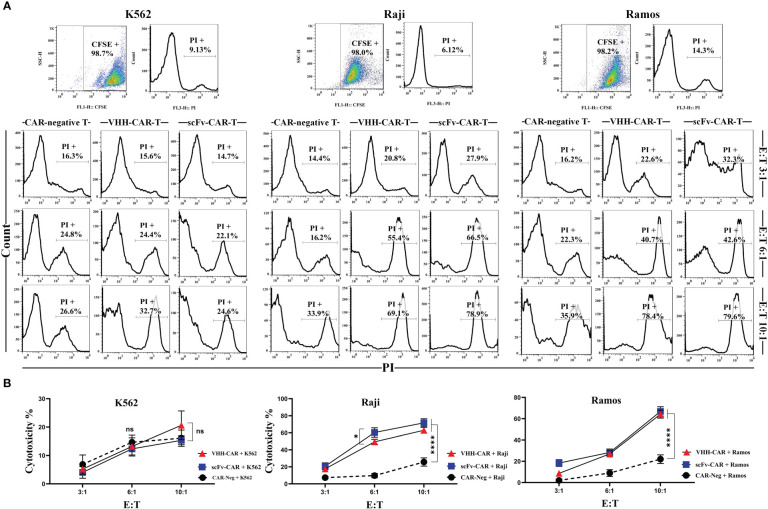
Human primary T cells were transduced to express a second-generation 4-1BB-CD3ζ-based CAR construct whose targeting domain was based on a CD19-specific VHH. The expansion rate, cytotoxicity, and secretion of proinflammatory cytokines (IFN-γ, IL-2, and TNF-α) of the developed CAR-Ts were assessed and compared with their FMC63 scFv-based counterpart as they were co-cultured with CD19-positive (Raji and Ramos) and CD19-negative (K562) cell lines.
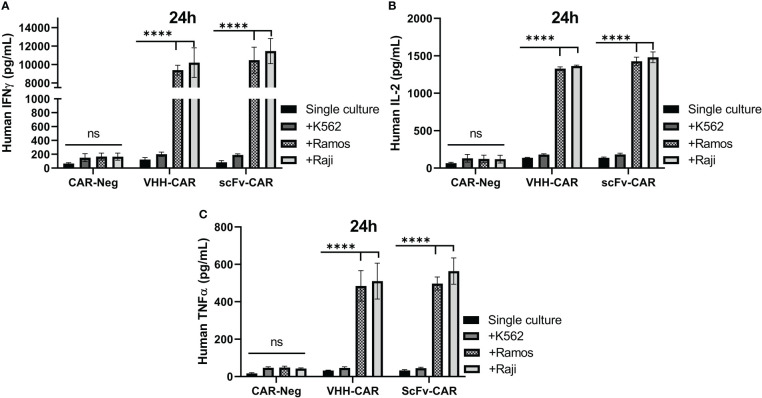
VHH-CAR-Ts showed an expansion rate comparable to that of the scFv-CAR-Ts. In terms of cytotoxicity, VHH-CAR-Ts mediated cytolytic reactions against CD19-positive cell lines, comparable to those of their scFv-based counterparts. Moreover, both VHH-CAR-Ts and scFv-CAR-Ts secreted remarkably higher and similar levels of IFN-γ, IL-2, and TNF-α upon co-cultivation with Ramos and Raji cell lines compared with while cultured alone or co-cultured with K562 cells.
Our results demonstrated that our VHH-CAR-Ts could mediate CD19-dependent tumoricidal reactions as potently as their scFv-based counterparts. Moreover, VHHs could be applied as the targeting domains of CAR constructs to overcome the issues associated with the use of scFvs in CAR-T therapies.
嵌合抗原受体 (CAR)-T 细胞疗法已成为某些复发/难治性 (R/R) 血液恶性肿瘤患者的有效治疗选择。迄今为止,已有四种靶向 CD19 的 CAR-T 细胞产品获得美国食品和药物管理局 (FDA) 的批准用于医疗用途。然而,所有这些产品都配备了单链片段可变区 (scFv) 作为其靶向结构域。骆驼科单域抗体 (VHH 或纳米抗体) 也可以替代 scFv。在这项研究中,我们开发了基于 VHH 的 CD19 靶向 CAR-T,并将其与基于 FMC63 scFv 的对应物进行了比较。
将人原代 T 细胞转导表达第二代 4-1BB-CD3ζ 为基础的 CAR 构建体,其靶向结构域基于 CD19 特异性 VHH。评估开发的 CAR-T 与基于 FMC63 scFv 的对应物在共培养时的扩增率、细胞毒性和促炎细胞因子(IFN-γ、IL-2 和 TNF-α)的分泌情况,与 CD19 阳性(Raji 和 Ramos)和 CD19 阴性(K562)细胞系进行比较。
VHH-CAR-T 的扩增率与 scFv-CAR-T 相当。在细胞毒性方面,VHH-CAR-T 介导对 CD19 阳性细胞系的溶细胞反应,与基于 scFv 的对应物相当。此外,与单独培养或与 K562 细胞共培养相比,VHH-CAR-T 和 scFv-CAR-T 在与 Ramos 和 Raji 细胞系共培养时都显著分泌更高和相似水平的 IFN-γ、IL-2 和 TNF-α。
我们的结果表明,我们的 VHH-CAR-T 可以像基于 scFv 的对应物一样有效地介导 CD19 依赖性杀伤反应。此外,VHH 可以作为 CAR 构建体的靶向结构域,以克服在 CAR-T 疗法中使用 scFv 相关的问题。