Chalfant Victor, Riveros Carlos, Bradfield Scott M, Stec Andrew A
Department of Urology, Creighton University School of Medicine, Omaha, NE, 68108, USA.
Department of Urology, University of Florida Health, Jacksonville, FL, 32209, USA.
Lancet Reg Health Am. 2023 Feb 24;20:100454. doi: 10.1016/j.lana.2023.100454. eCollection 2023 Apr.
Studies reporting on the impact of social determinants of health on childhood cancer are limited. The current study aimed to examine the relationship between health disparities, as measured by the social deprivation index, and mortality in paediatric oncology patients using a population-based national database.
In this cohort study of children across all paediatric cancers, survival rates were determined using the Surveillance, Epidemiology, and End Results (SEER) database from 1975 to 2016. The social deprivation index was used to measure and assess healthcare disparities and specifically the impact on both overall and cancer-specific survival. Hazard ratios were used to assess the association of area deprivation.
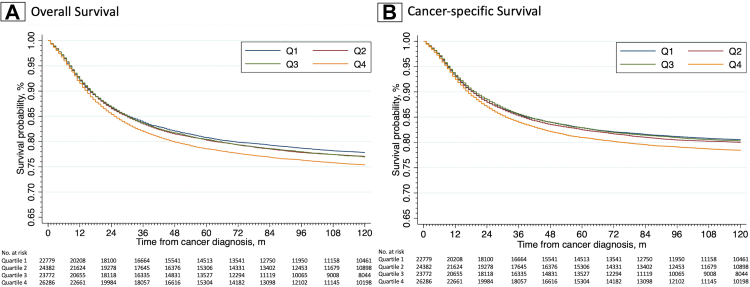
The study cohort was composed of 99,542 patients with paediatric cancer. Patients had a median age of 10 years old (IQR: 3-16) with 46,109 (46.3%) of female sex. Based on race, 79,984 (80.4%) of patients were identified as white while 10,801 (10.9%) were identified as Black. Patients from socially deprived areas had significantly higher hazard of death overall for both non-metastatic [1.27 (95% CI: 1.19-1.36)] and metastatic presentations [1.09 (95% CI: 1.05-1.15)] compared to in more socially affluent areas.
Patients from the most socially deprived areas had lower rates of overall and cancer-specific survival compared to patients from socially affluent areas. With an increase in childhood cancer survivors, implementation of social determinant indices, such as the social deprivation index, might aid improvement in healthcare outcomes for the most vulnerable patients.
There was no study sponsor or extramural funding.
关于健康的社会决定因素对儿童癌症影响的研究有限。本研究旨在利用基于人群的国家数据库,探讨以社会剥夺指数衡量的健康差异与儿科肿瘤患者死亡率之间的关系。
在这项针对所有儿科癌症患儿的队列研究中,使用1975年至2016年的监测、流行病学和最终结果(SEER)数据库确定生存率。社会剥夺指数用于衡量和评估医疗保健差异,特别是对总体生存率和癌症特异性生存率的影响。风险比用于评估地区剥夺的关联。
研究队列由99542例儿科癌症患者组成。患者的中位年龄为10岁(四分位间距:3 - 16岁),其中46109例(46.3%)为女性。按种族划分,79984例(80.4%)患者被确定为白人,10801例(10.9%)为黑人。与社会经济较富裕地区的患者相比,来自社会贫困地区的患者在非转移性[1.27(95%置信区间:1.19 - 1.36)]和转移性表现[1.09(95%置信区间:1.05 - 1.15)]情况下的总体死亡风险均显著更高。
与社会经济富裕地区的患者相比,来自社会最贫困地区的患者总体生存率和癌症特异性生存率较低。随着儿童癌症幸存者数量的增加,实施社会决定因素指数,如社会剥夺指数,可能有助于改善最脆弱患者的医疗结局。
本研究无研究资助者或外部资金。