Geeganage Grace, Iturrino Johanna, Shainker Scott A, Ballou Sarah, Rangan Vikram, Nee Judy
Division of Gastroenterology, Beth Israel Deaconess Medical Center and Harvard Medical School, Boston, MA (Ms Geeganage and Drs Iturrino, Ballou, Rangan, and Nee).
Division of Obstetrics and Gynecology, Beth Israel Deaconess Medical Center and Harvard Medical School, Boston, MA (Dr Shainker).
AJOG Glob Rep. 2023 Jan 28;3(1):100166. doi: 10.1016/j.xagr.2023.100166. eCollection 2023 Feb.
Hyperemesis gravidarum is the most severe form of nausea and vomiting of pregnancy, potentially affecting both maternal and pregnancy health. Hyperemesis gravidarum often results in emergency department visits, although the exact frequency and costs associated with these visits have not been well studied.
This study aimed to analyze the trends in hyperemesis gravidarum emergency department visits, inpatient admissions, and the associated costs between 2006 and 2014.
Patients were identified from the 2006 and 2014 Nationwide Emergency Department Sample database files using International Classification of Diseases, Ninth Revision diagnosis codes. Patients with a primary diagnosis of hyperemesis gravidarum, nausea and vomiting of pregnancy, and all nondelivery pregnancy-related diagnoses (all antepartum visits) were identified. All groups were analyzed; trends in demographics, number of emergency department visits, and visit costs were compared. Costs were inflation-adjusted to 2021 US dollars.
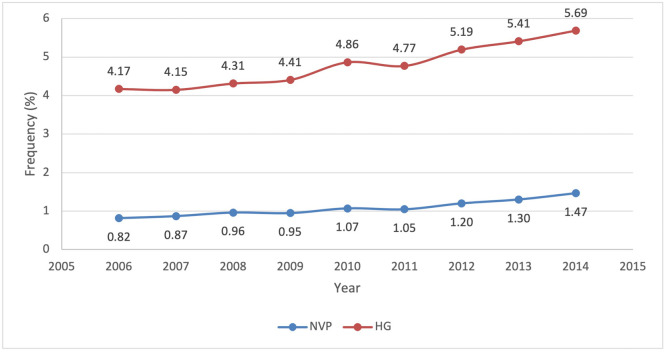
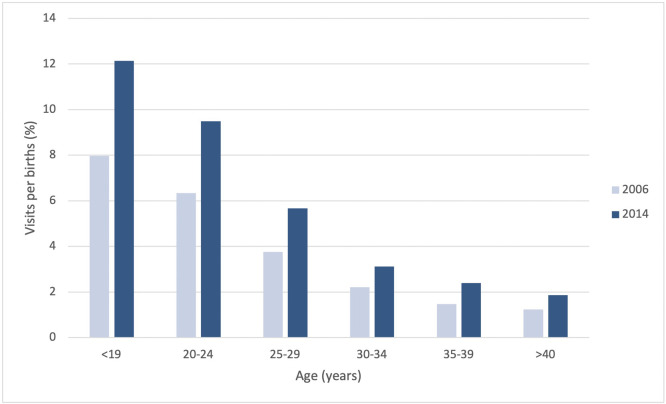
Emergency department visits for hyperemesis gravidarum increased by 28% from 2006 to 2014; however, the proportion of those who were subsequently admitted to the hospital decreased. The average cost of an emergency department visit for hyperemesis gravidarum increased by 65% ($2156 to $3549), as opposed to an increase of 60% for all antepartum visits ($2218 to $3543). The aggregate cost for all hyperemesis gravidarum visits increased by 110% ($383,681,346 to $806,696,513) from 2006 to 2014, which was similar to the increase observed for all antepartum emergency department visits.
From 2006 to 2014, emergency department visits for hyperemesis gravidarum increased by 28%, with associated costs increasing by 110%, whereas the number of admissions from the emergency department for hyperemesis gravidarum decreased by 42%.
妊娠剧吐是妊娠期恶心和呕吐最严重的形式,可能会影响孕产妇和妊娠健康。妊娠剧吐常导致患者前往急诊科就诊,不过与这些就诊相关的确切频率和费用尚未得到充分研究。
本研究旨在分析2006年至2014年期间妊娠剧吐患者前往急诊科就诊、住院及相关费用的趋势。
利用国际疾病分类第九版诊断编码,从2006年和2014年全国急诊科样本数据库文件中识别患者。确定以妊娠剧吐、妊娠期恶心和呕吐以及所有与妊娠相关的非分娩诊断(所有产前就诊)为主诊断的患者。对所有组进行分析;比较人口统计学、急诊科就诊次数和就诊费用的趋势。费用经通货膨胀调整为2021年美元。
2006年至2014年,妊娠剧吐患者的急诊科就诊次数增加了28%;然而,随后住院的患者比例下降。妊娠剧吐患者急诊科就诊的平均费用增加了65%(从2156美元增至3549美元),而所有产前就诊的费用增加了60%(从2218美元增至3543美元)。2006年至2014年,所有妊娠剧吐就诊的总费用增加了110%(从383,681,346美元增至806,696,513美元),这与所有产前急诊科就诊的费用增长情况相似。
2006年至2014年,妊娠剧吐患者的急诊科就诊次数增加了28%,相关费用增加了110%,而妊娠剧吐患者从急诊科住院的人数减少了42%。