Department of Neuroinformatics, Faculty of Science, Donders Institute for Brain, Cognition and Behaviour, Radboud University, P.O. Box 9010, 6500 GL, Nijmegen, The Netherlands.
Donders Institute for Brain, Cognition and Behaviour, RadboudUMC, Nijmegen, The Netherlands.
Anim Cogn. 2023 Jul;26(4):1131-1140. doi: 10.1007/s10071-023-01757-2. Epub 2023 Mar 6.
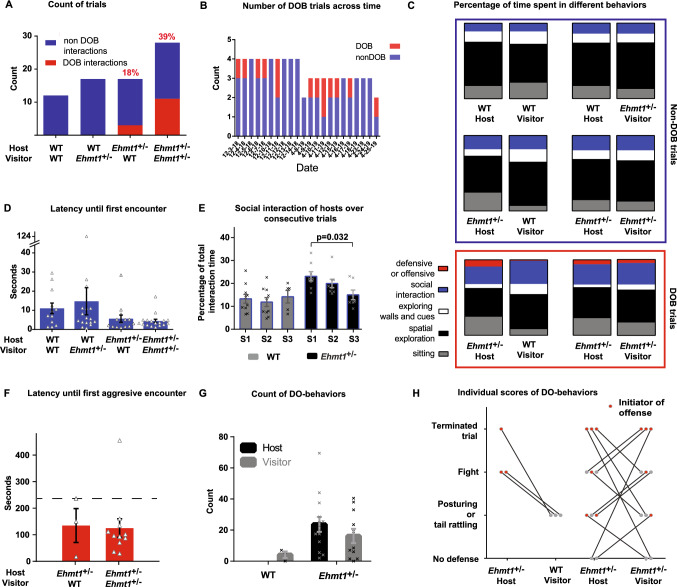
Kleefstra syndrome in humans is characterized by a general delay in development, intellectual disability and autistic features. The mouse model of this disease (Ehmt1) expresses anxiety, autistic-like traits, and aberrant social interactions with non-cagemates. To investigate how Ehmt1 mice behave with unfamiliar conspecifics, we allowed adult, male animals to freely interact for 10 min in a neutral, novel environment within a host-visitor setting. In trials where the Ehmt1 mice were hosts, there were defensive and offensive behaviors. Our key finding was that Ehmt1 mice displayed defensive postures, attacking and biting; in contrast, wild-type (WT) interacting with other WT did not enact such behaviors. Further, if there was a fight between an Ehmt1 and a WT mouse, the Ehmt1 animal was the most aggressive and always initiated these behaviors.
人类克莱夫斯特拉综合征的特征是发育迟缓、智力残疾和自闭症特征。这种疾病的小鼠模型(Ehmt1)表现出焦虑、类自闭症特征以及与非同笼小鼠异常的社交互动。为了研究 Ehmt1 小鼠如何与陌生同种动物互动,我们让成年雄性小鼠在一个中性、新颖的环境中,在一个宿主-访客设置中自由互动 10 分钟。在 Ehmt1 小鼠作为宿主的实验中,出现了防御和攻击行为。我们的主要发现是 Ehmt1 小鼠表现出防御姿势,攻击和咬;相比之下,与其他 WT 相互作用的 WT 不会表现出这样的行为。此外,如果 Ehmt1 小鼠和 WT 小鼠之间发生争斗,Ehmt1 动物的攻击性最强,总是先发起这些行为。